

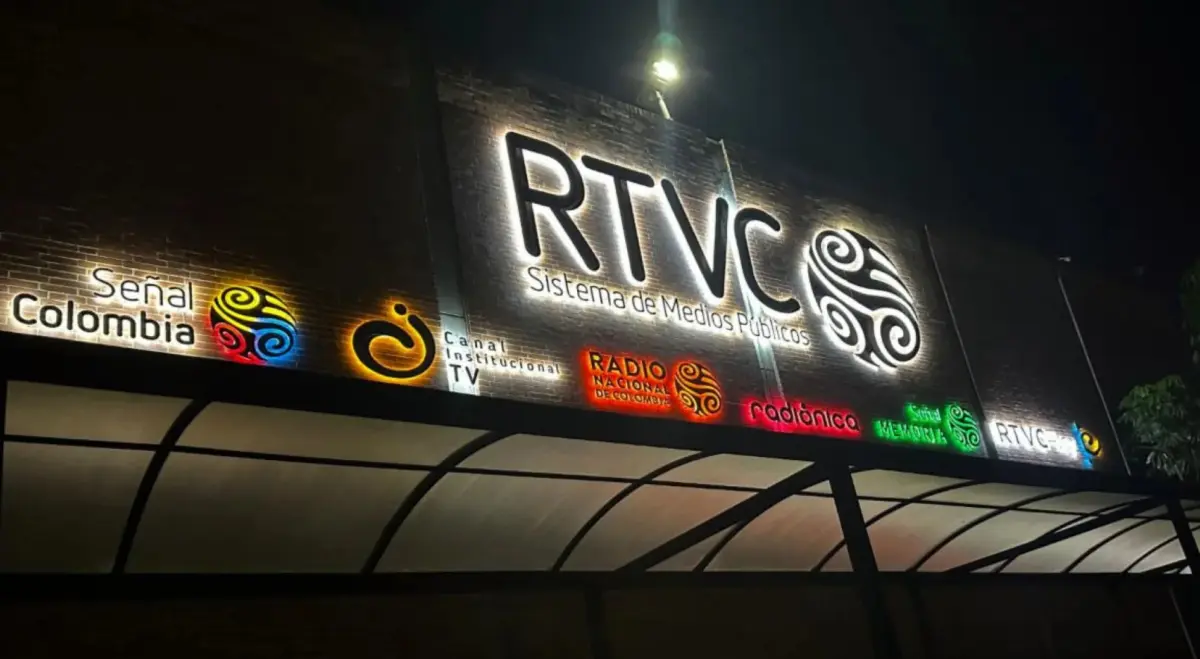
BOGOTÁ, COLOMBIA — In a decisive move to safeguard public assets and protect national audiences from misinformation, RTVC – Sistema de Medios Públicos (The State Public Media System of Colombia S.A.S.) has officially launched a dual legal offensive. The state-run media organization has filed a formal lawsuit with the Superintendency of Industry and Commerce (SIC) for industrial property rights infringement, alongside a criminal complaint submitted to the Office of the Attorney General (Fiscalía General de la Nación) regarding the alleged usurpation of industrial property rights.
The legal actions explicitly target two former contractors of the entity, alongside any other individuals or entities found culpable for the creation, administration, financing, or dissemination of a controversial digital ecosystem operating under the name “RTC Noticias.”
This developing controversy underscores the fragile intersection between independent digital journalism, the protection of state-owned intellectual property, and the public’s fundamental right to receive verified information from legitimate state channels. As state media institutions face evolving digital landscapes, RTVC’s aggressive posture sets a significant precedent for how Colombian public entities will police unauthorized brand mimicry in the future.
Main Facts of the Case
The core of the dispute centers on the deliberate and, according to RTVC, calculated effort by a breakaway digital media project to mimic the visual identity, nomenclature, and heritage of Colombia’s premier public broadcaster.
On September 14, 2026, compliance and monitoring teams at RTVC – Sistema de Medios Públicos made a startling discovery. A web domain (rtcnoticias.co) and a corresponding network of active social media profiles had materialized online. Operating under the banner “RTC Noticias,” the digital platform immediately raised red flags due to its striking resemblance to official RTVC properties.
The infractions identified by RTVC’s legal team are comprehensive and granular:
- Nomenclature Mimicry: The name “RTC Noticias” replicates eleven out of the twelve characters comprising the registered trademark “RTVC Noticias,” selectively omitting only the letter “V.”
- Visual Appropriation: The digital ecosystem utilizes a circular graphic symbol featuring geometric trappings that closely mirror the precolombian seal historically used by RTVC.
- Audiovisual and Presentation Overlap: The video formatting, lower-thirds, presentation styles, and editorial framing mimic the proprietary aesthetic standards established by RTVC Noticias.
- Misleading Public Statements: Promoters of the “RTC Noticias” initiative publicly blurred the lines of institutional lineage by issuing statements such as: “We were part of RTVC Noticias and today we continue reporting from the regions through RTC Noticias.”
According to RTVC, this combination of visual cues, semantic trickery, and rhetorical positioning is systematically engineered to induce public confusion. The average citizen encountering “RTC Noticias” online could easily mistake the private digital venture for an official channel, a regional subsidiary, or an authorized continuation of the State Public Media System.
Chronology of Events
Understanding how the “RTC Noticias” controversy unfolded requires mapping the trajectory from internal contracting relationships to open digital conflict. While the public-facing manifestation of the brand launched in mid-September 2026, the structural roots of the dispute trace back several months.
- Phase 1: The Internal Relationship (Late 2024 – Early 2026): The individuals targeted by RTVC’s legal actions were previously engaged as external contractors within the production and reporting infrastructure of RTVC Noticias. During their tenure, these contractors gained intimate familiarity with the stylistic guidelines, branding frameworks, technological pipelines, and regional reporting networks of the state broadcaster.
- Phase 2: Departure and Conceptualization (Mid-2026): Following the termination or conclusion of their contractual obligations with RTVC, the individuals allegedly conceptualized a decentralized digital news initiative focused on regional reporting ("desde los territorios"). Rather than building a distinct brand from the ground up, the creators allegedly leveraged their insider knowledge to construct a visual and nominal shadow of their former employer.
- Phase 3: The Digital Launch and Detection (September 14, 2026): The
rtcnoticias.codomain went live alongside synchronized social media accounts across platforms like X (formerly Twitter), Instagram, YouTube, and Facebook. RTVC monitoring teams flagged the digital ecosystem on the exact day of its widespread rollout, instantly escalating the matter to executive leadership and legal counsel. - Phase 4: Institutional Response and Legal Filing (Late September 2026): Recognizing the immediate threat to brand integrity and public trust, RTVC’s legal department rapidly compiled technical and legal briefs. Formal petitions were lodged concurrently with the Superintendency of Industry and Commerce (SIC) and the Office of the Attorney General, initiating administrative and criminal tracks simultaneously.
Supporting Data and Legal Demands
The magnitude of RTVC’s response is proportional to the legal weight it holds as a state-owned enterprise. Trademarks held by public entities are not merely commercial assets; they represent accumulated cultural capital, taxpayer investments, and public trust.
Actions Before the Superintendency of Industry and Commerce (SIC)
In its administrative filing with the SIC—Colombia’s industrial property watchdog—RTVC requested immediate precautionary and punitive measures against the defendants. These demands include:
- An Immediate Injunction: A total cessation of the use of the phrase “RTC Noticias” in any commercial, informational, or digital context.
- Visual Stripping: The removal and prohibition of all graphic elements, logos, and audiovisual presentation styles that bear a confusing similarity to RTVC’s registered assets.
- Digital Blockades: The administrative blocking and seizure of the domain
rtcnoticias.co. - Account Suspensions: The suspension of all social media handles and accounts operating under the infringing moniker.
- Content Purge: The complete retraction and removal of legacy and current digital contents that explicitly or implicitly suggest a structural relationship, lineage, or authorization stemming from RTVC.
Actions Before the Office of the Attorney General (Fiscalía)
On the criminal front, RTVC’s filing requests a thorough investigation into the alleged crime of usurpation of industrial property rights. Prosecutors have been asked to trace:
- The precise degree of participation and liability of the targeted ex-contractors.
- The financial origins, funding sources, and logistical backing used to establish the “RTC Noticias” ecosystem.
- The extent of any illicit commercial, political, or reputational advantage gained by the perpetrators through the unauthorized utilization of the state brand.
RTVC has emphasized that filing these legal actions does not constitute a premature declaration of guilt. The entity maintains full respect for due process and the constitutional presumption of innocence, leaving it strictly to judicial authorities to weigh the evidentiary record and render lawful decisions.
Official Responses and Institutional Positioning
In the wake of public discussions surrounding the lawsuit, RTVC leadership has moved proactively to clarify the boundaries of the dispute. Critics and media observers occasionally express concern when state entities take legal action against digital journalistic ventures, raising questions about potential chilling effects on free speech.
Addressing these concerns head-on, the RTVC Office of Communications released a firm policy clarification:
"These actions do not seek to limit freedom of expression or the independent exercise of journalism. Any person is entirely free to create a media outlet and disseminate their ideas. However, no one may do so by employing signs that generate confusion with a registered public trademark, nor may they present themselves as an unauthorized continuation of a state entity."
The statement reinforces that press freedom and freedom of enterprise do not extend to trademark infringement or consumer deception. While independent reporting from Colombia’s diverse regions is encouraged and vital to democracy, it must be conducted transparently without piggybacking on the hard-earned brand equity of public institutions.
Furthermore, RTVC highlighted the collective nature of the brand they are defending:
- A Public Patrimony: RTVC Noticias is not a corporate vanity project; it is an enduring public asset built over generations using the financial contributions and tax revenues of all Colombian citizens.
- Accountability to Audiences: Ensuring that state-funded media remains distinct, recognizable, and untainted by impersonators is vital for maintaining transparency and keeping citizens accurately informed.
Broader Implications for Colombian Media and Intellectual Property
The clash between RTVC and the creators of “RTC Noticias” carries profound implications that stretch far beyond a simple courtroom dispute in Bogotá. As the media landscape undergoes rapid digital transformation, several systemic trends and concerns are brought to the forefront:
1. The Proliferation of "Shadow Media" in the Digital Age
With the collapse of traditional distribution barriers, launching a digital news outlet has never been easier. However, this democratization has also given rise to "shadow media"—operations that intentionally mimic established, trusted brands to capture algorithmic traffic, harvest audience trust, and build immediate credibility without earning it organically. RTVC’s lawsuit establishes a modern benchmark for how legacy and state media can legally combat digital impersonation.
2. The Precarious Nature of Media Contracting
The involvement of former contractors in the creation of “RTC Noticias” highlights vulnerabilities in how public media entities manage institutional knowledge, non-disclosure agreements, and intellectual property clauses upon the termination of professional relationships. Moving forward, state media organizations across Latin America will likely tighten restrictive covenants in contractor agreements to prevent former insiders from recycling proprietary brand elements into competitive, unauthorized spin-offs.
3. Protecting the Integrity of Regional Journalism
A central pillar of the defendants’ messaging was their focus on reporting "from the regions" (desde los territorios). Regional journalism is a critical public good in Colombia, often underrepresented in mainstream media. However, RTVC maintains that noble journalistic intent does not excuse intellectual property theft. The case forces a national conversation on how regional reporting can expand independently without resorting to brand-borrowing that misleads vulnerable or trusting audiences.
4. Setting a Precedent for State-Owned Intellectual Property
State entities frequently struggle to vigorously defend their trademarks due to bureaucratic inertia or a fear of political blowback. By aggressively pursuing both administrative remedies through the SIC and criminal investigations through the Fiscalía, RTVC is signaling a new era of proactive institutional defense. State brands—ranging from educational television networks to public radio syndicates—possess intrinsic value that must be guarded just as aggressively as private sector commercial properties.
Conclusion
As the legal proceedings before the Superintendency of Industry and Commerce and the Office of the Attorney General advance, the eyes of Colombia’s legal and journalistic communities remain fixed on the outcome.
For RTVC – Sistema de Medios Públicos, the stakes are existential: preserving the uncompromised integrity of its brand, ensuring that its regional reporting is unequivocally identified, and protecting the citizenry from deceptive imitations. As the digital sphere continues to expand into increasingly complex and unregulated territories, RTVC’s firm stance serves as a definitive reminder that while the freedom to inform is absolute, the right to deceive under the guise of public trust is not.



Leave a Reply