

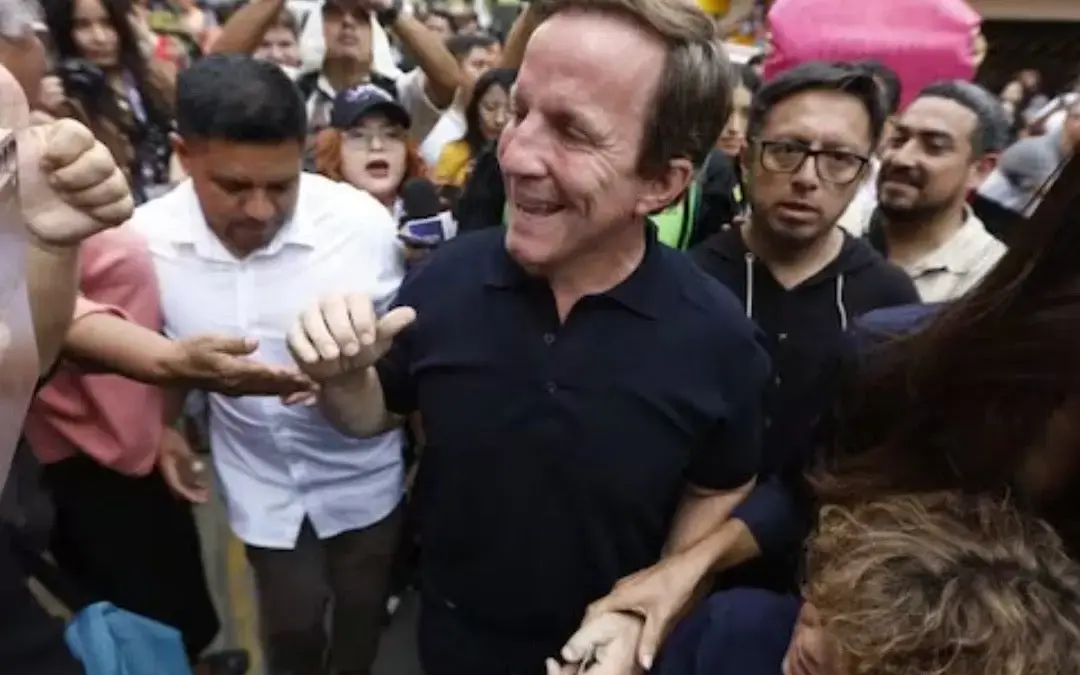
LIMA, PERU — In a development that has reignited national debates surrounding Peru’s municipal and regional governance structures, Francis Allison, the candidate for the mayoralty of Lima representing the Avanza País party, has publicly endorsed the implementation of a second-round electoral runoff system for the capital city.
Allison’s proposal emerges amid a tightly contested electoral landscape where the margins separating the front-running political factions have narrowed to fractions of a percent. The core of his argument rests on the unique administrative weight of Lima—a jurisdiction that functions simultaneously as a municipality and a regional government—and the democratic legitimacy conferred by winning a broad consensus of the electorate rather than a fractured plurality.
Main Facts
The central proposal put forward by Francis Allison is the introduction of a mandatory ballot runoff in municipal elections for the Municipality of Lima (MML) whenever no single mayoral candidate manages to secure at least 30% of the valid votes cast.
According to Allison, who also serves as the mayor of the district of Magdalena del Mar, the current electoral framework creates a democratic deficit in Peru’s largest and most populous city. Under the existing rules, a candidate can capture the mayoralty with a relatively low percentage of the total electorate, potentially leaving office with an overwhelming majority of citizens—up to 75% in some theoretical fracture scenarios—having voted against them.
Allison argues that this lack of broad-based political capital undermines governability. By mirroring the second-round mechanisms already utilized in Peru’s regional government elections and presidential contests, Lima could ensure that its chief executive enters office backed by a decisive mandate, thereby fostering greater institutional stability and public trust.
The proposal has drawn immediate attention from political analysts, legal scholars, and rival political camps, occurring precisely as the national electoral authorities process the final, razor-thin margins of the recent municipal contest.
Chronology of Events
The debate over the electoral system for Lima did not materialize in a vacuum; it is the culmination of a tense electoral cycle characterized by high polarization, shifting voter loyalties, and an extraordinarily close statistical race.
The Campaign Trail and Initial Skepticism
In the months leading up to the election, campaign discourse primarily focused on citizen security, public transportation, and fiscal management. However, as polls tightened in the final stretch, discussions regarding governability and the electoral threshold began to surface among political strategists. While regional governments in Peru have long operated under a system requiring a clear threshold or subsequent runoff mechanics to prevent deeply fractured local leadership, provincial municipalities—including Lima—remained bound by simple plurality rules.
Election Day and the Narrow Margins
As polling stations closed and the Oficina Nacional de Procesos Electorales (ONPE) began releasing its official quick counts and preliminary results, the race for the Lima mayoralty quickly transformed into a nail-biting statistical contest. The early returns indicated an intense, neck-and-neck battle between the candidate for Renovación Popular, Rafael López Aliaga, and Francis Allison of Avanza País.
Post-Election Declarations and the Runoff Proposal
With the ONPE steadily processing the remaining electoral tallies—reaching nearly 93% of processed reports—Allison took to the airwaves, specifically granting an interview to the media outlet Exitosa. It was during this high-stakes post-election window that Allison formally articulated his stance on the necessity of a second-round system for Lima, using the ongoing electoral tension to underscore his structural critique of the current municipal law.
Supporting Data and Electoral Context
To understand the weight of Allison’s proposal, one must examine the specific electoral data and administrative realities of the Peruvian capital.
The ONPE Tallies
According to official data released by the Oficina Nacional de Procesos Electorales (ONPE) with 92.919% of the electoral records contabilized, the political map of Lima was intensely polarized between the top two contenders:
- Renovación Popular: Leading the count with 27.714% of the valid votes.
- Avanza País (Francis Allison): Close behind in second place with 26.833% of the valid votes.
The mathematical gap between the first and second-place contenders represents a fraction of a percentage point, illustrating a deeply divided electorate where no single political platform managed to capture the hearts and minds of even a third of Lima’s voters.
Demographic and Administrative Weight
Lima is home to nearly a third of Peru’s total population, concentrating economic power, administrative infrastructure, and complex social demands. Beyond its status as a province, the Municipalidad Metropolitana de Lima (MML) holds unique legal attributions that mirror those of regional governments—including specific competencies in regional health management, infrastructure planning, and regional-level socioeconomic development programs.
Allison emphasized this structural anomaly during his public statements:
"Why wouldn’t regional governments have a second round, and provincial ones not? Because provincial municipalities typically have fewer people than a regional government and fewer functions. In the case of Lima, that is not how it is. Lima is the province with the most citizens in the country and holds regional government functions."
Official Responses and Political Reactions
The proposal for a Lima-specific electoral runoff has triggered diverse reactions across the political spectrum, touching on issues of constitutional reform, legislative inertia, and partisan self-interest.
The Argument for Governability
Proponents of Allison’s view argue that winning an election with just over 27% of the vote—meaning that more than 70% of the voting population actively chose a different option—creates an uphill battle for any incoming administration. Allison explicitly warned against the dangers of an isolated executive:
"With 75% against [them]… it is not healthy for the city nor for the mayor-elect himself."
From this perspective, a second round forces political coalitions, obligates candidates to moderate their discourse, build broad consensus, and secure a definitive mandate that surpasses the 50% threshold of active voters, thereby insulating the mayor’s office from immediate, paralyzing legislative or civic opposition.
Counter-Arguments and Legal Challenges
Critics of the proposal, including legal experts and representatives from rival political parties, point out several logistical and constitutional hurdles:
- Legislative Precedent: Changing the electoral rules mid-game or proposing structural alterations immediately following a tight election cycle often leads to accusations of opportunistic posturing. Electoral laws in Peru generally require stable, long-term congressional reforms rather than ad-hoc adjustments driven by the results of a specific municipal race.
- Logistical Complexity: Organizing a second-round municipal election in a mega-city like Lima involves massive financial costs, extensive mobilization of electoral machinery by the ONPE and the Jurado Nacional de Elecciones (JNE), and potential voter fatigue.
- Constitutional Framework: Critics note that Lima’s status is defined by the Organic Law of Municipalities and the Constitution. Altering its electoral mechanics requires a formal legislative bill debated and approved by the Peruvian Congress, rather than executive municipal decree.
Broader Implications for Peruvian Democracy
Francis Allison’s call for a second-round system in Lima opens a much broader dialogue regarding the health, evolution, and structural design of local democracy in Peru.
1. The Crisis of Plurality in Fragmented Societies
Peru’s political ecosystem is notoriously fragmented, with dozens of registered political parties and local movements frequently resulting in multi-candidate races where winners emerge with low single-digit or low double-digit support. When a leader governs a metropolis of nearly 10 million inhabitants with the backing of only one-fourth of the voters, the social contract can become strained. A runoff system forces consolidation, compelling political actors to look beyond their core partisan bases and forge alliances with broader segments of civil society.
2. Institutional Reform and Congressional Action
For Allison’s proposal to transition from a campaign talking point to a legal reality, it must travel through the halls of the Peruvian Congress. Lawmakers would need to draft, debate, and pass specific amendments to the Organic Law of Municipalities. This introduces a political variable: whether current congressional majorities have the appetite to legislate structural electoral reforms that could reshape the balance of power in the nation’s capital ahead of future election cycles.
3. Public Trust and Voter Participation
Electoral fatigue is a tangible concern in contemporary Latin American democracies. Introducing runoff elections demands additional time, civic engagement, and financial resources from the state. However, advocates argue that the short-term inconvenience is vastly outweighed by the long-term benefit of enhanced democratic legitimacy. A mayor backed by a clear majority is theoretically better positioned to negotiate with the central government, manage massive public works, and implement long-term structural reforms in transportation, security, and urban development.
Conclusion
As the Oficina Nacional de Procesos Electorales (ONPE) finalizes the last remaining percentages of the Lima municipal vote, the debate catalyzed by Francis Allison’s statements has firmly established itself on the national agenda. Whether or not the proposal for a second-round runoff system in Lima ultimately translates into concrete legislative reform in the Peruvian Congress, it has exposed a fundamental tension in modern urban governance: how to reconcile the mathematical realities of a deeply fragmented electorate with the democratic imperative for strong, stable, and widely supported leadership in the nation’s capital.



Leave a Reply