

The upcoming winter aviation season—spanning from October 25 to March 27—presents a uniquely unforgiving economic landscape for airlines operating low-margin routes across Europe.
Driven by soaring jet fuel prices, escalating operational levies, and localized airport taxes, major carriers are aggressively trimming their winter schedules. However, a deeper analysis reveals that these adjustments are not uniform. While low-cost giants and legacy carriers alike are scaling back capacity in high-cost or geopolitically volatile markets, many are simultaneously doubling down on high-demand tourism hubs, resulting in a complex patchwork of reduced frequencies, restructured bases, and targeted regional growth.
1. Executive Summary & Main Facts
The defining characteristic of the 2025–2026 winter season is the unprecedented financial strain of jet fuel combined with regulatory pressures. According to data from Eurocontrol, the average spot price of jet fuel surged to $4.63 per gallon in September, a dramatic escalation compared to the $2.26 per gallon recorded in January and February. While individual airlines experience varying degrees of relief depending on their hedging portfolios and long-term supply contracts, the overarching market pressure is undeniable.
Major European carriers have responded by curbing their capacity growth plans:
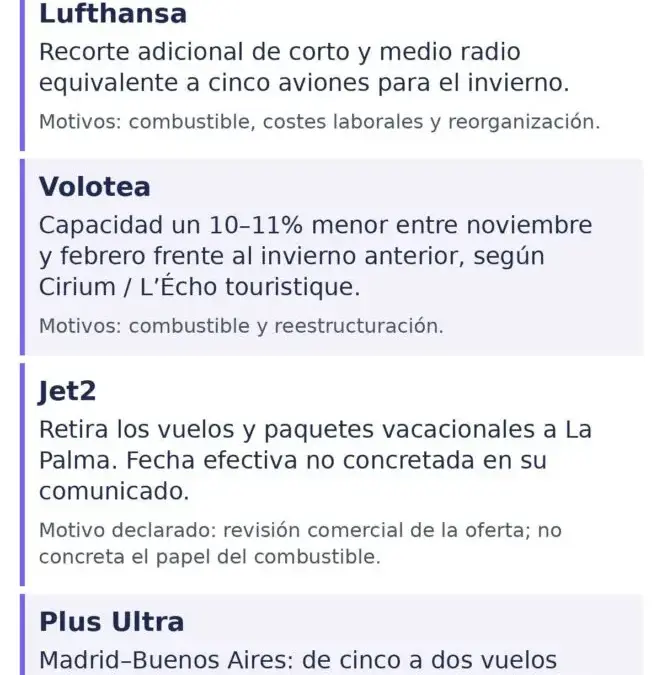
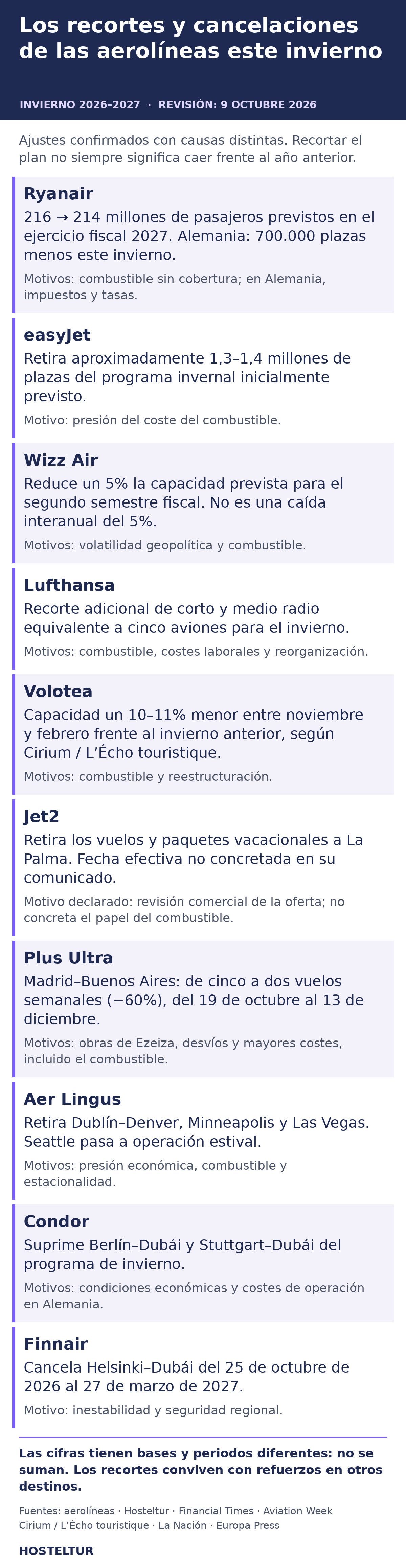
- Ryanair lowered its traffic target for fiscal 2027 from 216 million to 214 million passengers, scaling back exposure to unhedged winter fuel costs while maintaining a relatively stable year-over-year winter volume.
- easyJet has expanded its planned capacity cuts, shedding an additional 600,000 to 700,000 seats on top of 700,000 previously removed, bringing its total winter reduction to 1.3 to 1.4 million seats.
- Wizz Air announced a 5% reduction in its original second-half fiscal capacity, citing geopolitical volatility and fuel prices.
- Lufthansa previously confirmed short- and medium-haul cuts equivalent to five aircraft for the winter schedule, citing soaring kerosene expenses and rising labor costs.
Despite these headline-grabbing reductions, industry analysts emphasize a crucial distinction: withdrawing planned capacity does not inherently mean carrying fewer passengers than the previous year, nor does it translate directly to a one-to-one ratio of canceled flights. Instead, airlines are engaging in a sophisticated reallocation of assets, abandoning unprofitable routes while expanding their footprints in resilient tourism strongholds like Spain’s Canary Islands and major hubs like Madrid and Barcelona.
2. Chronology of Airline Adjustments and Strategic Shifts
The wave of schedule revisions unfolded systematically throughout late summer and early autumn as carriers finalized their winter networks in response to escalating cost reports and infrastructural bottlenecks.
August to Early September: The Initial Warnings
As fuel prices climbed steadily toward late-summer peaks, carriers began discreetly adjusting their forward-looking schedules. Lufthansa’s earlier announcements regarding labor and kerosene overhead set the tone for the industry. Shortly thereafter, ultra-low-cost carrier Wizz Air formalized its 5% capacity trim on October 2, pinning the adjustment squarely on volatile jet fuel markets and regional instability.
Mid-September: Ryanair’s Dual Strategy in Germany and Spain
Mid-September marked a turning point for Ryanair, which announced a sweeping contraction in the German market. Citing punishing aviation taxes and high airport charges, the airline cut 700,000 seats in Germany (a 10% year-on-year drop) and confirmed the October 24 closure of its seven-aircraft base in Berlin. Overall capacity in the German capital will plunge by 50%, with 12 routes scrapped—including essential leisure links to Fuerteventura, Gran Canaria, and Lanzarote.
Conversely, Ryanair aggressively expanded in Spain. The airline announced a robust 3.4 million seat offering in Madrid (representing a 6% increase) and confirmed it will operate 53 routes from Barcelona while boosting frequencies on 20 other connections. This geographic bifurcation underscores a core industry reality: a carrier can trim its macro-level plan while simultaneously scaling up operations in jurisdictions with more favorable operating environments.
Late September to October: Volotea, Jet2, and Long-Haul Adjustments
By late September, regional and leisure specialists also felt the pinch. Volotea, absorbing a heavy financial impact estimated at €150 million from fuel inflation and ongoing corporate restructuring, reduced its winter capacity by 10% to 11% compared to the previous year, according to Cirium data cited by L’Écho touristique. These cuts affected regional Spanish gateways such as Asturias, Bilbao, and Lanzarote through temporary suspensions and frequency reductions.
Concurrently, Jet2 streamlined its winter portfolio, confirming the complete removal of flights and holiday packages to La Palma, while maintaining an otherwise robust leisure program. In the long-haul sector, Plus Ultra slashed its Madrid–Buenos Aires rotation from five weekly flights down to two between October 19 and December 13—a 60% reduction driven by a combination of fuel economics, detour expenses, and runway construction restrictions at Buenos Aires’ Ezeiza Airport.
Other long-haul adjustments saw Aer Lingus scrap its Dublin routes to Denver, Minneapolis, and Las Vegas (relegating Seattle to a summer-only schedule). Condor eliminated its Berlin–Dubai and Stuttgart–Dubai services due to difficult economic conditions in Germany, and Finnair suspended its Helsinki–Dubai winter service citing regional instability.
3. Supporting Data and Economic Indicators
To contextualize these operational cutbacks, economists and regulatory bodies have released extensive datasets detailing fuel costs, inventory levels, and regulatory burdens.
Fuel Costs and Supply Stability
- Price Volatility: Eurocontrol’s data highlights the drastic spike in jet fuel spot prices to $4.63 per gallon in September, up from roughly $2.26 earlier in the year.
- Physical Supply: Despite soaring prices, official reports confirm there is no generalized fuel shortage in Europe. On September 29, the European Commission reported that jet fuel supplies remained stable despite price pressures. Commercial inventories in the Amsterdam-Rotterdam-Antwerp (ARA) refining hub sat below their five-year averages but held steady in recent weeks, with European refineries operating close to maximum capacity.
- Structural Risks: The International Air Transport Association (IATA) has warned of structural vulnerabilities in refining capacity and supply chain concentration. Furthermore, the persistent crack spread—the price differential between crude oil and refined jet fuel—introduces financial risks that standard crude oil tracking fails to capture. While fuel hedging mitigates some of this exposure, its protective shield varies significantly by airline.
Environmental Regulations: SAF and ETS
Beyond conventional kerosene, airlines face rising compliance costs tied to the European Union Emissions Trading System (ETS) and mandates for Sustainable Aviation Fuels (SAF).
According to the European Union Aviation Safety Agency (EASA), SAF accounted for 2.8% of the total fuel supply in 2025, comfortably exceeding the mandatory 2% minimum threshold. However, the production scaling and procurement costs of synthetic fuels continue to introduce heavy cost pressures that must be analyzed separately from traditional fossil fuel inflation.
4. Official Responses and Industry Stakeholders
The decisions made by individual airlines have drawn commentary from aviation authorities, tourism boards, and institutional watchdogs, clarifying the distinct motivations behind each schedule cut.
- The European Commission: Reiterated that while pricing pressures are acute, physical availability of jet fuel remains secure across the continent, dismissing fears of regional energy blackouts stalling the aviation sector.
- Airport Operators and Governments: Faced intense criticism from low-cost carriers. Ryanair’s decision to abandon its Berlin base and slash German routes serves as a direct rebuke of national aviation taxes and high infrastructure fees, positioning airports as co-conspirators in the degradation of regional connectivity. Conversely, Spanish airports are reaping the rewards of more competitive cost structures, successfully capturing capacity shed by airlines elsewhere in Europe.
- Airlines (Plus Ultra, Jet2, and Wizz Air): Emphasized that operational decisions are multifaceted. For instance, Plus Ultra’s drastic cut on the Buenos Aires route was heavily influenced by operational constraints—specifically, runway rehabilitation works at Ezeiza Airport necessitating technical stops and lighter takeoff weights—proving that not all reductions are purely financial. Similarly, Jet2 framed its adjustments around shifting consumer holiday preferences rather than systemic supply failures.
5. Broader Implications for Tourism and Connectivity
The compounding pressures of expensive kerosene, environmental levies, and localized airport taxes are fundamentally reshaping Europe’s aviation network.
The Survival of the Fittest Route
Airlines are engaging in ruthless yield management. Low-margin regional routes are being systematically sacrificed to protect the profitability of core trunk routes. However, this contraction does not spell doom for the entire tourism sector. Winter sun destinations—most notably the Canary Islands—continue to see robust demand, prompting carriers like KLM, Eurowings, and parts of Jet2’s network to reinforce their offerings even as other regions experience severe connectivity dips.
The Outlook for Travelers
For consumers, the winter 2025–2026 season will likely translate to fewer direct options from secondary European cities, potentially higher ticket prices on remaining monopoly routes, and a greater reliance on major mega-hubs.
Ultimately, the current aviation environment demonstrates that while the sky is not falling—and fuel remains physically abundant—the economic threshold for keeping an aircraft in the air has risen dramatically. Airlines are responding with surgical precision, pruning unprofitable branches to ensure the structural integrity of their broader networks through a volatile winter season.




Leave a Reply