

By Global Entertainment Desk
There are songs that function as auditory time machines. The mere opening seconds of *NSYNC’s "Bye Bye Bye" instantly transport listeners back to the year 2000—an era defined by scratched CDs rattling in car glove compartments, the tactile thrill of peeling the cellophane off a newly purchased jewel case, and physical media dominance. Fast-forward fifteen years, and the haunting opening piano chords of Adele’s "Hello" evoke the late-2015 zeitgeist, when it felt as though the entire global population was dialing up an ex-lover.
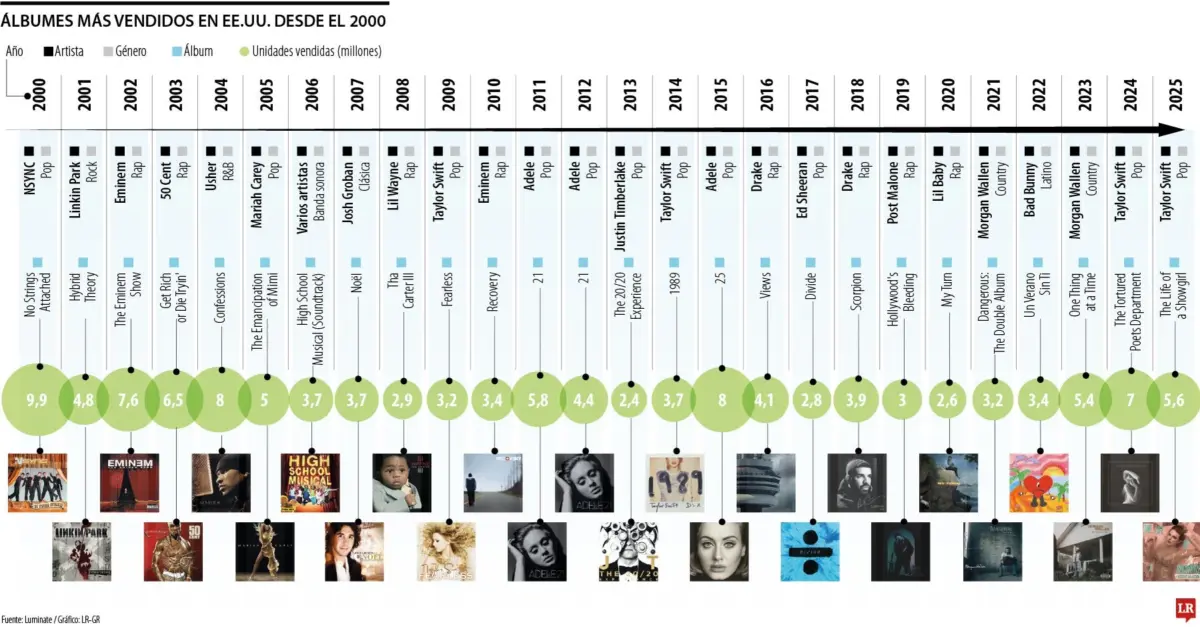
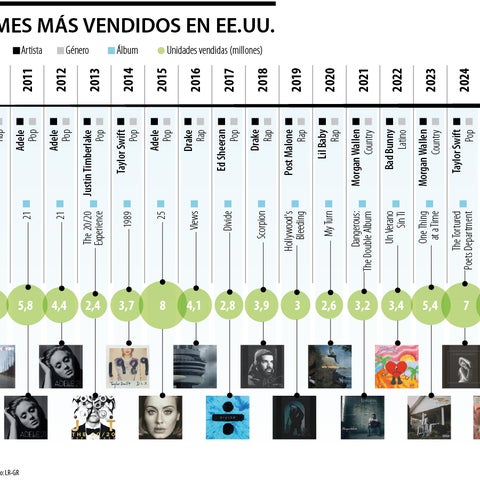
Beneath the nostalgia of these collective cultural memories lies a definitive commercial ledger: the roster of the best-selling albums in the United States year by year, spanning from the dawn of the millennium through 2025. Compiled using data from industry trackers like Luminate, this 26-year timeline maps out not just chart-topping hits, but the profound tectonic shifts in how humanity consumes music.
Main Facts: The Eras, the Titans, and the Numbers
The modern history of American recorded music sales begins precisely with NSYNC, the definitive millennial boy band featuring a young Justin Timberlake. In 2000, their sophomore studio album, No Strings Attached, shifted a staggering 9.9 million physical copies. Crucially, 2.4 million of those sales occurred within the first week alone—a monumental industry record that remained unbroken for an astonishing 15 years.
At the other end of the timeline stands Taylor Swift, whose 2025 release, The Life of a Showgirl, dominated the charts with 5.6 million equivalent album units. Between these two bookends lies a quarter-century of sweeping industrial evolution. The landscape transformed from the era of physical compact discs—where million-selling opening weeks were heavily incentivized by brick-and-mortar retail—to the fractured, algorithm-driven world of digital downloads and ubiquitous audio streaming.
Despite 26 years of intense competition across global markets, only five musical acts managed to secure the year-end top spot multiple times. Among them, Taylor Swift reigns supreme as the undisputed queen of the modern charts, claiming the annual crown on four distinct occasions. Her dominance traces a fascinating career arc:
- 2009: Fearless, cementing her status as a breakout country-pop crossover star and making her the youngest artist in history at the time to win the Grammy Award for Album of the Year.
- 2014: 1989, her definitive, full-scale transition into mainstream pop—a release famously shadowed by her decision to pull her catalog from Spotify in protest of royalty payouts.
- 2024: The Tortured Poets Department, which grazed seven million units.
- 2025: The Life of a Showgirl, which shattered historical debut-week records.
Chronology: A 26-Year Journey Through Sound
To understand the changing face of popular culture, one must trace the historical lineage of the annual best-sellers, broken down by eras of media consumption.
The CD Supremacy Era (2000–2006)
The early 2000s were defined by massive physical retail numbers. NSYNC opened the decade in 2000, followed in 2001 by Linkin Park’s seismic nu-metal debut, Hybrid Theory, an album that eventually surpassed 10 million units sold in the U.S. alone. In 2002, Eminem seized the crown with The Eminem Show, an album his label was forced to release ahead of schedule after it leaked onto peer-to-peer sharing networks.
Hip-hop continued its commercial ascent in 2003 with 50 Cent’s Get Rich or Die Tryin’, before Usher’s R&B masterclass Confessions dominated 2004. The mid-decade anomalies were as fascinating as the blockbusters: 2005 belonged to Mariah Carey’s triumphant comeback, The Emancipation of Mimi, while 2006 yielded zero traditional artist albums at the top. Instead, the year’s best-seller was the Disney Channel phenomenon High School Musical soundtrack—notable because lead actor Zac Efron’s vocals were largely blended with or doubled by singer Drew Seeley. The eccentricities continued in 2007 with Josh Groban’s holiday collection, Noël, proving that traditional seasonal music could outsell every contemporary pop and rock record on the market.
The Digital Transition and Streaming Dawn (2008–2019)
As digital storefronts like iTunes began chipping away at physical retail, the scale of first-week sales adjusted. Eminem returned to the top in 2010 with Recovery (featuring the global Rihanna collaboration "Love the Way You Lie"). Adele then captured the global consciousness in 2011 and 2012 with 21, a soulful juggernaut anchored by "Rolling in the Deep" that swept the Grammy Awards.
Taylor Swift bridged the physical-to-digital gap before streaming completely reshaped the landscape. Adele temporarily paralyzed the industry again in 2015 with 25, shifting an astonishing 3.38 million units in its opening week while initially withholding the record from streaming platforms. As streaming finally solidified its monopoly, rap icon Drake assumed control with Views (2016) and Scorpion (2018)—the latter becoming the first album in history to surpass one billion global streams within its debut week.
The Modern Streaming & Fragmentation Era (2020–2025)
Entering the 2020s, the charts began reflecting hyper-consumption habits and marathon tracklists. Country music experienced a massive commercial renaissance via Morgan Wallen, who captured consecutive year-end crowns with sprawling projects: the 30-track Dangerous: The Double Album in 2021, and the 36-track One Thing at a Time in 2023.
Sandwiched between Wallen’s dominance was a historic milestone for Latin music: Bad Bunny’s Un Verano Sin Ti took the 2022 crown with 3.4 million equivalent units. It marked the first time a Spanish-language album finished as the year’s top-selling record in the United States, spending 13 weeks atop the Billboard 200, landing 22 of its 23 tracks simultaneously on the singles charts, earning a historic Grammy Album of the Year nomination, and ultimately becoming the most-streamed album in Spotify history.
Supporting Data: Genres, Demographics, and Consumption Shifts
An analytical breakdown of the past 26 years reveals stark trends regarding genre dominance, gender representation, and the economics of music distribution.
Genre Breakdown
- Pop: The undisputed king of commercial longevity, capturing the annual top spot in 12 out of the 26 evaluated years.
- Rap & Hip-Hop: Securing the crown seven times, hip-hop enjoyed its absolute peak commercial efficiency during the 2000s and late 2010s, highlighted by blockbuster debuts from Eminem, 50 Cent, and Lil Wayne (whose Tha Carter III famously crossed the million-copy mark in its first week in 2008).
- Country: Represented primarily by Taylor Swift’s early career and Morgan Wallen’s modern streaming marathons, holding the top spot three times.
- Rock, R&B, Soundtracks, and Holiday: Singular entries like Linkin Park (Hybrid Theory), Usher (Confessions), the High School Musical OST, and Josh Groban (Noël) highlight the occasional wide swings in American consumer tastes.
Gender Representation at the Apex
While the commercial landscape features a diverse array of male rappers and country stars, female representation at the absolute peak of the year-end charts is concentrated among a select few powerhouses. Only three women—Taylor Swift, Adele, and Mariah Carey—have managed to claim the year-end #1 spot. Remarkably, however, through their combined multi-year blockbusters, these three female artists account for eight of the 26 evaluated years, underscoring their extraordinary cultural footprint.
The Economics of Media Consumption
The most profound takeaway from the 26-year data set is the stark deflation of raw unit numbers over time. In the early 2000s, top albums routinely cleared 6 to 9 million sales in a single calendar year, powered by high physical price points ($15–$18 per CD).
By contrast, as the industry transitioned through digital downloads and into the fractionalized economics of subscription streaming services (where hundreds or thousands of streams equate to a single traditional album sale), the year-end winners of the 2010s and 2020s typically hovered between 2 and 4 million equivalent units. Even Justin Timberlake’s chart-topping The 20/20 Experience in 2013 pulled in a modest (by historical standards) 2.4 million units, signaling that the era of the universal, mono-cultural blockbuster had been replaced by a fragmented media environment where engagement is measured in billions of fragmented streams rather than stacked plastic discs.
Official Responses and Industry Perspectives
Music industry analysts, trade bodies like the Recording Industry Association of America (RIAA), and data architects at Luminate have routinely pointed to these milestones as barometers of cultural health.
When discussing the evolution of consumption, industry executives emphasize that modern metrics do not necessarily indicate a decline in musical appreciation, but rather an explosion of access. "The shift from ownership to access fundamentally altered how we quantify success," noted one senior musicologist and chart historian. "When a fan bought a CD in 2000, that purchase represented a financial and emotional commitment. Today, an album like Bad Bunny’s Un Verano Sin Ti or Morgan Wallen’s blockbusters succeed because streaming allows for hyper-repetition, turning records into lifestyle soundtracks that accompany listeners through every hour of their day."
Furthermore, representatives for major publishing and streaming platforms have highlighted the democratizing power of digital distribution—noting that while physical sales favored major-label retail monopolies in traditional music hubs, streaming platforms have allowed cross-cultural phenomena, such as Latin trap and reggaeton, to compete equally on global year-end leaderboards.
Implications for the Future of Recorded Music
What do these 26 years of data suggest for the future of the global music industry?
First, the data proves that event-driven album releases still matter. Artists who can manufacture a sense of communal urgency—whether through Taylor Swift’s meticulously planned rollout cycles, Adele’s strategic scarcity, or Beyonce’s surprise drops—continue to pierce through the endless white noise of the algorithmic feed.
Second, the structural dominance of streaming points toward a future defined by content volume and fan loyalty. The massive tracklists favored by modern streaming champions (such as Morgan Wallen’s 36-track albums) are not artistic accidents; they are calculated responses to algorithmic ecosystems where listener retention and playlist placement dictate commercial survival.
Finally, the historic barriers broken by projects like Un Verano Sin Ti indicate that the American music market is increasingly borderless. As language barriers dissolve in the digital age, future retrospectives of the best-selling albums are unlikely to be dominated exclusively by English-language releases.
Ultimately, whether pulling a scratched jewel case out of a car glove compartment in 2000 or streaming a 30-track blockbuster on a smartphone in 2025, the human desire to anchor memories to a specific collection of melodies remains entirely unchanged.



Leave a Reply