

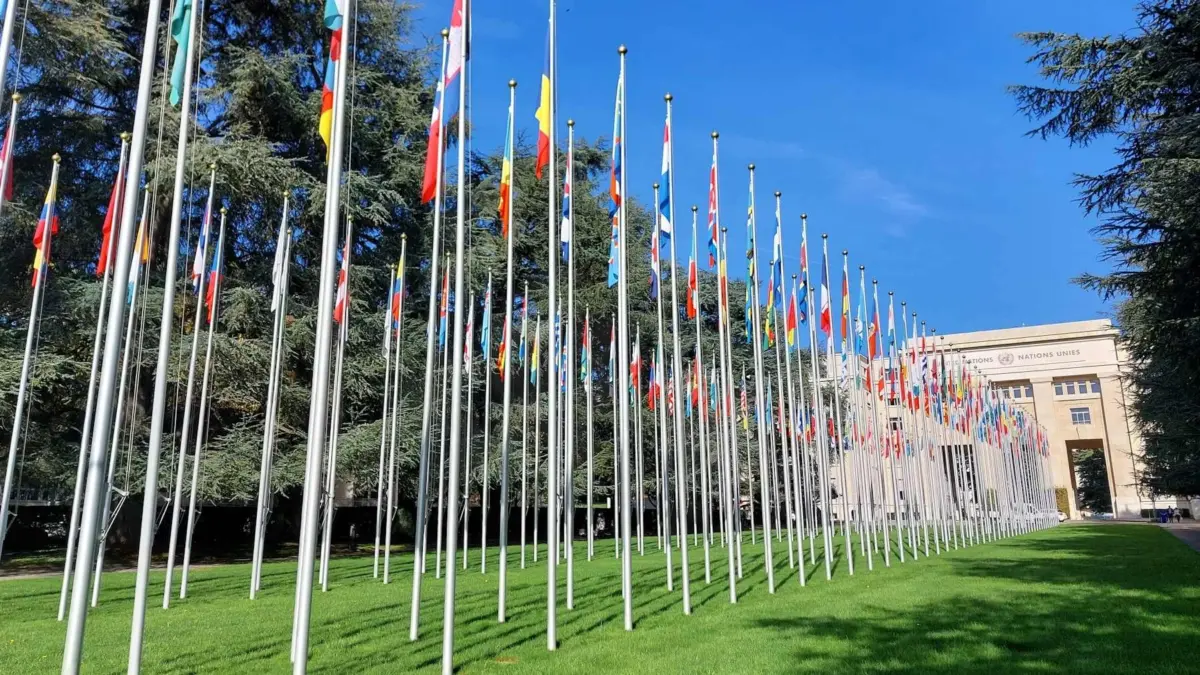
NEW YORK — As geopolitical fault lines deepen and planetary boundaries are pushed to their absolute limits, the United Nations General Assembly once again convened the world’s foremost political leaders, diplomats, scientists, and civil society delegates. Set against a backdrop of cascading international conflicts, economic volatility, and intensifying environmental degradation, this year’s high-level debates crystallized an uncomfortable truth: the traditional architecture of global governance is struggling to keep pace with the multifaceted crises of the 21st century.
Throughout the intense days of deliberation, speeches oscillated between staunch defenses of national sovereignty and urgent, sometimes desperate, pleas to revitalize multilateralism. While protectionist tendencies and regional conflicts continue to force millions from their homes and strain international solidarity, a parallel existential narrative dominated the plenary halls—one centered on rising seas, the scramble for critical transition minerals, and the looming, unregulated frontier of artificial intelligence.
Main Facts
The latest session of the UN General Assembly served as a crucible for several defining global challenges, producing landmark policy shifts, sharp ideological divides, and urgent warnings from the scientific community:
- The Rising Tides Crisis: The General Assembly formally adopted a historic declaration addressing the exponential acceleration of global sea-level rise, a direct existential threat to the roughly 900 million people residing in low-lying coastal zones worldwide.
- The Critical Minerals Divide: Developing nations forcefully challenged the traditional dynamics of the green transition, calling out industrialized economies for attempting to reduce the Global South to mere primary extraction sites for renewable energy components.
- AI and Planetary Governance: European leadership pushed for the United Nations to become the central regulatory hub for Artificial Intelligence (AI), warning that the current fragmented approach leaves systemic risks unaddressed and heavily favors a handful of multinational tech conglomerates.
- Multilateral Strain: Debates laid bare the deep fractures between sovereign unilateralism and cooperative global governance, particularly regarding the enforcement of climate commitments and the humanitarian fallout of localized geopolitical conflicts.
Chronology of the Summit: A Week of High-Stakes Diplomacy
The high-level segment unfolded through a carefully choreographed sequence of plenaries, emergency ministerial meetings, and specialized thematic sessions, mapping out a timeline of mounting tension and diplomatic breakthrough.
Day 1: The Opening Salvo and Geopolitical Fracture
The summit opened with stark warnings from the UN leadership regarding the state of international affairs. Secretary-General assessments highlighted a world increasingly characterized by "great fracture" rather than cooperation. Early interventions by heads of state underscored the friction between regional security crises—ranging from prolonged conflicts in Eastern Europe and the Middle East to instability in parts of Africa—and the long-term, transboundary threats of climate change. The day established a contentious tone, with several major powers signaling reluctance to bind themselves to expanded international mandates without strict sovereign safeguards.
Day 2: The Oceans and the Sovereign Landmass Debate
The second day shifted focus decisively toward the cryosphere and global oceans. Following exhaustive scientific briefings on polar ice-sheet collapse, the plenary turned its attention to maritime boundaries and coastal vulnerability. Delegates grappled not only with the physical engineering challenges of rising tides, but also with unprecedented legal dilemmas: What happens to the sovereignty of a nation-state if its entire landmass is permanently submerged? The adoption of the historic sea-level declaration marked a turning point, transforming coastal protection from an environmental footnote into a core pillar of international law and security.
Day 3: Economic Ecology and the Energy Transition
Midway through the summit, discussions pivoted to the political economy of the green transition. This was the day the "extractivism vs. industrialization" debate took center stage. Leaders from Latin America and Africa challenged the global North’s paradigm for procuring green technologies. The dialogue forced a reckoning over supply chains, pointing out that transitioning away from fossil fuels cannot be achieved by replicating the exploitative socio-economic models of the past. Discussions also turned to the protection of global carbon sinks, recognizing tropical rainforests and major ecosystems as shared planetary assets requiring transnational financial support.
Day 4: Technology, Transparency, and the Digital Divide
The final substantive phase of the General Assembly addressed the technological revolution. With AI development outpacing regulatory frameworks, European and developing-nation delegates converged on the urgent need for international oversight. The discourse moved away from naive optimism regarding digital expansion toward concrete warnings about algorithmic bias, energy consumption by data centers, and the widening digital chasm between advanced economies and the Global South. The summit concluded with calls to draft binding international principles for tech governance before the end of the decade.
Supporting Data and Scientific Metrics
The urgency driving the debates at the UN was undergirded by hard data presented by scientific panels, specialized agencies, and environmental monitoring networks:
- 900 Million: The estimated population currently living in low-lying coastal zones highly vulnerable to coastal erosion, storm surges, and permanent inundation driven by sea-level rise.
- Double-Digit Inches: Scientific projections indicate that global mean sea levels are on track to rise by several dozen inches over the course of the 21st century, depending heavily on the trajectory of global greenhouse gas emissions and polar ice-sheet melting rates.
- 100°F Extremes: Frequency markers for extreme atmospheric and oceanic temperatures hitting or exceeding 100°F in diverse maritime and terrestrial regions, accelerating glacial melt and disrupting global weather patterns.
- Trillion-Dollar Transition Costs: The estimated capital requirement for overhauling global energy grids, securing critical mineral supply chains, and constructing coastal defense infrastructure—costs that heavily disproportionately burden developing nations lacking fiscal space.
Official Responses and Ministerial Perspectives
The polarization within the General Assembly was reflected in the diverse, often conflicting, stances articulated by national delegations and international bodies.
The Developing World: Demanding a Just Transition
Bolivian President Rodrigo Paz Pereira delivered one of the most resonant critiques of current global economic policies, arguing that the global clean energy transition risks perpetuating historical inequalities.
"The transition to new clean energies must be just and generate genuine local technological capabilities," declared President Paz Pereira. "The nations that hold the most wealth and power must stop treating impoverished populations as a mere primary extraction base. This ecological revolution must ensure that industrialization and value addition take place in the countries of origin, so that the crushing weight of the climate crisis is not perpetually shifted onto the shoulders of the most vulnerable."
The European Perspective: Urging Centralized Tech and Climate Governance
Representing the European Union, the President of the European Council threw institutional weight behind the proposition that contemporary threats—specifically artificial intelligence and climate destabilization—cannot be managed by isolated national policies.
"No single country can stabilize the global climate or effectively regulate these sophisticated digital tools in solitude," asserted the European Council President. "Our global technological architecture cannot simply be left to regulate a handful of massive private firms. We require a framework of absolute transparency anchored in international community standards that genuinely serves human well-being and enhances environmental sustainability across every level of the planet."
Scientific and Legal Communities: Warning of Uncharted Territory
International legal scholars and oceanographers attending the parallel panels underscored that international law is woefully unprepared for the legal anomalies produced by climate change. As island nations face total submersion, questions regarding maritime exclusive economic zones (EEZs), stateless climate refugees, and the legal continuity of dissolved states have transitioned from theoretical exercises to immediate crises requiring urgent codification.
Implications for Global Stability and the Road Ahead
The resolutions passed and the positions staked out during this session of the UN General Assembly carry profound implications for the remainder of the decade and beyond.
- The Redefinition of Sovereignty: The sea-level declaration forces the international community to rethink the Westphalian model of statehood. If a nation’s territory becomes uninhabitable or submerged, questions of legal continuity, maritime resource rights, and population resettlement will require binding multilateral instruments rather than ad-hoc humanitarian responses.
- Resource Nationalism vs. Global Supply Security: The friction over critical minerals—such as lithium, cobalt, and rare earth elements—signals that the green transition could become a flashpoint for resource nationalism. If industrialized economies fail to transfer technology and ensure fair compensation for producer nations, the green transition risks triggering severe geopolitical instability across the Global South.
- The Regulatory Race Against AI: The demand for the United Nations to step into the vacuum of AI governance highlights a growing realization that algorithmic systems possess transboundary externalities as severe as carbon emissions. Without a unified global framework, the digital divide will deepen, and automated systems could exacerbate disinformation, economic displacement, and security risks on a planetary scale.
Ultimately, the UN General Assembly demonstrated that while the international community remains deeply fractured by immediate geopolitical conflicts, the undeniable pressures of a changing planet and an unfolding technological revolution are forcing a reluctant acknowledgement: humanity’s future remains indivisible, requiring institutional cooperation that transcends national borders.



Leave a Reply