

By Global Environmental Desk
Published: September 18
Main Facts
Every September 18 marks World Water Quality Monitoring Day, a global observance born in the United States designed to foster public awareness regarding the vital necessity of preserving aquatic ecosystems and vigilantly tracking the purity of Earth’s diminishing water resources. Traditionally, assessing the health of rivers, lakes, and oceans has relied heavily on chemical assays and laboratory testing. While these methods can identify specific toxins, heavy metals, and chemical pathogens, they possess glaring vulnerabilities: they provide merely a static snapshot in time, are often prohibitively expensive, and frequently fail to register complex or compounding ecological alterations in real time.
Enter a paradigm-shifting bioinnovation originating from France: molluSCAN-eye. This pioneering technology bypasses the limitations of traditional grab-sampling by harnessing the natural sensitivities of mollusks—specifically oysters, mussels, and scallops—to monitor aquatic health continuously. Backed by decades of academic and scientific research, this biotechnology bridges the gap between ancient natural filtering mechanisms and cutting-edge digital telemetry, offering a 24/7 early-warning system for marine and freshwater ecosystems worldwide.
Chronology of an Ecological Revolution
To understand how a humble mussel or oyster became a high-tech sentinel for water purity, it is necessary to trace the historical timeline of water monitoring and the evolution of bivalve research.
- The Late 20th Century (The Chemical Era): For decades, water monitoring relied almost exclusively on chemical and physical testing protocols. Environmental agencies collected periodic water samples, transporting them to laboratories to test for pH, turbidity, dissolved oxygen, and specific pollutant loads. While effective for localized regulatory compliance, these methods left massive temporal gaps between samples—often weeks or months—during which catastrophic contamination events could go completely unnoticed.
- Early 2000s (Academic Breakthroughs in France): Researchers at the prestigious University of Bordeaux and the French National Centre for Scientific Research (CNRS) embarked on a rigorous, multi-decade investigation. They sought to determine whether aquatic organisms could serve as living bio-indicators. Their research demonstrated that bivalve mollusks do not merely filter water; their internal physiological rhythms and shell-movement behaviors alter dramatically in response to chemical stress, heavy metal spikes, and thermal variations.
- The 2010s (Development of Valvometry): Translating biological observation into actionable data required engineering innovations. Scientists developed Non-Invasive High-Frequency Valvometry (HFNI), utilizing micro-electromagnets affixed to the shells of bivalves. This allowed researchers to track opening and closing cycles with unprecedented precision without harming the animals.
- Present Day (Global Deployment): Today, technologies like molluSCAN-eye are deployed across diverse international waters—from the heavily industrialized estuaries of South Korea and Japan to the recovering habitats of the Hudson River in the United States and the Mar Menor in Spain. Bivalves have officially transitioned from seafood delicacies and natural filters into frontline biological sentinels of the Anthropocene.
Supporting Data and Environmental Context
The urgency driving these technological innovations stems from compounding global water crises, chief among them being eutrophication. According to multilateral environmental organizations, the excessive accumulation of nutrients in aquatic ecosystems is one of the most pervasive threats to global water quality.
The Mechanism of Eutrophication
Eutrophication occurs when water bodies receive an unnaturally high influx of inorganic nutrients—predominantly nitrogen and phosphorus. These chemical loads are driven by modern human activities, including:
- Intensive Agriculture: Runoff containing synthetic fertilizers rich in nitrates and phosphates.
- Animal Husbandry: Improperly managed livestock waste entering watershed systems.
- Industrial Effluents: Factory discharge containing chemical byproducts.
- Urban Wastewater: Inadequately treated municipal sewage systems.
When these nutrient loads surge, they trigger massive algal blooms. As these dense mats of algae die and decompose, they fuel hyper-active bacterial populations that rapidly consume dissolved oxygen in the water column. Concurrently, the thick layers of algae block essential sunlight from reaching submerged aquatic vegetation. The resulting anoxic (low-oxygen) "dead zones" devastate fish populations, seagrasses, and benthic communities.
The Power of Natural Filtration
This is where bivalves demonstrate their staggering ecological utility. Organisms such as oysters, mussels, and clams are suspension feeders. They draw water through their siphons and pass it over their complex gill structures, trapping phytoplankton, organic particulates, and suspended sediment for nourishment.
- Astonishing Filtering Capacity: Environmental science non-profit The Nature Conservancy notes that a single adult oyster is capable of filtering up to 190 liters (approximately 50 gallons) of water per day.
- Ecosystem Engineering: In large populations (such as oyster reefs or mussel beds), these animals act as natural biological wastewater treatment plants, clarifying the water column, reducing turbidity, and locking away excess carbon and nitrogen.
Official Responses and Technological Implementation
The integration of biological sentinels with digital telemetry has garnered significant attention from municipal authorities, environmental protection agencies, and industrial conglomerates alike.
How molluSCAN-eye Operates
The system developed by the French firm relies on a sophisticated yet remarkably gentle approach:
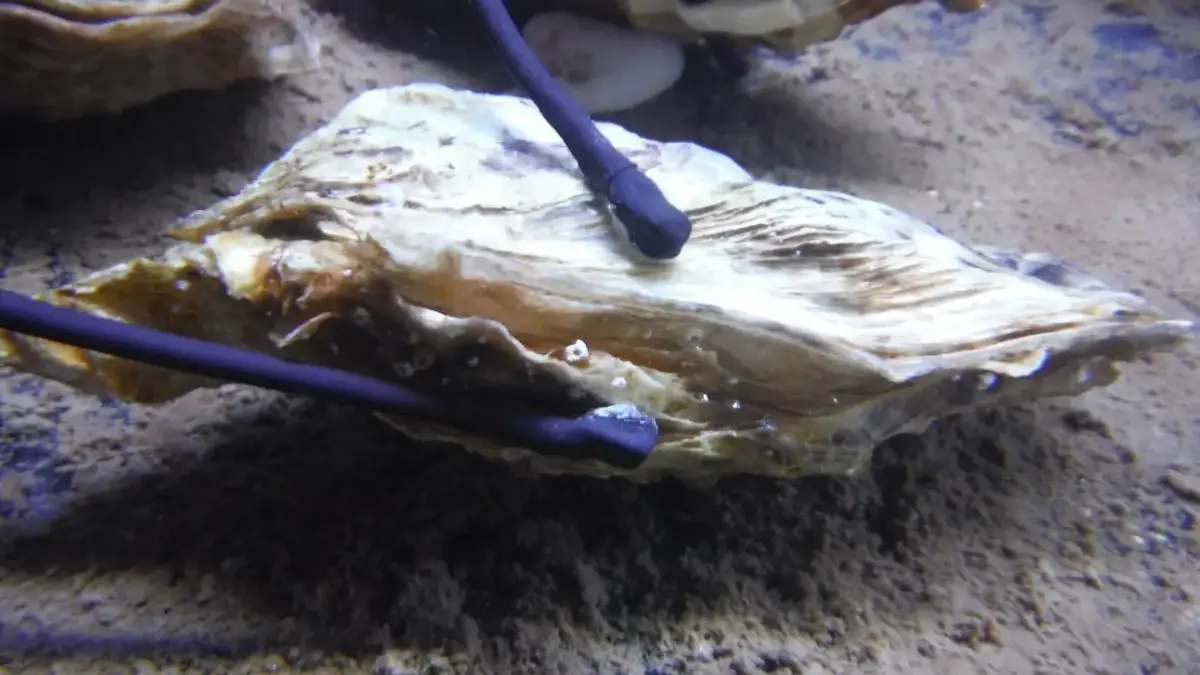
- Non-Invasive Sensors: Tiny electromagnetic sensors are glued to the opposing valves of selected bivalves.
- Continuous Behavioral Tracking: The system records the opening and closing cycles of the shell, alongside secondary indicators such as growth rates and micro-movements.
- Behavioral Stress Responses: When toxic elements, heavy metals, or abrupt temperature and pH shifts occur in the water, bivalves naturally exhibit defensive behaviors—such as keeping their shells tightly sealed for extended, abnormal periods.
- Real-Time Data Transmission: The sensors capture these behavioral anomalies via HFNI technology, translating them into more than 10 distinct physiological and behavioral parameters monitored daily.
Global Applications
Environmental protection agencies and industrial operators utilize this biotechnology across multiple critical sectors:
- Industrial Discharge Oversight: Factories and manufacturing plants situated near rivers use bivalve bio-stations to ensure their wastewater output is not inadvertently harming local aquatic life.
- Municipal Water Treatment: Wastewater treatment facilities employ the systems as an immediate failsight, detecting toxic chemical spills before they can compromise municipal water supplies or natural receiving waters.
- Restoration Projects: In fragile ecosystems like the Mar Menor lagoon in Spain or the Hudson River estuary in New York, combined restoration initiatives pair physical oyster re-seeding with high-tech valvometry to track environmental recovery in real time.
"High-frequency non-invasive valvometry allows us to track more than 10 different physiological and behavioral parameters every single day, enabling round-the-clock health checkups for our aquatic environments," notes documentation from the molluSCAN-eye platform.
Implications for the Future of Conservation
The convergence of biology and digital technology seen in bivalve-based monitoring systems carries profound implications for the future of global ecology and environmental governance.
1. Shifting from Reactive to Proactive Defense
Historically, environmental management has been largely reactive—agencies discover a fish kill or a chemical spill after the damage has already been sustained. By tapping into the acute sensory awareness of living organisms, humanity gains a proactive shield. Because bivalves react instantly to physiological stressors long before traditional chemical sensors might flag a novel or unforeseen pollutant, communities gain critical lead time to mitigate disasters.
2. Biomimicry and Bio-Inspiration
This technology underscores a vital philosophical and practical shift in environmental engineering: rather than trying to conquer nature with entirely synthetic, resource-intensive machinery, humanity is learning to collaborate with natural systems. Recognizing the intrinsic evolutionary adaptations of animals and scaling them up via digital tools represents a masterclass in biomimicry.
3. A Blueprint for Planetary Health
As climate change accelerates extreme weather events, raises water temperatures, and exacerbates droughts and floods, traditional water testing infrastructure will face unprecedented strain. Integrating living organisms into global monitoring networks offers a resilient, self-sustaining, and cost-effective layer of defense.
Ultimately, World Water Quality Monitoring Day serves as an annual reminder that water is the fundamental lifeblood of human civilization. By turning to the silent, tireless guardians of the riverbeds and ocean floors—our bivalve allies—humanity is discovering that nature itself holds the most sophisticated tools for its own preservation.




Leave a Reply