

Main Facts
Margaret Hamilton, a pioneering computer scientist who laid the foundational principles for modern software engineering and ensured the success of the historic Apollo 11 lunar landing, passed away on September 30, 2026, at the age of 90. Her death was confirmed by the Massachusetts Institute of Technology (MIT), an institution where she spent over two decades shaping a discipline that barely existed when she first began her career.
Long before software was recognized as a prestigious, standalone profession—at a time when massive mainframe computers occupied entire rooms and were viewed merely as glorified calculators—Hamilton was writing code. Her crowning achievement remains her leadership of the software engineering division for NASA’s Apollo space program. Under her direction, her team developed the onboard flight software that guided humanity to the lunar surface in July 1969.
Hamilton was not merely a programmer; she was a visionary who conceptualized asynchronous executive processing, priority scheduling, and fault tolerance. Her work prevented catastrophic mission failures, most notably during the frantic final minutes of the Apollo 11 lunar descent when the spacecraft’s computer was overwhelmed by unexpected radar data. By designing a system intelligent enough to drop low-priority tasks in favor of critical landing functions, Hamilton and her team guaranteed that Neil Armstrong and Buzz Aldrin could safely touch down on the Moon.
Her iconic 1969 photograph—standing proudly beside a towering stack of paper filled with the hand-written assembly code required to take humanity to space, a stack nearly as tall as she was—remains one of the most enduring symbols of the dawn of the computer age. In 2016, her monumental contributions were officially recognized when President Barack Obama awarded her the Presidential Medal of Freedom, the highest civilian honor in the United States.
Chronology: From Meteorology to the Stars
The trajectory of Margaret Hamilton’s life mirrors the evolution of computer science itself. Born Margaret Heafield in Paoli, Indiana, in 1936, she displayed an early aptitude for abstract reasoning and mathematics. She pursued her passion at Earlham College, where she earned a bachelor’s degree in mathematics in 1958. Fresh out of college, she briefly taught high school mathematics before moving to Boston in 1959 to pursue graduate studies at Brandeis University, a move that accidentally thrust her into the epicenter of the technological revolution.
The Early Days: Chaos Theory and Air Defense
In Boston, Hamilton secured a temporary position in the meteorology department at MIT. There, she worked alongside Edward Lorenz, one of the founding fathers of modern chaos theory. Hamilton was tasked with programming primitive computers to model weather prediction systems. It was her first professional baptism by fire into the world of computing, teaching her how complex, dynamic systems could behave unpredictably.
Seeking greater technical challenges, Hamilton transitioned to MIT’s Lincoln Laboratory, where she worked on the Semi-Automatic Ground Environment (SAGE) project. SAGE was a massive, continental-scale U.S. air defense system designed to track potential Soviet bomber attacks in real time. Working on SAGE deeply influenced Hamilton’s engineering philosophy. She became obsessed with a fundamental, terrifying question: What happens when a computer program crashes, and how can it be engineered to survive human or mechanical error?
Entering the Space Age: The Apollo Program
By 1965, the United States was locked in a fierce Space Race against the Soviet Union, and NASA was desperately seeking engineering talent to build the guidance and navigation systems for the crewed lunar missions. The MIT Instrumentation Laboratory was awarded the contract to build the Apollo Guidance Computer (AGC) software.
Hamilton applied for a position and was promptly hired, becoming the very first programmer assigned to the Apollo project and the first female software developer on the MIT team. What began as a small group quickly expanded under her leadership. By 1968, Hamilton was directing more than 400 engineers, programmers, and technicians across multiple teams, managing the mammoth task of writing the real-time flight software that would govern the command and lunar modules.
Supporting Data: The Architecture of Resilience
To understand the magnitude of Hamilton’s work, one must understand the hardware limitations of the era. The Apollo Guidance Computer possessed a mere 72 kilobytes of ROM (Read-Only Memory) and a staggering 2,048 words of RAM. To put this in perspective, a modern smartphone possesses millions of times more processing power than the computer that flew humanity to the Moon. Every single line of code had to be meticulously optimized, written in assembly language, and manually woven by seamlasses—often referred to as "LOL memory" (Little Old Lady memory)—into copper wire ropes.
The Lauren Incident: Anticipating Human Error
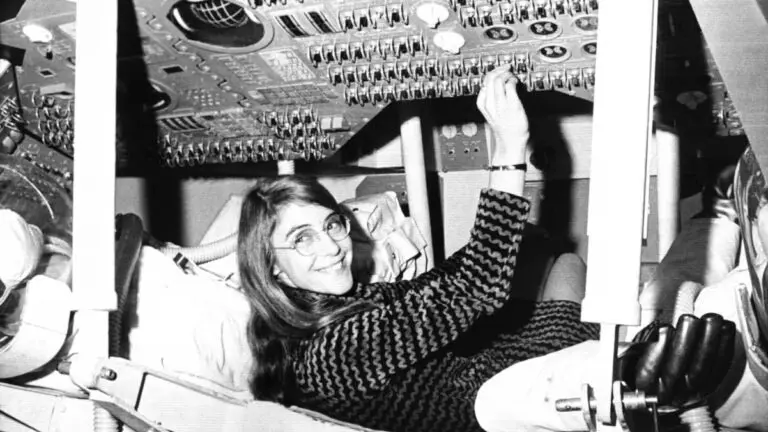
Hamilton’s rigorous methodology was driven by her obsession with safety and fault tolerance. Her uncompromising foresight was famously demonstrated by a domestic incident involving her four-year-old daughter, Lauren.
While visiting her mother at the MIT lab on a weekend, young Lauren was playing inside a command module simulator. She accidentally pressed a sequence of keys that activated a pre-launch simulation program while the system was supposedly locked in flight mode. The simulation crashed, wiping out the navigation data.
When Hamilton analyzed the event, she realized that an astronaut could easily make the exact same mistake due to fatigue, distraction, or motion sickness during a critical phase of flight. She proposed altering the software to intercept and prevent such accidental commands. Initially, her NASA superiors rejected the fix, arguing that highly trained astronauts would never make such a careless error.
However, during the flight of Apollo 8, an astronaut accidentally triggered the exact same command sequence that Lauren had discovered years earlier. Thanks to the prior close call, Hamilton’s team had already developed the patch, which was hurriedly integrated into subsequent missions. This philosophy—designing systems that expect and gracefully handle human error—became a foundational pillar of software reliability engineering.
The 1202 Alarm: Saving Apollo 11
The ultimate test of Hamilton’s architectural philosophy occurred on July 20, 1969. As Neil Armstrong and Buzz Aldrin descended toward the lunar surface in the Eagle lunar module, the radar system—left unintentionally switched on—began flooding the Apollo Guidance Computer with unnecessary, redundant data requests.
The computer was instantly overburdened, triggering the dreaded 1202 Program Alarm. In lesser-designed systems, an overload of this magnitude would cause a total system crash or infinite reboot loop, which, in the middle of a lunar descent, would have meant certain death for the astronauts.
Instead, Hamilton’s priority-scheduling architecture immediately went to work. The software analyzed the incoming tasks, recognized that processing the radar data was less important than maintaining thruster control and life support, and ruthlessly purged the low-priority processes. The computer flashed a warning to the astronauts to let them know it was overwhelmed, but it continued executing the vital calculations required for the landing. Armstrong and Aldrin trusted the system, continued their descent, and successfully landed on the Moon.
Official Responses and Tributes
Following the announcement of her passing, tributes poured in from the scientific community, academic institutions, and space agencies worldwide, celebrating a woman who had spent decades quietly operating behind the scenes before finally receiving the global acclaim she deserved.
In an official statement, the Massachusetts Institute of Technology praised her foundational contributions:
"Margaret Hamilton did not just write code; she invented the very paradigm of how we build reliable software today. Her legacy is embedded in every airplane that flies, every medical device that saves a life, and every digital system we rely upon. She taught a nascent industry how to think about failure before it happened."
NASA also issued a commemorative statement highlighting her vital role in the space program:
"The giant leap taken by humanity on July 20, 1969, was built upon the rigorous, unflinching engineering discipline championed by Margaret Hamilton. As the lead software architect for the Apollo missions, she solved problems that the world had never encountered before. NASA mourns the loss of a true pioneer whose brilliance opened the cosmos to humankind."
Historians and technologists alike noted that Hamilton’s impact extended far beyond the space race. By coining the term "software engineering" and fighting for it to be recognized as a formal, rigorous branch of engineering on par with mechanical or electrical engineering, she fundamentally altered the technological landscape of the 20th and 21st centuries.
Implications: A Legacy Carved in Code
Margaret Hamilton’s life and work carry profound implications for the modern digital era. In a world increasingly dominated by software—where algorithms dictate everything from financial markets and medical diagnostics to autonomous vehicles and global infrastructure—the principles she championed are more relevant than ever.
When Hamilton entered the field, coding was often dismissed as clerical "women’s work," relegated to typing punch cards while male engineers designed the physical hardware. Through sheer brilliance, rigorous methodology, and unwavering leadership, she shattered those institutional barriers and elevated software to its rightful place as the intellectual core of modern technology.
Moreover, her insistence on fail-safe design—anticipating the worst-case scenario and building systems resilient enough to survive human and mechanical flaws—remains the gold standard for software developers across the globe. Today’s cybersecurity frameworks, cloud resilience architectures, and error-handling protocols all trace their conceptual lineage back to the foundational work done at MIT for the Apollo missions.
Margaret Hamilton spent her life grappling with a deceptively simple question: How do you build a machine that works when everything goes wrong? Her answers did not just take humanity to the Moon; they built the digital foundation of the modern world.




Leave a Reply