

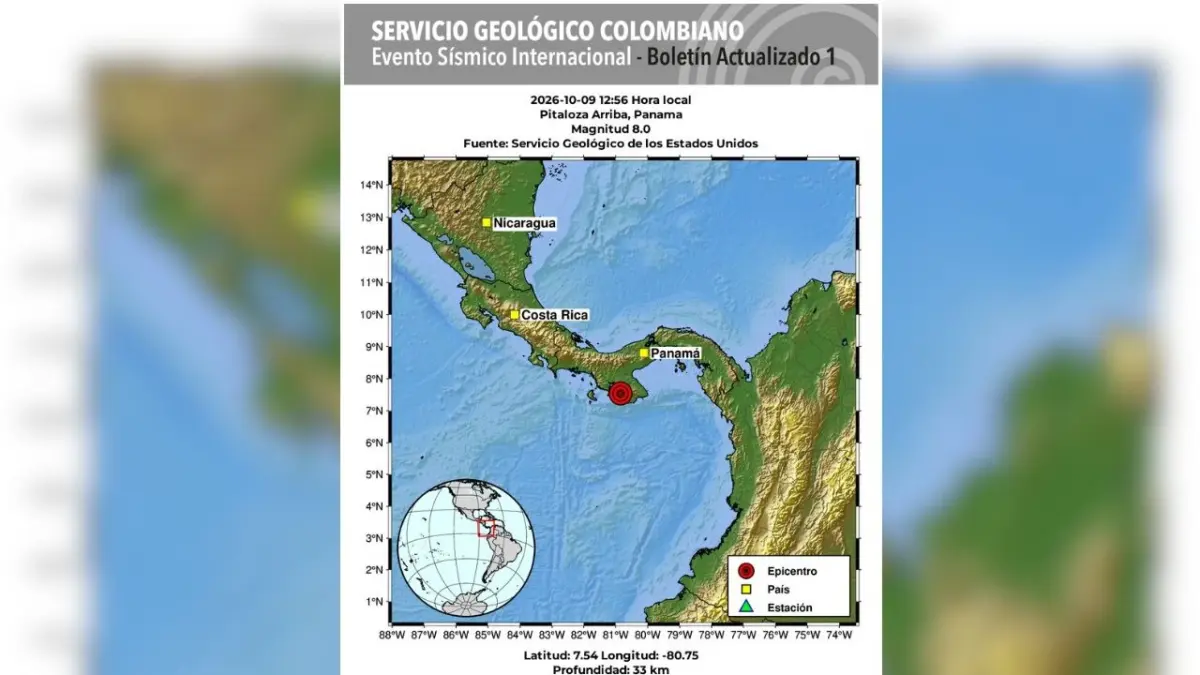
Panama City, Panama — A powerful, shallow earthquake with a magnitude of 8.0 struck Panama on Friday afternoon, October 9, 2026, sending shockwaves across Central America and prompting immediate regional responses, including disaster management evaluations and international solidarity messages.
According to the updated bulletin issued by the Colombian Geological Service (Servicio Geológico Colombiano – SGC), the major seismic event was registered at precisely 12:56 p.m. local time. The epicenter was located in the vicinity of Pitaloza Arriba, Panama, at a shallow depth of just 33 kilometers (approximately 20.5 miles). Because of its high magnitude and shallow hypocenter, the tremor was felt intensely across widespread areas, triggering immediate concern among residents and emergency services alike.
Chronology of Events: From the Initial Tremor to Ongoing Aftershocks
The sequence of events unfolded rapidly on Friday afternoon, catching citizens and local authorities by surprise:
- 12:56 p.m. (Local Time): The primary earthquake, measuring an 8.0 magnitude, hits Pitaloza Arriba, Panama. The shallow depth of 33 kilometers amplifies the surface shaking, causing panic in urban and rural settlements alike. Buildings sway significantly in Panama City and surrounding regions, prompting mass evacuations of office towers, schools, and shopping centers.
- Immediate Post-Event Phase: Communication lines experience temporary disruptions as panicked citizens attempt to reach loved ones. Emergency protocols are instantly activated nationwide. The Instituto de Geociencias at the University of Panama, led by expert Néstor Luque, begins monitoring seismic instruments to track the frequency and magnitude of ensuing activity.
- Early Afternoon: Seismologists record the first major aftershocks. By mid-afternoon, authorities confirm a total of 13 aftershocks rippling through the region, the most potent of which registers at a staggering magnitude of 5.0, keeping the population on edge and complicating rescue and damage-assessment operations.
- Post-Meridian Hours: National and international agencies analyze data to determine the full scope of the disaster. While damage assessments are ongoing in remote areas near the epicenter, disaster management bodies issue initial safety clearances regarding maritime threats.
Supporting Data and Seismological Profile
Seismological institutions across the continent quickly mobilized to analyze the technical parameters of the October 9 earthquake. An 8.0 magnitude earthquake is classified as a "major" or "great" earthquake capable of causing severe damage over large areas, particularly near the epicenter.
- Magnitude: 8.0 (SGC International Seismic Event Report)
- Epicenter: Pitaloza Arriba, Panama
- Depth: 33 kilometers (Classified as a shallow focus earthquake, which typically results in significantly stronger ground motion and higher damage potential than deeper earthquakes of similar magnitudes).
- Timestamp: October 9, 2026, at 12:56 p.m. local time.
- Aftershock Activity: Over 13 documented aftershocks within the initial hours following the primary shock, led by a notable 5.0-magnitude aftershock that tested the resilience of already-shaken infrastructure.
Seismologists emphasize that while shallow earthquakes transfer energy more violently to the surface, the specific geological faults in the region are under constant observation to predict the trajectory of ongoing aftershocks, which are expected to continue for days.
Official Responses and Tsunami Evaluations
In the immediate aftermath of a seismic event of this scale, the primary concern for coastal nations is the potential generation of destructive tsunami waves.
Tsunami Threat Ruled Out
Shortly after the quake struck, Colombia’s National Unit for Disaster Risk Management (Unidad Nacional para la Gestión del Riesgo de Desastres – UNGRD) formally evaluated regional oceanic data and discarded any threat of a tsunami for both Colombian coasts and broader Caribbean and Pacific zones. Local maritime authorities in Panama also monitored sea levels closely, ultimately offering reassurance to coastal communities that no anomalous wave formations were detected.
Local Scientific Assessment
Néstor Luque of the Institute of Geosciencias at the University of Panama provided crucial updates to the public, confirming the high frequency of aftershocks. Luque urged citizens to remain vigilant, stay away from structurally compromised buildings, and rely exclusively on official bulletins rather than unverified social media reports. Emergency response teams were deployed across vulnerable provinces to inspect bridges, roads, hospitals, and residential sectors for structural integrity.
International Implications and Diplomatic Solidarity
The sheer scale of the 8.0-magnitude earthquake drew immediate international attention, prompting leaders from neighboring and partner nations to offer their unwavering support to the Panamanian government and its citizens.
Colombia Extends a Helping Hand
Among the first international leaders to respond was Colombian leadership. High-ranking officials and political figures expressed profound solidarity with the neighboring nation.
In a public statement shared via his official social media channels, prominent figure and leader Abelardo de la Espriella voiced his deep affection and support for Panama during its hour of crisis:
"I express all my solidarity and affection to the brotherly people of Panama and their government during the difficult moments they are experiencing due to the strong earthquake. Colombia accompanies the Panamanian nation in this adversity. We are united by history, brotherhood, and bonds of friendship that are forged especially in difficult times. Panama is not alone! Count on Colombia’s backing and our full willingness to provide any assistance that may be necessary," stated De la Espriella, addressing Panamanian President José Raúl Mulino directly with a message of fraternal unity.
The diplomatic outreach underscores the deep historical, economic, and cultural ties binding Panama and Colombia. As damage assessments continue, international aid organizations and regional governments remain on standby to dispatch search-and-rescue teams, medical supplies, and engineering units should the Panamanian government formally request external assistance.
Outlook and Ongoing Recovery
As Friday evening approaches, Panama remains in a state of heightened alert. While initial reports suggest that widespread catastrophic structural collapses have been averted thanks to modern building codes and the rapid mobilization of emergency services, authorities caution that the situation remains fluid.
Search-and-rescue units continue to penetrate rural areas closest to Pitaloza Arriba to evaluate isolated communities. Experts remind the public that aftershocks—some potentially strong enough to cause further damage to weakened structures—will persist in the coming days. Citizens have been advised to maintain emergency kits, identify safe zones, and heed all directives issued by national disaster relief agencies.