

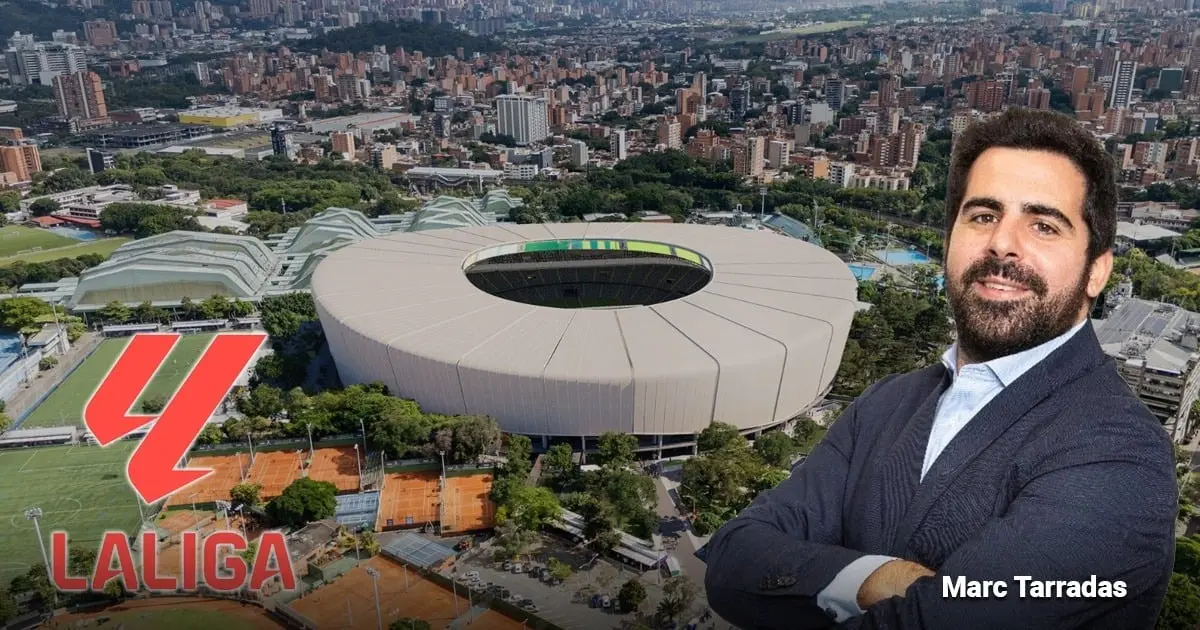
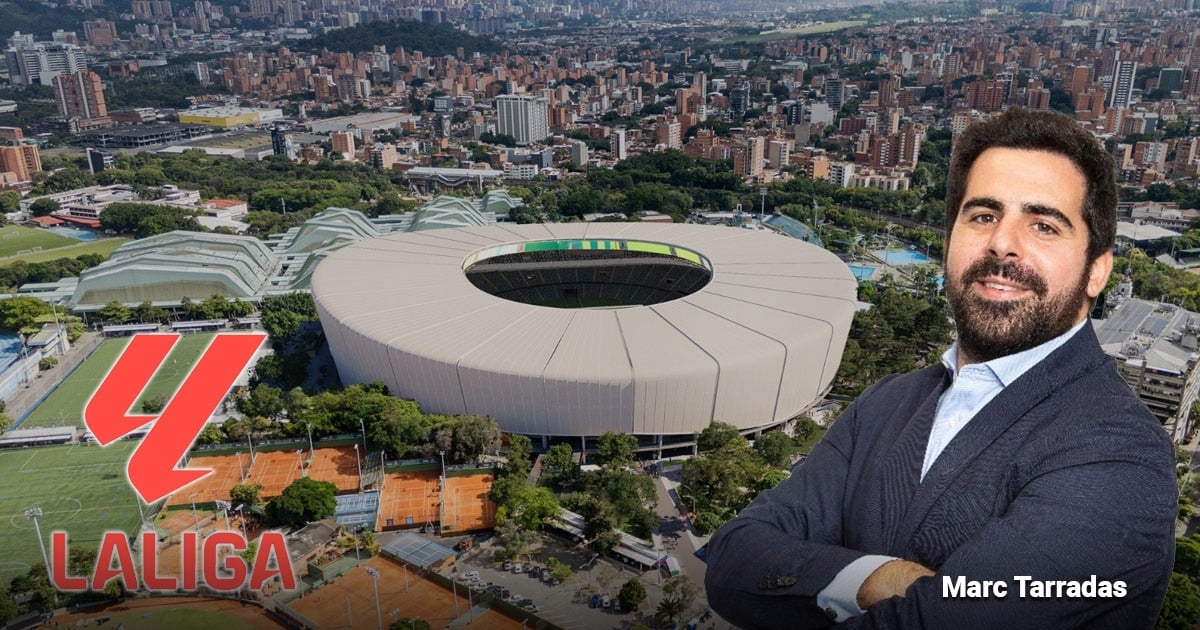
MEDELLÍN, Colombia — In a bold move that signals a paradigm shift for South American sports infrastructure, the city of Medellín has officially enlisted the expertise of Spain’s Liga Nacional de Fútbol Profesional (LaLiga) to spearhead the technological and operational modernization of the historic Estadio Atanasio Girardot.
Valued at an estimated 1.1 trillion Colombian pesos, the ambitious revitalization project aims to transform the legendary home of Atlético Nacional and Independiente Medellín into a cutting-edge, world-class venue. Rather than directly executing construction work, LaLiga—represented in South America by Managing Director Marc Tarradas—has been brought in as a high-level strategic consultant. The objective: to bridge the gap between South American football culture and the elite operational standards seen at iconic European venues like FC Barcelona’s Camp Nou and Atlético de Madrid’s Riyadh Air Metropolitano.
This partnership is more than just a renovation; it is a calculated leap into the future of sports management, security, and broadcast quality. With municipal backing spearheaded by Medellín Mayor Federico Gutiérrez and executed through the Empresa para la Seguridad y Soluciones Urbanas (ESU), managed by Mateo González Benítez, the Atanasio Girardot is positioning itself as the most technologically advanced stadium in Colombia, if not the entire Andean region.
1. Main Facts of the Atanasio Girardot Modernization Project
The overhaul of the Estadio Atanasio Girardot represents a multi-faceted investment plan designed to upgrade every touchpoint of the matchday experience.
- The Scope of Investment: The master project carries an estimated price tag of 1.1 trillion pesos, with funding streams currently being finalized, combining public allocations from the Mayor’s Office of Medellín with potential private-sector partnerships.
- The Consultant: LaLiga of Spain acts as the primary architectural, technological, and operational consultant, bringing decades of European know-how in stadium monetization, fan experience, and broadcast optimization.
- Core Areas of Improvement:
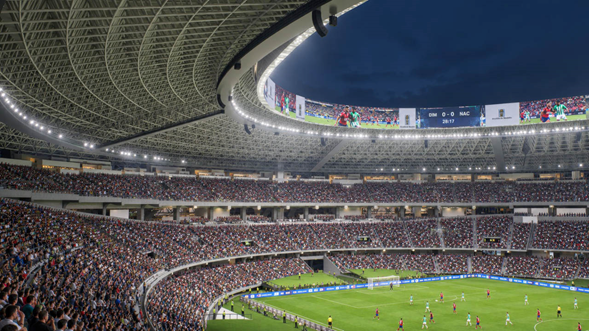
- Broadcast Quality: Upgrading lighting, acoustics, and camera placements to meet top-tier European television production standards.
- Fan Experience & Safety: Modernizing access control, stadium aesthetics, and hospitality zones.
- Security and Biometrics: Implementing advanced surveillance systems, including state-of-the-art facial recognition technology—a historic first for Colombian football.
- Local Leadership: The initiative is driven locally by Medellín Mayor Federico Gutiérrez and coordinated through Mateo González Benítez, General Manager of the ESU (Empresa para la Seguridad y Soluciones Urbanas).
- Regional Representation: Marc Tarradas, a seasoned executive trained at Esade Business School and bearing a nine-year tenure within LaLiga, leads the project’s strategy across South America.
2. Chronology of the Transformation: From Vision to Biometric Reality
The path toward transforming the Atanasio Girardot into a European-style arena has unfolded through a series of calculated administrative and technological milestones:
- Late 2023 – Early 2024 (The Vision): Upon taking office, Medellín Mayor Federico Gutiérrez and his administration identified the urgent need to modernize municipal sports infrastructure. Recognizing that stadiums like the Camp Nou and the Metropolitano function as year-round entertainment hubs rather than mere 90-minute pitches, the city sought international consulting.
- Mid-2024 (Engaging LaLiga): Through the coordination of ESU and executive Marc Tarradas, discussions began between the local government and LaLiga’s international expansion division. The goal was established: leverage Spanish expertise not just for brick-and-mortar construction, but for holistic operational transformation.
- Late 2024 – 2025 (Master Planning): The 1.1 trillion-peso master plan was shaped, categorizing improvements into distinct pillars: digital infrastructure, structural aesthetics, broadcast capabilities, and security protocols.
- Early 2026 (The Biometric Milestone): The modernization scored its first major public success during a high-profile match between Independiente Medellín and Jaguares. For the first time in Colombian football history, a facial biometric control system was successfully implemented at the gates of the Atanasio Girardot. Developed through a collaborative effort involving Brazilian and Colombian tech specialists, the system effectively screened attendees, setting a new benchmark for stadium safety in the country.
- Mid-2026 and Beyond (Advisory and Expansion): With the biometric foundation laid, LaLiga’s ongoing advisory role shifts toward optimizing the stadium’s commercial spaces, digital broadcast feeds, and acoustic engineering, aligning the venue with global trends.
3. Supporting Data and Financial Metrics
To comprehend the scale of the Atanasio Girardot overhaul, one must examine the financial and operational indicators underpinning the project:
- 1.1 Trillion Pesos: The total projected investment envelope for the comprehensive structural, technological, and urban integration of the stadium and its surrounding sports complex.
- 9 Years: The professional tenure of Marc Tarradas within LaLiga, establishing a reliable corporate bridge between European sports governance and Latin American market execution.
- 1st in Colombia: The Atanasio Girardot is officially the pioneer venue in the nation to successfully integrate automated facial recognition systems for mass crowd ingress, dramatically reducing gate congestion and curbing hooliganism ("barravravas").
- Multiple Stakeholders: The project coordinates municipal entities (Alcaldía de Medellín, ESU), sports associations (LaLiga), local clubs (Atlético Nacional and Independiente Medellín), and international tech contractors from Brazil, Colombia, and Spain.
- Strategic Expansion Markets: For LaLiga—presided over by Javier Tebas Medrano—Colombia represents a core market within its broader Latin American expansion strategy, which also includes grassroots partnerships such as training academies run in conjunction with Compensar.
4. Official Responses and Administrative Perspectives
The convergence of European sports consulting and Colombian municipal governance has generated significant commentary from key institutional figures.
The City of Medellín and Local Administration
Mayor Federico Gutiérrez has consistently emphasized that Medellín deserves public infrastructure that matches the global prestige of its cultural and athletic movements. By partnering with international consultants, the city aims to ensure that public funds are spent efficiently, adhering to blueprints that have been proven successful in major European leagues.

Mateo González Benítez, head of the ESU, highlighted the technical rigor brought by the partnership: "We are not merely painting walls or fixing seats. We are redesigning how citizens interact with public spaces, ensuring that safety, technology, and entertainment merge seamlessly. Working alongside entities like LaLiga allows us to bypass trial-and-error and implement best practices straight from the elite tiers of world football."
LaLiga’s Regional Leadership
Marc Tarradas, speaking on behalf of LaLiga’s international expansion efforts, has repeatedly underscored the organization’s commitment to South America. While LaLiga is fundamentally a private, non-profit sports association comprising clubs like Real Madrid, Barcelona, and Atlético de Madrid, its business arm operates with a global, corporate mindset.
"Our goal in Latin America, and specifically in Colombia, is to export the value proposition of the Spanish football industry," Tarradas has noted in past institutional forums. "When we advise on a project like the Atanasio Girardot, we bring the cumulative knowledge of stadium security, broadcast optimization, and fan engagement models that have taken decades to refine in Europe. Medellín has the passion; our role is to help elevate the infrastructure to match that passion."
5. Broader Implications for Colombian and South American Football
The transformation of the Atanasio Girardot carries deep strategic implications that extend far beyond the borders of Antioquia, potentially reshaping the future of sports entertainment across the continent.
Setting a New Domestic Standard
For decades, stadiums across Colombia have struggled with outdated infrastructure, poor acoustic designs for television broadcasts, and persistent security concerns regarding crowd control. The successful pilot of facial recognition biometrics at the Atanasio Girardot serves as a blueprint for other major Colombian cities, such as Bogotá (Estadio El Campín) and Cali (Estadio Pascual Guerrero). If Medellín proves that high-tech security can coexist with a welcoming family atmosphere, regulatory and municipal pressures will likely force other clubs and cities to follow suit.
Commercialization and Matchday Revenue
European clubs generate a massive percentage of their annual revenue not just from television rights, but from matchday operations—stadium tours, VIP hospitality boxes, high-end merchandising, and year-round event hosting. By consulting with LaLiga, the stakeholders managing the Atanasio Girardot are positioning the venue to operate as a multi-purpose entertainment complex. Concerts, corporate conventions, and digital-first fan zones will transform the stadium from a sporadic expense into a self-sustaining economic engine.
Strengthening European-Latin American Football Bridges
LaLiga’s active presence in Colombia—ranging from technical training pacts with entities like Compensar to high-level infrastructure consulting—demonstrates a deeper commercial integration between European football brands and South American talents. By embedding Spanish operational philosophies into foundational local structures, LaLiga deepens its brand loyalty in a continent that has historically exported its best players to Europe, while now exporting European operational standards back across the Atlantic.
Ultimately, the modernization of the Atanasio Girardot is a testament to Medellín’s ambition. Backed by a 1.1 trillion-peso vision and guided by the seasoned hand of European consultancy, the "Capital of Mountain" is steadily building an arena designed to rival the grandest cathedrals of world football.




Leave a Reply