

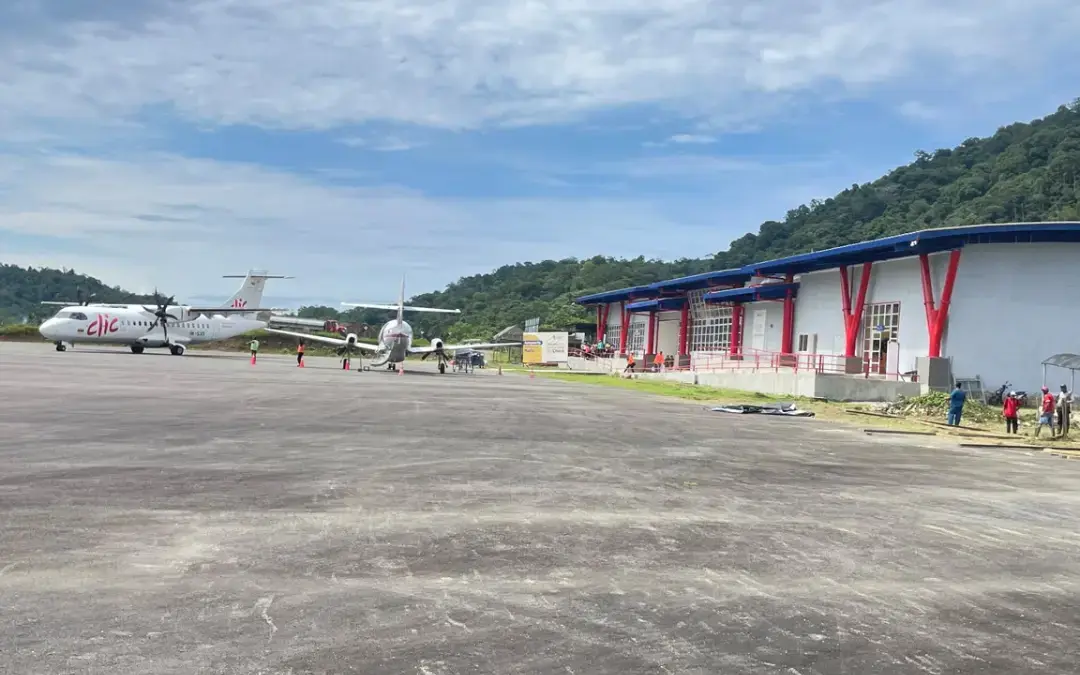
Bahía Solano, Chocó — In a historic milestone aimed at transforming the economic, touristic, and social landscape of the Colombian Pacific, the departmental administration of Chocó has officially inaugurated the brand-new passenger and cargo terminal at the José Celestino Mutis Airport in Bahía Solano. Spearheaded by the Governor of Chocó, Nubia Carolina Córdoba, this monumental infrastructure project represents a vital leap forward for a region historically plagued by connectivity challenges, yet blessed with unmatched natural wealth and biodiversity.
Valued at $31,195 million COP in its initial phase, the project was entirely financed through national royalty allocations (regalías). Local and regional authorities harbor ambitious expectations for the new terminal: they project that the modernized facilities will double tourist influx to the municipality, scaling annual visitor numbers from 80,000 to 160,000.
Beyond tourism, the infrastructure is engineered to serve as a critical logistics hub, streamlining the transportation of goods—most notably artisan fishing products—and ensuring that the local economy can efficiently connect with domestic and international markets.
1. Main Facts: The Architecture of Modern Connectivity
Located just three kilometers from the municipal seat of Bahía Solano, the newly minted terminal spans an impressive 2,200 square meters of modern, highly functional architectural design. Moving far beyond the limitations of the previous facilities, the new complex has been meticulously planned to offer a seamless passenger experience, aligning regional airports with national service standards.
Key Infrastructure Features:
- Passenger Processing and Flow: The terminal features a dedicated, spacious check-in area designed to eliminate bottlenecks during peak travel seasons, alongside modern arrival and departure halls.
- Commercial and Administrative Spaces: Five dedicated commercial locales have been integrated into the design, offering economic opportunities for local vendors and ensuring travelers have access to amenities. Additionally, the complex houses comprehensive administrative offices and modern, high-capacity public restrooms.
- Cargo Handling Capabilities: Recognizing the economic reality of Bahía Solano—where fresh seafood and regional products form the bedrock of daily trade—the facility has been equipped to handle both passenger traffic and cargo logistics simultaneously.
- Commercial Airline Integration: Operations at the new terminal will immediately host three commercial passenger airlines (Satena, Clic, and Moonflight), alongside a specialized cargo carrier. This multi-airline presence guarantees competitive options for travelers and robust supply chains for local merchants.
Despite the grandeur of the current delivery, project leads emphasize that the terminal is only the first major chapter in a larger modernization master plan designed to future-proof Bahía Solano’s aviation capabilities.
2. Chronology and Future Development: A Multi-Phase Vision
The realization of the José Celestino Mutis Airport terminal was not achieved overnight. It is the culmination of rigorous planning, financial management, and phased execution designed to ensure structural integrity and regulatory compliance.
According to Frank Kenneth, director of oversight (interventoría) for the Consorcio Control Pacífico, the master project has been structured into five distinct operational phases.
- Phase I (Completed): The construction and delivery of the primary 2,200-square-meter terminal building, passenger zones, check-in desks, and initial operational areas. This phase represents the core $31,195 million COP investment and enables immediate commercial flights.
- Upcoming Phases (In Progress & Planned): The subsequent stages of the master plan focus heavily on safety and emergency response infrastructure, most notably the construction of a dedicated airport fire station (infraestructura bomberil).
When these auxiliary safety and operational phases are fully integrated, the total cumulative investment in the José Celestino Mutis Airport is expected to climb to approximately $43,000 million COP.
Governor Nubia Carolina Córdoba underscored the magnitude of this financial commitment during her inaugural tour of the facilities:
"We have invested more than $30,000 million of the royalties belonging to the men and women of Chocó to build this airport terminal. The total will reach approximately $43,000 million if we take into account the upcoming phase encompassing the entire firefighting infrastructure."
This phased approach ensures that while the economic benefits of tourism and cargo can begin immediately, the airport is systematically brought up to the highest standards of international aviation safety and emergency preparedness.
3. Supporting Data: Soaring Demand and Operational Realities
The inauguration of the terminal does not arrive in a vacuum; rather, it is a desperately needed response to an undeniable, exponential surge in travel demand heading toward the Colombian Pacific coast. For years, Bahía Solano’s breathtaking landscapes have captured the imaginations of travelers worldwide, but the region’s transport infrastructure has struggled to keep pace.
Data provided by commercial operators vividly illustrate this pressure. Carlos Andrés Guzmán, director of operations and senior pilot for the airline Clic, shared compelling operational statistics highlighting the region’s booming popularity:
- In 2025 alone, Clic transported approximately 28,000 passengers directly into Bahía Solano.
- In the first three quarters of the current year, that passenger count had already surpassed 20,000 individuals, signaling that annual totals are on track to shatter previous records.
- Clic’s fleet features aircraft with a 50-passenger capacity, and Guzmán noted an astonishing 90% load factor across standard flights.
- During peak holiday and whale-watching seasons, the airline ramps up operations drastically, executing up to seven flights per day to meet consumer demand.
When combined with regular operations from Satena, Moonflight, and cargo carriers, the old terminal infrastructure was operating far beyond its designed thresholds. The new 2,200-square-meter facility provides the critical breathing room required to scale these operations safely and comfortably, preventing passenger congestion on the tarmac and elevating the overall reputation of the destination.
4. Official Responses and Stakeholder Perspectives
The rollout of a project of this magnitude requires alignment across departmental governance, municipal leadership, and private enterprise. The inauguration drew praise from key figures across the political and economic spectrum, each emphasizing a different facet of the terminal’s transformative potential.
Governor Nubia Carolina Córdoba: A Vision for Regional Equity
For the departmental administration, the airport is a testament to the efficient use of public resources. Governor Córdoba emphasized that the royalties of Chocó’s citizens have been translated into tangible, generational progress. By opening up the skies over Bahía Solano, the departmental government is effectively dismantling the geographic isolation that has historically hindered the region’s integration with the rest of Colombia.
Mayor Leonel Valencia Pinilla: Catalyzing Local Investment
The Mayor of Bahía Solano, Leonel Valencia Pinilla, expressed immense gratitude to the Gobernación del Chocó, framing the terminal as an open door for sweeping local development.
"It is a pleasure today to receive from the Governorate of Chocó a new passenger and cargo air terminal infrastructure. This opens the doors for works that integrate the progress of our communities," stated Valencia.
The mayor stressed that tourism remains the foundational pillar of the local economy, but he was quick to highlight that the benefits extend far beyond hospitality. The terminal is expected to attract ancillary investments in hotels, restaurants, tour agencies, and eco-infrastructure, fundamentally altering the trajectory of local commerce.
5. Implications: Tourism, Artisanal Fishing, and Economic Diversification
The true measure of the José Celestino Mutis Airport terminal will not be found solely in its square footage or the millions invested, but in its profound socioeconomic ripple effects across Bahía Solano and the broader Chocó department.
A World-Class Eco-Tourism Destination
Chocó’s Pacific coast is globally renowned as one of the most biodiverse and visually stunning regions on the planet. Bahía Solano specifically draws international and domestic travelers seeking pristine, untouched rainforests meeting the ocean, world-class sport fishing, secluded beaches, and—most famously—the annual migration of humpback whales.
With tourist numbers expected to double from 80,000 to 160,000 visitors annually, local operators are preparing for a massive influx. Improved airport logistics mean that families, eco-tourists, and adventure seekers will no longer face grueling, unpredictable transit bottlenecks, making Bahía Solano a far more competitive destination compared to other Caribbean or Andean alternatives in Colombia.
Revolutionizing Artisanal Fishing and Trade
While tourism claims the headlines, the inclusion of dedicated cargo facilities carries an equally powerful, localized economic impact: the revitalization of artisan fishing.
Mayor Leonel Valencia Pinilla pointed out the game-changing nature of the cargo terminal for local fishermen:
"This impact will also be felt in artisanal fishing… this allows fishermen to place their products in less than 24 hours from the moment they are pulled from the sea and take them to restaurants throughout the entire country."
Previously, transporting perishable seafood out of Bahía Solano was plagued by logistical delays, often resulting in spoilage, high freight costs, or missed market windows in major metropolitan hubs like Medellín, Cali, and Bogotá. With three commercial airlines and a specialized cargo operator running daily routes out of a modern terminal, local fishermen can now harvest the rich waters of the Pacific in the morning and see their fresh catch served in high-end urban restaurants the very next day. This direct supply chain drastically cuts out exploitative middlemen, boosts profit margins for local cooperatives, and infuses vital capital directly into the hands of working-class families.
Conclusion
The inauguration of the new terminal at the José Celestino Mutis Airport in Bahía Solano marks a defining chapter in the modern history of Chocó. By successfully executing a $31,195 million COP infrastructure project funded through regional royalties—with sights set on a $43,000 million COP total investment upon completion of safety facilities—the departmental government has proven that strategic planning can bridge the gap between geographic isolation and national integration.
As Satena, Clic, and Moonflight ramp up operations to meet the soaring demand of a projected 160,000 annual visitors, and as local fishermen leverage rapid cargo transport to reach national culinary markets within 24 hours, Bahía Solano stands poised on the precipice of a new era. It is an era where natural beauty meets modern efficiency, promising sustainable economic growth, increased dignity for its communities, and a shining beacon of progress for the Colombian Pacific.




Leave a Reply