

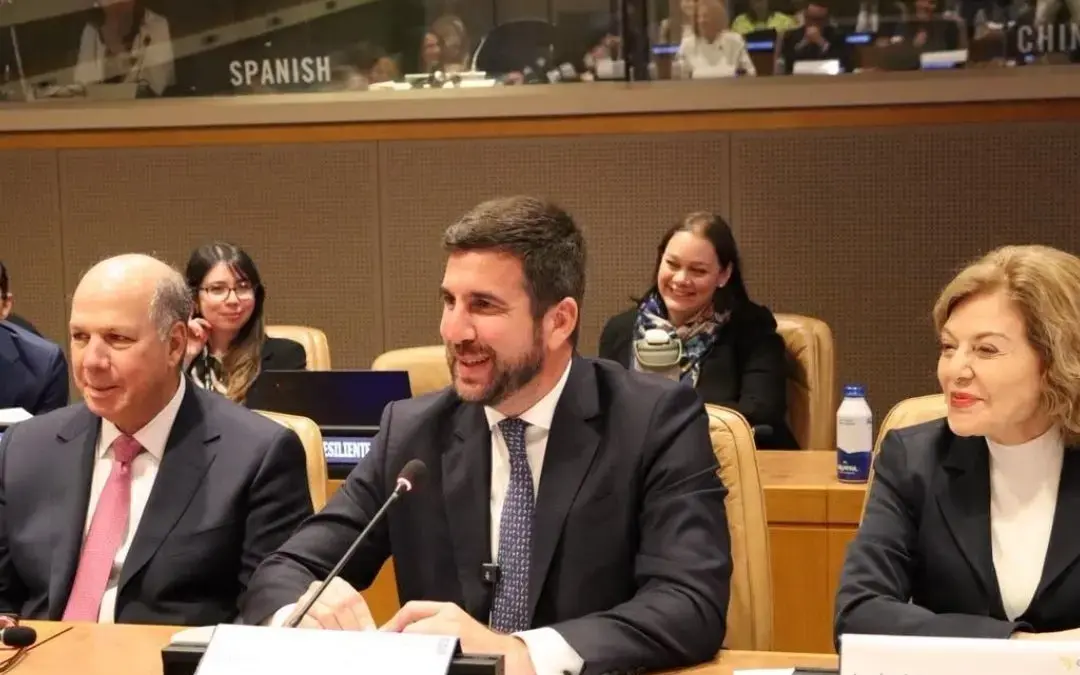
NEW YORK — As the global economy accelerates toward deep decarbonization, digital transformation, and widespread electrification, the foundational infrastructure supporting these monumental shifts is facing unprecedented pressure. Speaking at a high-level business summit held on the sidelines of the 81st United Nations General Assembly, Enrique Riquelme, founder and president of global utility and energy infrastructure company Cox, delivered a clear and urgent message: Latin America’s path to a sustainable, resilient future hinges on an immediate and massive upgrade to its electrical grids.
Riquelme’s remarks came during a specialized panel discussion titled “Boosting Competitiveness: A Bi-regional Alliance to Finance a Just Energy Transition and Resilient Growth.” Co-organized by the Business Council of the Alliance for Ibero-America (CEAPI) and the United Nations Development Programme (PNUD), the event gathered key private sector leaders, policymakers, and international development experts to discuss how Latin America and Europe can forge stronger financial and strategic partnerships to meet the dual challenges of climate change and economic competitiveness.
The executive’s intervention pierced through standard optimistic rhetoric about renewable energy adoption, shifting the conversation away from generation—such as solar farms and wind turbines—and onto the critical, yet often neglected, arteries of the power sector: transmission, distribution, and grid modernization.
1. Main Facts: The Core of Riquelme’s Proposition
The primary takeaway from Riquelme’s address is that the global energy transition cannot succeed if transmission networks remain outdated and underfunded. According to the Cox president, the convergence of three mega-trends—global electrification, the explosive growth of artificial intelligence (AI), and the proliferation of data centers—is creating a surge in power demand that existing grids simply cannot handle.
The Central Pillars of the Cox Strategy for Latin America:
- Grid Modernization as a Prerequisite: Riquelme argued that the success of renewable energy integration depends entirely on the flexibility, modernity, and interconnectivity of power grids. Without robust transmission infrastructure, green energy generated in remote regions cannot reach urban and industrial centers efficiently.
- Navigating Global Uncertainty: In an era defined by geopolitical instability, economic volatility, and shifting regulatory landscapes, private investment is suffering. Governments alone lack the fiscal capacity to fund necessary strategic projects in energy and water management.
- The AI and Data Center Demand Shock: The exponential rise of generative artificial intelligence and hyper-scale data centers requires constant, high-quality, and massive supplies of electricity. Grids must evolve to guarantee zero-latency, high-reliability power.
- The Necessity of Public-Private Partnerships (PPPs): Bridging the infrastructure investment gap requires regulatory certainty, bankable projects, and deep collaboration between state entities and private capital.
2. Chronology: Contextualizing the Dialogue at the UN General Assembly
The high-level discussions in New York unfolded within a carefully structured framework of international diplomacy and economic strategy. The timeline leading up to and during Riquelme’s address illustrates the mounting urgency surrounding Ibero-American infrastructure cooperation.
Timeline of Events
-
Phase 1: Pre-Summit Preparations (Mid-2024)
Ahead of the 81st UN General Assembly, CEAPI and PNUD identified a critical bottleneck in the global sustainability agenda: while capital is available for renewable energy generation projects, emerging markets—particularly in Latin America—struggle to secure funding for grid transmission and water management infrastructure. -
Phase 2: The Convening in New York (Assembly Week)
Global leaders gathered at UN Headquarters to evaluate progress on the Sustainable Development Goals (SDGs). Within this ecosystem, business councils organized side events to bridge the gap between high-level diplomatic commitments and actionable corporate investment. -
Phase 3: The CEAPI-PNUD Panel Intervention
Enrique Riquelme took the floor alongside other prominent Ibero-American business figures. Rather than focusing solely on carbon emission reductions, Riquelme redirected the debate toward structural economic resilience, highlighting how deficient grids threaten regional competitiveness. -
Phase 4: Post-Panel Strategic Alignment
Following the panel, business leaders and multilateral representatives initiated dialogues regarding the establishment of new financial instruments capable of mitigating regulatory risks for private investors operating in Latin American energy markets.
3. Supporting Data: The Rising Pressure on Modern Electrical Grids
To fully comprehend the gravity of Riquelme’s warnings, one must examine the macroeconomic and technical data governing the modern energy landscape. The convergence of energy transition mandates and digital transformation has created an unprecedented demand vector for electricity grids.
The Mathematics of Modern Power Demand
- The Data Center Boom and AI: According to industry analysts, a single modern AI query consumes significantly more energy than a traditional search engine request. Global data center electricity consumption is projected to double or even triple by the end of the decade. Latin America—particularly countries like Chile, Brazil, and Mexico—is emerging as a preferred hub for data center investments due to its renewable energy potential and cooler climates. However, local grids lack the redundancy required for hyper-scale facilities.
- The Electrification of Transport and Industry: Electric vehicle (EV) adoption, fleet electrification, and industrial heating processes are shifting heavy loads onto electrical distribution networks designed decades ago for lower, predictable demand profiles.
- The Transmission Bottleneck: Data from international energy agencies indicates that global investments in grids have stagnated relative to investments in solar and wind generation. For every dollar spent on renewables, significantly less is invested in grid infrastructure. This imbalance leads to "curtailment"—where clean energy is wasted because transmission lines cannot carry it to consumers.
[ Renewable Generation (Solar/Wind) ]
                 │
                 ▼
     ⚠️ THE TRANSMISSION GAP ⚠️  <-- (Riquelme's Core Focus)
                 │
                 ▼
[ Modernized Grids & Interconnections ]
                 │
                 ▼
[ High-Demand End-Users: AI Data Centers, EVs, Industry ]
Riquelme’s data-driven perspective emphasizes that without closing this transmission gap, billions of dollars invested in renewable generation risk yielding sub-optimal returns due to grid congestion and instability.
4. Official Responses and Stakeholder Perspectives
The panel “Impulsando la Competitividad” drew diverse reactions from multilateral organizations, business leaders, and financial institutions, reflecting a broad consensus that traditional funding models are no longer sufficient.
Perspectives from the Private Sector and Multilaterals
- The Business Council Perspective (CEAPI): Representatives from CEAPI emphasized that Ibero-America possesses natural resources, human capital, and strategic geographical advantages that position it to lead the global green economy. However, they warned that bureaucratic hurdles, political instability, and inconsistent legal frameworks often drive private capital toward safer, more predictable markets in North America or Europe.
- The Development Perspective (PNUD): Officials from the United Nations Development Programme underscored that a "Just Energy Transition" cannot leave vulnerable populations behind. Upgrading grid infrastructure is not merely an industrial requirement; it is a social imperative that ensures reliable, affordable electricity reaches underserved rural and peri-urban communities.
- The Corporate View from Cox: Through Riquelme’s leadership, Cox has consistently positioned itself as a global player capable of executing integrated utility projects spanning water, energy, and infrastructure. The company’s corporate philosophy stresses that infrastructure must be viewed as an integrated ecosystem where power generation, water desalination, and grid transmission are mutually dependent.
5. Implications: What Riquelme’s Warning Means for Latin America’s Future
The implications of Enrique Riquelme’s statements at the United Nations extend far beyond corporate boardrooms; they strike at the heart of Latin America’s macroeconomic competitiveness for the next thirty years.
Strategic Implications for the Region
- Regulatory Certainty as Currency: If Latin American nations wish to attract the multi-billion-dollar investments required to modernize their grids, governments must establish ironclad regulatory frameworks. Investors require long-term visibility, protection against arbitrary policy shifts, and fair tariff structures that reward capital expenditure on infrastructure.
- The Risk of Digital and Industrial Stagnation: Without high-capacity, high-quality power networks, Latin America risks missing out on the digital revolution. Regions that cannot guarantee stable electricity for artificial intelligence hubs, cloud computing infrastructure, and advanced manufacturing will see capital and technological innovation migrate elsewhere.
- Deepening Bi-Regional Cooperation: The dialogue fostered by CEAPI and PNUD highlights the vital role of Europe-Latin America alliances. European institutional funds, seeking stable long-term yields and aligned with stringent ESG (Environmental, Social, and Governance) standards, represent a natural source of capital for Latin American infrastructure projects—provided that risk-mitigation mechanisms are put in place.
- The Water-Energy Nexus: Riquelme’s broader corporate experience highlights an often-overlooked reality: energy production requires water, and water treatment and distribution require vast amounts of energy. Modernizing grids simultaneously facilitates more efficient water management systems, addressing two critical infrastructure deficits in a single strategic push.
Conclusion
Enrique Riquelme’s address at the 81st United Nations General Assembly served as a sobering reality check for policymakers and industry leaders alike. While the global narrative has justifiably celebrated the rapid expansion of renewable energy generation, the plumbing of the global energy system—its electrical grids—remains dangerously inadequate for the demands of the 21st century.
As artificial intelligence scales, data centers multiply, and the electrification of transport accelerates, Latin America stands at a critical juncture. According to Cox’s leadership, bridging the infrastructure gap through robust public-private partnerships, modern regulatory frameworks, and targeted investments in grid flexibility is no longer optional. It is the absolute baseline condition for sustainable growth, regional competitiveness, and a truly just energy transition.

Leave a Reply