

KIRKLAND, Washington — The line between the urban sprawl of the Pacific Northwest and the wild, untamed wildernesses that define the region is often thinner than residents realize. For one homeowner in the quiet neighborhood of Moss Bay in Kirkland, Washington, that boundary vanished entirely in the dead of night, replaced by a surreal encounter that turned a routine emergency call into a wildlife rescue operation fit for the modern digital age.
What began as the terrifying suspicion of a residential burglary culminated in the peaceful apprehension and release of a wild bobcat. The incident not only tested the tactical adaptability of the local police department but also highlighted the increasing frequency of human-wildlife overlap in suburban America.
Main Facts
The extraordinary sequence of events unfolded in a residential neighborhood of Kirkland, Washington, located just east of Lake Washington. A local homeowner, awakened by a series of strange, unexplained thuds and rustling sounds echoing through the interior of the house, feared the worst: an active home invasion.
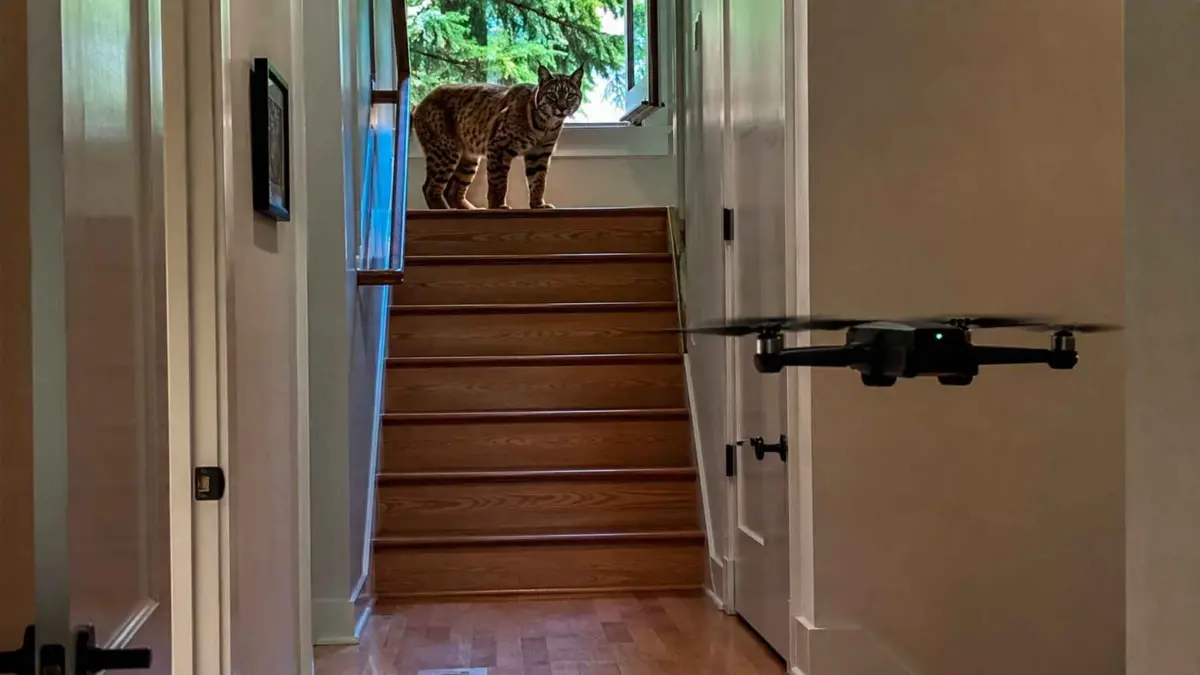
Acting on instinct, the resident dialed 911, prompting a rapid response from the Kirkland Police Department. Officers arrived prepared to confront a suspected burglar, securing the perimeter and entering the dwelling to sweep the rooms. However, the perceived threat turned out to be entirely non-human. Perched regally—and bewilderingly—at the top of the indoor staircase was a wild bobcat (Lynx rufus).
Rather than escalating the situation or attempting a dangerous, old-school physical capture, responding officers utilized cutting-edge police technology. Deploying a drone to monitor the feline’s movements from a safe distance, law enforcement successfully contained the animal in a spare bedroom. Wildlife specialists were subsequently called to the scene, where they sedated the bobcat and transported it to a secure release site near Forbes Creek.
Miraculously, the operation concluded with zero injuries to humans, pets, or the animal itself. The homeowner’s cat, initially unaccounted for during the chaotic ordeal, was later found safe and unharmed, while the bobcat was successfully returned to its natural habitat.
Chronology of Events
The dramatic timeline of the Moss Bay incident highlights how quickly an ordinary night can transform into an unpredictable wildlife encounter.
Phase 1: The Midnight Disturbance
The incident began in the small hours of the morning. The homeowner, resting inside their residence, heard distinct, heavy thuds echoing from downstairs. In a suburban neighborhood where safety is generally taken for granted, the immediate assumption pointed toward criminal activity. Believing an intruder had breached the property, the resident retreated to a safe location, secured a line of communication, and contacted emergency services.
Phase 2: The Tactical Response
Within minutes, patrol units from the Kirkland Police Department arrived at the scene. Treating the call as a standard residential burglary in progress, the officers adopted a tactical posture. They methodically entered the home, weapons drawn, anticipating a confrontation with a human suspect.
As they moved through the lower levels and approached the central staircase, the beam of their flashlights illuminated an unexpected silhouette. There, calmly surveying the officers from the top of the stairs, was a medium-sized wild cat with distinct tufted ears and a bobbed tail—classic markers of a North American bobcat.
Phase 3: High-Tech Containment
The operational objective shifted instantaneously. The mission was no longer about apprehending a criminal; it was about safely extracting an unpredictable apex predator from a confined domestic space without inflicting harm on the animal or putting officers at risk.
Recognizing the danger of cornering a wild feline in a hallway, Kirkland police officers innovated on the fly. Rather than pursuing the animal through the labyrinth of rooms, officers deployed a departmental unmanned aerial vehicle (UAV)—a drone—inside the house. The drone allowed law enforcement to maintain a constant visual lock on the bobcat’s position and track its movements in real-time without making physical contact or provoking defensive aggression.
Through careful, coordinated maneuvering using the aerial perspective, officers gently guided the bobcat into a single, isolated room and secured the door. They then established a holding pattern, sealing off the area while waiting for professional wildlife handlers to arrive.
Phase 4: Sedation and Extraction
Upon arrival, state wildlife specialists assessed the animal’s condition and determined that chemical immobilization was the safest path forward. Entering the room with specialized darting equipment, professionals successfully sedated the bobcat, putting it into a temporary, safe sleep.
The animal was carefully placed into a secure transport crate, lifting it out of the residential environment where it had inadvertently caused such a stir.
Phase 5: The Return to the Wild
With the bobcat safely contained, transport was arranged to a suitable natural habitat. Wildlife officers drove the animal to a protected greenbelt area near Forbes Creek, a local waterway rich in natural cover and prey. As the sedative wore off, the bobcat was released back into the wild, sprinting away into the underbrush to resume its natural life cycle.
Supporting Data and Urban Ecology
While finding a bobcat inside a residential home is exceptionally rare, the presence of wildlife in suburban zones across Washington State is a well-documented and growing phenomenon.
The Urban-Wildland Interface
Washington is home to a robust population of bobcats, which are remarkably adaptable creatures capable of thriving in forests, brushlands, swamps, and even semi-rural and suburban developments. As human populations expand and housing developments encroach deeper into historic wildlife corridors, instances of human-animal proximity naturally increase.
According to state wildlife management data, bobcats are solitary, highly territorial animals. They typically hunt small mammals such as rabbits, rodents, and birds. However, when young bobcats disperse in search of new territory—or when drawn by the presence of backyard chickens, small pets, or accessible shelter—they occasionally venture deep into human settlements.
The Entry Point Hypothesis
Investigators examining the Moss Bay home sought to answer the most pressing question of the morning: How did the animal get inside?
Based on an inspection of the premises, police and wildlife experts concluded that the bobcat likely scaled a mature tree adjacent to the property line. From an overhanging branch, the agile climber accessed an upper-floor window that had been left open to let in the night air. Once inside, the cat descended the interior architecture, inadvertently creating the mysterious thuds that woke the homeowner.
Official Responses and Expert Perspectives
The Kirkland Police Department handled the bizarre call with a blend of professional poise and modern technological savvy. By sharing details of the operation on their official public channels, they turned an anomalous event into an educational opportunity for the community.
"This is not a call we receive every day," noted a departmental representative during post-incident debriefings. The decision to employ a drone inside a residence—while unconventional—was praised by wildlife control experts as a masterclass in risk mitigation. By keeping physical distance between the officers and the stressed animal, the department prevented what could have easily escalated into a dangerous scratch-and-bite scenario or forced a tragic outcome for the animal.
Local wildlife agencies emphasized that urban wildlife sightings are generally harmless if the animals are given adequate space. However, when an animal becomes trapped indoors, professional intervention is mandatory.
"Wild animals experiencing the disorientation of a human home are operating entirely on a fight-or-flight response," explained a regional wildlife biologist not directly involved in the case. "Trying to herd a bobcat out with a broom or a blanket is a recipe for severe injury. The Kirkland police made the exact right call by isolating the animal and waiting for trained handlers."
Implications and Lessons Learned
The Moss Bay bobcat incident serves as a fascinating case study in modern municipal policing, wildlife management, and co-existence in an increasingly crowded world.
The Evolution of Public Safety Tools
The successful use of a tactical drone inside a private residence underscores how rapidly technology is transforming emergency response. Originally designed for outdoor surveillance, tactical reconnaissance, and search-and-rescue operations, drones are proving their worth in indoor environments where line-of-sight is compromised. For wildlife management, utilizing aerial tech inside buildings minimizes human stress markers in wild animals, allowing for smoother, safer resolutions.
Coexisting with Urban Wildlife
For residents living in regions where wildlife is prevalent, the incident offers several practical takeaways:
- Secure Access Points: Keep second-story windows screened and properly latched, especially during warmer months when windows are left open for ventilation.
- Protect Small Pets: Domestic cats and small dogs can attract medium-sized predators. Keeping pets indoors—particularly during twilight and nighttime hours when crepuscular animals like bobcats are most active—greatly reduces the risk of negative encounters.
- Never Attempt Direct Capture: If a wild animal enters a home or enclosed space, citizens should immediately evacuate the room, secure any domestic pets, close interior doors to contain the animal, and call emergency services or local wildlife authorities.
- Avoid Feeding Wildlife: Leaving pet food outdoors or unsecured garbage bins attracts the very prey species (like raccoons and rodents) that draw predators into neighborhoods.
A Happy Ending
Ultimately, the story of the Moss Bay intruder stands out because of its harmonious conclusion. No human was harmed, the homeowner’s cat emerged safe from its hiding spot, the police successfully navigated an unprecedented tactical puzzle, and a wild bobcat was granted a second chance in the forests of Washington State.
As urban centers continue to expand into natural habitats, encounters like this one remind us of the fragile, fascinating balance between human civilization and the wild world that quietly surrounds us.




Leave a Reply