
Main Facts
In late January 2019, a private executive jet touched down on the tarmac of the Ernesto Cortissoz International Airport in Barranquilla, Colombia, arriving directly from Panama. Aboard was Ronald Alexander Ramírez Mendoza, a Venezuelan national poised to assume the presidency of Monómeros, the strategically vital petrochemical company whose control has long been contested between Colombia and Venezuela.
However, Ramírez’s ambitions were abruptly halted. Officials from Migración Colombia intercepted him at the airstrip, notifying him that he was barred from entering the country and would be immediately deported.
Behind this deportation lay an intricate web of international intelligence, corporate espionage, and state-sponsored corruption. According to dossiers compiled since August 2017 by Venezuela’s former Attorney General, Luisa Ortega—who sought asylum in Colombia after fleeing persecution by the Nicolás Maduro administration—Ramírez was merely a proxy. He was acting directly on behalf of two Colombian nationals identified by investigators as primary architects of the Maduro regime’s illicit financial operations and asset laundering networks: Alex Saab and Álvaro Pulido.
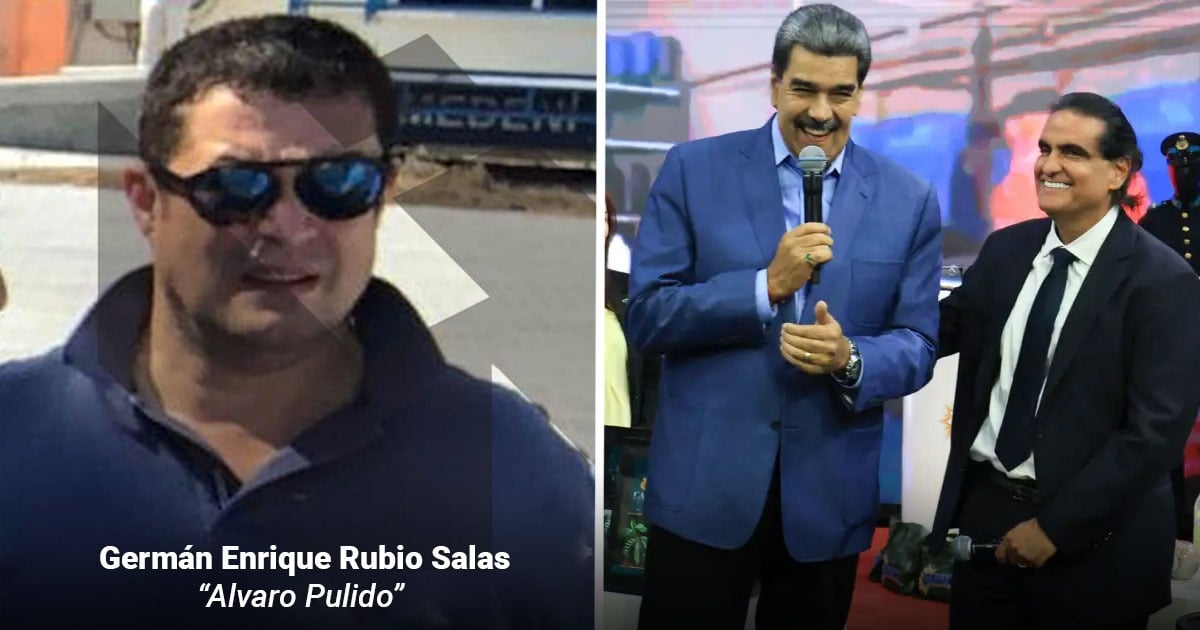
The intelligence dossier painted Saab and Pulido as core frontmen for Nicolás Maduro, backed by a sprawling empire of 36 shell companies in Colombia and complex global financial footprints. Ramírez was intended to serve as a Trojan horse operating out of Barranquilla. From this strategic Colombian port, he would have enjoyed the operational freedom to advance the syndicate’s interests without the mounting scrutiny faced by Saab, who was already under investigation in Colombia for smuggling, tax evasion, and financial crimes.
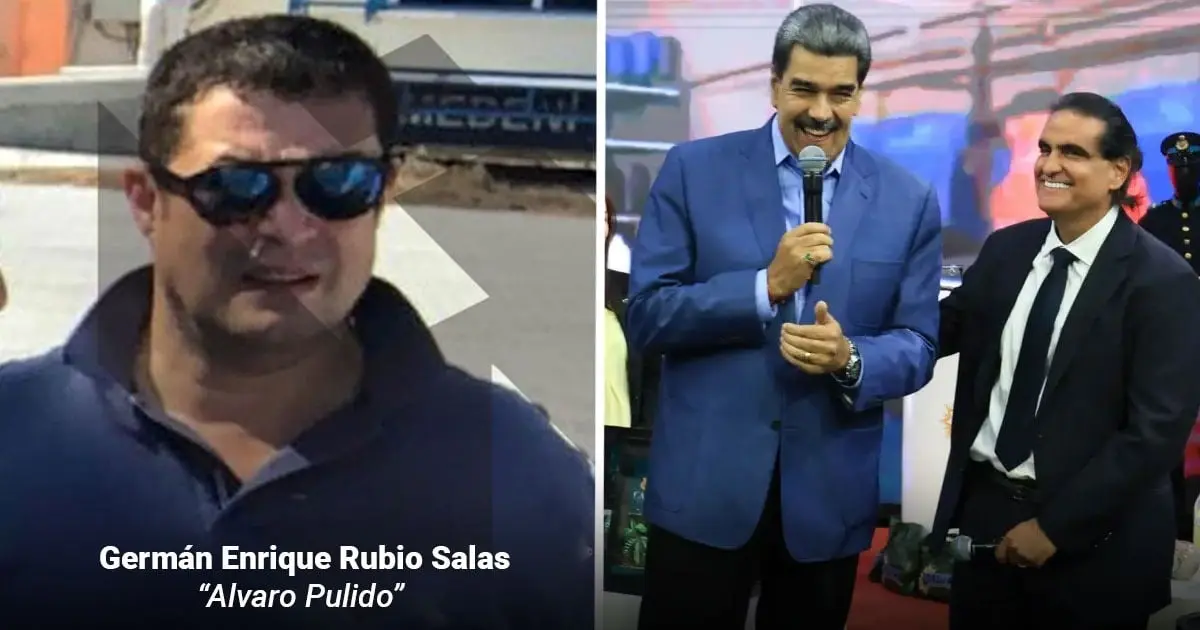
The scaffolding of this criminal enterprise relied on false identities, transnational shell companies, and the systematic looting of Venezuelan state resources. Most notably, Álvaro Pulido—whose real name was uncovered by veteran Colombian journalist Gerardo Reyes as Germán Enrique Rubio Salas—was a convicted drug trafficker with historical ties to the Bogotá cartel and connections to the network of Pablo Escobar. Operating under a stolen identity belonging to a deceased individual, Rubio (alias Pulido) managed multi-million-dollar illicit schemes spanning Ecuador, Europe, Russia, Iran, and Turkey, solidifying his role as one of the most elusive financial masterminds of the 21st-century Venezuelan state capture.
Chronology of an International Conspiracy
To understand how a former drug trafficker and a modest Barranquilla businessman became the financial lifeline of the Maduro regime, one must trace a timeline spanning decades of illicit operations.

1997–2000s: The Narco-Roots and the Birth of a False Identity
- 1997: Germán Enrique Rubio Salas is convicted of drug trafficking in Italy, revealing early ties to high-level South American narcotics distribution networks, including connections to the Bogotá cartel and the orbit of Pablo Escobar.
- The Post-Conviction Shift: Recognizing that a criminal record in Europe would severely limit his global business maneuvers, Rubio acquires the identity and civil registry documents of a deceased Colombian citizen, effectively erasing his past and assuming the name Álvaro Pulido.
2010–2015: The Rise of the Construction and Food Scams
- Early 2010s: Alex Saab and the newly rebranded "Álvaro Pulido" launch the Fondo Global de Construcción (Global Construction Fund). Pulido takes charge of the Ecuadorian chapter of the firm.
- The Ecuadorian Investigation: The Ecuadorian chapter of Fondo Global de Construcción is investigated for fictitious exports nearing $160 million. The case ultimately devolves into a complex legal battle against former Venezuelan bankers whom Pulido accuses of attempting to extort and discredit him.
- The Pdvesa Ingress: The Saab-Pulido duo infiltrates Venezuela’s state-owned oil company, PDVSA, through an unregistered company named Trenaco. They secure multi-million-dollar contracts that the exiled Venezuelan Supreme Tribunal later classifies as blatant money-laundering operations.
- Group Grand Limited: The creation of shell entities continues with Group Grand Limited, later registered in Hong Kong, which becomes heavily involved in procuring food with exorbitant overprices for Venezuela’s Comités Locales de Abastecimiento y Producción (CLAP) subsidized food program.
2017–2019: The Clash Over Monómeros and State Protection
- August 2017: Exiled Venezuelan Attorney General Luisa Ortega begins supplying Colombian and international authorities with comprehensive documentation detailing Saab and Pulido’s role as Maduro’s primary asset launderers.
- January 30, 2019: Ronald Alexander Ramírez Mendoza, handpicked by the Saab-Pulido network to head the Colombian-Venezuelan petrochemical giant Monómeros, is blocked by Migración Colombia at Barranquilla’s Ernesto Cortissoz Airport and deported back to Panama.
- June 2019: The United States Department of Justice formally targets Álvaro Pulido, including him on the Office of Foreign Assets Control (OFAC) Clinton List. Financial regulators outline specific figures: $350 million laundered from construction sector looting and the CLAP food importation racket. Simultaneously, it becomes an open secret that the inner circle is moving Venezuelan state gold reserves to Russia, Iran, and Turkey.
2020–2026: Arrests, Extraditions, and the Collapse of Impunity
- June 2020: Alex Saab is arrested in Cabo Verde during a refueling stop while traveling on a private jet carrying a cargo of Venezuelan gold. He is later extradited to the United States.
- Early October 2026: Following the political shifts in Venezuela, Germán Rubio (alias Álvaro Pulido) is captured in Venezuela by U.S. Drug Enforcement Administration (DEA) agents who travel directly into the country to apprehend him. He is swiftly extradited to the United States.
- Present Day: Pulido joins Saab in a U.S. federal detention facility, facing monumental money-laundering charges. Legal analysts note that Pulido’s capture provides federal prosecutors with a critical wildcard: a witness willing to testify not only against Saab, but directly against Nicolás Maduro.
Supporting Data and Financial Engineering
The mechanics of the Saab-Pulido network relied upon a sophisticated corporate matrix designed to obscure the origins of immense state funds while bleeding the Venezuelan economy dry. Investigative reports, journalistic findings by authors like Gerardo Reyes, and indictments from the U.S. Department of Justice highlight several key vectors of financial extraction:
- The 36-Company Matrix: In Colombia alone, Alex Saab established a network of at least 36 front companies. These entities were utilized to blur the lines between legitimate international trade and illicit capital flows, serving as a staging ground for asset accumulation and money laundering.
- The $350 Million CLAP and Construction Scheme: According to U.S. Treasury and DOJ metrics, Pulido and Saab engineered a massive overpricing scheme centered on the importation of basic foodstuffs for the CLAP program. By inflating invoices by several hundred percent, the syndicate siphoned an estimated $350 million, routing the proceeds through shell companies in Hong Kong, Europe, and Central America.
- The Ecuadoran Fictitious Export Scheme: Through the Fondo Global de Construcción, the duo orchestrated a $160 million fraudulent export operation between Colombia and Ecuador, utilizing a web of paper companies that existed solely to generate invoices and capture government-allocated foreign exchange at preferential rates.
- Gold-for-Goods and State Reserve Looting: Investigative trails confirmed that as traditional banking avenues closed due to international sanctions, the syndicate pivoted to physical commodities. Venezuelan gold reserves were routinely flown out of the country on private aircraft, traded through intermediaries in Turkey, the United Arab Emirates, Iran, and Russia, and converted into liquid assets to sustain the regime’s loyalists and elite enforcers.
- The Monómeros Valuation: The strategic value of Monómeros cannot be overstated. At the height of diplomatic discussions, former Colombian Minister Armando Benedetti publicly announced that Colombia intended to purchase Monómeros for $300 million—a transaction that ultimately collapsed amid regulatory hurdles, political friction, and the unmasking of the proxy network attempting to infiltrate the boardroom.
Official Responses and Geopolitical Fallout
The dismantling of the Saab-Pulido financial apparatus has triggered profound ripples across diplomatic and legal channels in Washington, Bogotá, and Caracas.
The United States Department of Justice and DEA
For U.S. federal prosecutors, the arrest and extradition of Germán Rubio (Álvaro Pulido) represents the culmination of a decade-long cross-border investigation. While Alex Saab’s defense hinged heavily on his disputed diplomatic status granted by Caracas—a maneuver rendered largely ineffective after his capture in Cabo Verde and subsequent transfer to Florida—Pulido’s legal posture is vastly different. Because Pulido was extracted directly from Venezuela following shifting political dynamics, legal experts suggest he holds few loyalties to the current Miraflores leadership. U.S. authorities view Pulido as a cooperating witness capable of bridging the evidentiary gap between corporate frontmen and the highest echelons of the Venezuelan government.

The Colombian Judiciary and Migration Authorities
Migración Colombia’s decisive action in January 2019 to block Ronald Ramírez at the Barranquilla airport marked a critical turning point in protecting national critical infrastructure from foreign criminal capture. Concurrently, Colombian investigative bodies, including the Fiscalía General de la Nación, have systematically moved to seize properties, mansions, and commercial assets linked to the syndicate. Notable legal actions—such as asset forfeiture proceedings targeting the luxurious Barranquilla mansion and other real estate holdings associated with Saab’s inner circle—demonstrate a concerted effort by Colombian authorities to purge domestic financial systems of illicitly acquired capital.
The Exiled Venezuelan Judiciary
The legitimate, exiled members of the Venezuelan Supreme Tribunal and former high-ranking state officials, such as former Attorney General Luisa Ortega, played a foundational role in exposing the syndicate. By providing international prosecutors with internal banking records, corporate registries, and wire transfer logs as early as 2017, the Venezuelan diaspora laid the groundwork that allowed U.S. and Colombian agencies to map the transnational movement of billions of dollars.
Implications
The unmasking of Germán Rubio’s true identity and his subsequent extradition alongside Alex Saab carries sweeping implications for international geopolitics, anti-money laundering enforcement, and the future of Venezuelan governance.
- The Collapse of Diplomatic Immunity as a Shield: The case serves as a watershed precedent proving that authoritarian regimes can no longer shield transnational criminals simply by conferring diplomatic titles, ambassadorial status, or state-sanctioned corporate appointments. International judicial cooperation and targeted financial sanctions have effectively pierced the veil of sovereign protection.
- Accelerated Legal Pressures on Caracas: With both Saab and Pulido in U.S. custody—and Pulido potentially positioned as a high-value cooperating witness—the evidentiary wall surrounding Nicolás Maduro and his inner circle has grown significantly denser. The detailed operational knowledge Pulido possesses regarding Pdvesa contracts, CLAP kickbacks, and state gold-smuggling routes provides prosecutors with an unprecedented roadmap of state capture.
- Protection of Critical Transnational Infrastructure: The blocking of Ronald Ramírez at the Barranquilla airport underscores the ongoing vulnerability of cross-border industrial assets like Monómeros. The incident highlights the necessity for rigorous corporate governance and intelligence-sharing between neighboring nations to prevent state-owned or state-influenced enterprises from being weaponized as laundering vehicles or geopolitical Trojan horses.
- The End of an Era for Shadow Networks: The saga of Rubio and Saab demonstrates the ultimate fragility of criminal empires built on stolen identities, shell companies, and state patronage. What began as low-level drug trafficking in 1990s Italy evolved into a multi-billion-dollar state-looting operation, only to collapse under the weight of investigative journalism, whistleblowers, and unyielding international justice.