

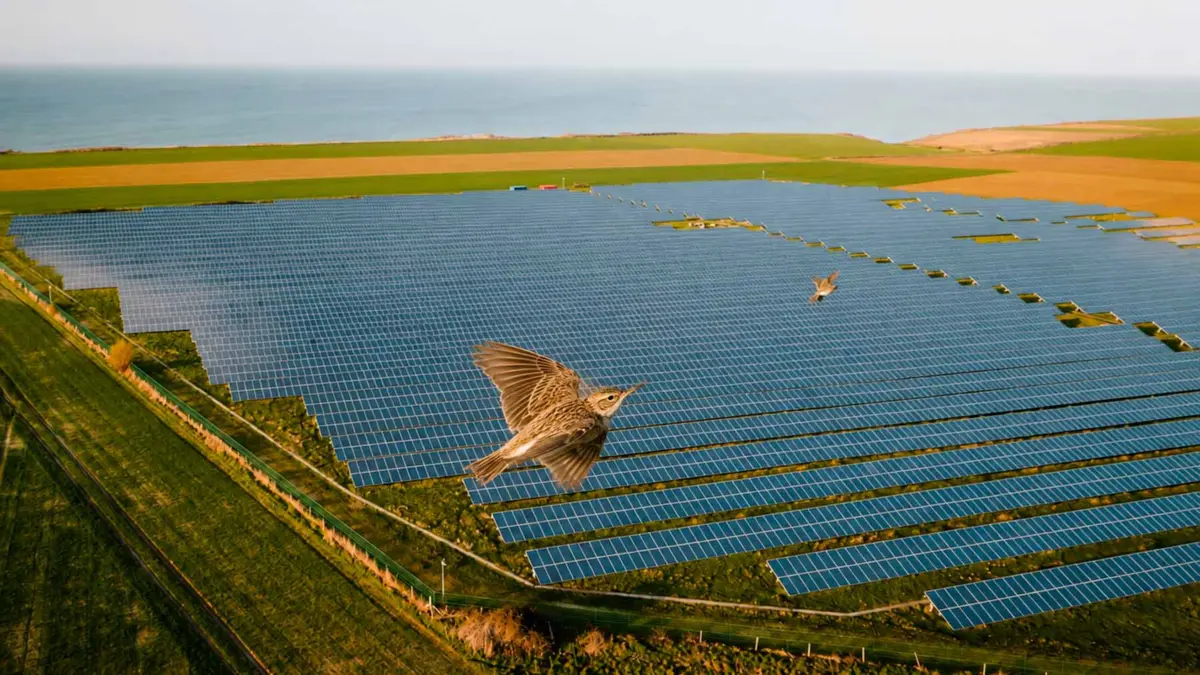
LAUTERBACH, HESSE — Where the sharp roar of heavy diesel tractors and the chemical sting of synthetic fertilizers once dominated the rural landscape, a remarkably different auditory experience now prevails. Across 55 hectares of rolling terrain in the central German region of Hesse, the predominant soundscape is defined not by heavy industry or intensive agriculture, but by the trilling, complex songs of dozens of protected bird species.
This acoustic metamorphosis is the result of a pioneering transformation in Lauterbach, where a sprawling tract of intensively farmed agricultural land was systematically converted into a utility-scale photovoltaic solar park, completed in 2022. Far from sterilizing the ecosystem—a common criticism historically leveled against large-scale renewable energy developments—this project has yielded an environmental paradox: clean energy infrastructure acting as an unexpected catalyst for ecological restoration.
By removing the land from intensive agricultural cycles and implementing targeted biodiversity management plans, the developers and environmental consultants behind the Lauterbach project have demonstrated that the green energy transition and environmental conservation are not mutually exclusive pursuits. In fact, when thoughtfully designed, they can act as powerful mutual allies.
Main Facts: The Lauterbach Photovoltaic Project
The Lauterbach solar park spans 55 hectares of land in Hesse, Germany, an area historically subjected to intensive agricultural exploitation. Developed and operated by renewable energy firm Enerparc, the site was conceived not merely as a power-generation asset, but as an integrated landscape capable of hosting both technological infrastructure and native flora and fauna.
The core finding of the multi-year environmental monitoring program conducted at the site centers on the Eurasian skylark (Alauda arvensis). Prior to the construction of the solar installation, baseline ecological assessments mapped between four and five skylark territories across the entire acreage. Following the cessation of plowing, the elimination of chemical agrochemicals, and the introduction of native low-growing vegetation and specialized wildflower strips between the solar panel rows, the avian population experienced a dramatic surge.
By 2025, advanced acoustic monitoring systems recorded an astounding 20 distinct skylark territories within the boundaries of the solar park—a four-to-fivefold increase over baseline pre-construction levels.
Furthermore, the skylark is not alone in its resurgence. Comprehensive ecological censuses have documented the return and establishment of several other high-priority conservation species. These include the northern wheatear (Oenanthe oenanthe), the common quail (Coturnix coturnix), the European stonechat (Saxicola rubicola), and the whinchat (Saxicola rubetra), alongside multiple native lizard populations.
The primary takeaway is clear: when the industrial management of soil is replaced with ecological stewardship, solar parks can function as protected sanctuaries, offering safe nesting grounds, abundant insect life, and refuge from the pressures of modern, hyper-industrialized farming.
Chronology of Transformation: From Agrochemicals to Artificial Intelligence
To understand how a commercial solar facility became a thriving wildlife habitat, it is necessary to examine the chronological evolution of the Lauterbach site over the past decade.
2018–2019: Baseline Mapping and Industrial Agriculture
Before a single photovoltaic module was manufactured or a concrete pile driven into the Hessian soil, the environmental consultancy firm Plan Ö was commissioned to conduct a comprehensive fauna and flora mapping of the 55-hectare agricultural tract. At this stage, the land was managed under intensive agricultural regimes. Heavy machinery routinely compressed the soil, seasonal plowing destroyed ground-nesting microhabitats, and the regular application of chemical fertilizers and pesticides decimated local insect populations—the foundational trophic level required by ground-nesting birds. Consequently, biological diversity was severely suppressed, with field observers identifying a meager four to five territories belonging to the Eurasian skylark.
2020–2022: Construction and Habitat Restructuring
Following regulatory approvals, Enerparc initiated construction of the photovoltaic plant, bringing the facility to full operational status in 2022. Crucially, the construction phase was paired with a deliberate shift in land management policy. Rather than paving over the soil or maintaining barren gravel between the panel rows—practices unfortunately common in early-generation solar developments—the project operators allowed natural low-growing vegetation to regenerate. In addition, targeted wildflower strips were sown across strategic open spaces. The spacing between the rows of solar modules was specifically calibrated to provide ample clearance for the territorial flight patterns of local avian species.
2023–2024: Post-Construction Monitoring and Early Indicators
In the immediate wake of plant completion, annual environmental impact assessments were instituted to track how local ecosystems adapted to the physical presence of the solar arrays. Early visual censuses and manual acoustic checks indicated a steady stabilization of wildlife numbers. Without the disruptive cycles of tilling and chemical spraying, soil biology began to recover, leading to a rapid rebound in earthworm and insect populations, which in turn drew in insectivorous and granivorous birds.
2025: Integration of Artificial Intelligence and Acoustic Sensors
By 2025, the monitoring methodology underwent a technological leap forward. Enerparc partnered with specialized tech firms Hula Earth and AviCon to deploy a cutting-edge artificial intelligence and acoustic monitoring system. Advanced acoustic sensors were strategically distributed throughout the 55-hectare park to continuously record the ambient soundscape.
Rather than relying solely on sporadic, human-led field observations, sophisticated machine-learning algorithms processed thousands of hours of audio data. These algorithms were trained to identify, isolate, and map the specific vocalizations of birds in real time, accurately pinpointing territorial boundaries across the entire park. The results of this high-tech audit revealed the dramatic spike to 20 skylark territories, providing empirical, data-driven validation of the habitat’s success.
Supporting Data: Numbers Behind the Recovery
The success of the Lauterbach solar park is anchored in quantifiable ecological metrics. While anecdotal observations of wildlife near industrial sites are common, the Lauterbach project offers robust data sets that illustrate the direct correlation between land-use change and population recovery.
| Metric | Pre-Construction (2018–2019) | Post-Construction (2025) | Percentage Change / Impact |
|---|---|---|---|
| Primary Land Use | Intensive agriculture (plowed fields, chemicals) | Photovoltaic solar park with ecological fallow management | Complete elimination of chemical fertilizers and heavy tilling |
| Skylark Territories | 4 – 5 territories | 20 territories | +300% to +400% increase in local breeding density |
| Monitoring Methodology | Manual visual mapping by human observers | AI-driven acoustic sensors (Hula Earth & AviCon) | Real-time audio data processing and automated mapping |
| Additional Species Recorded | Negligible / highly transient | Northern wheatear, common quail, stonechat, whinchat, multiple lizard species | Establishment of multiple IUCN-red-listed and conservation-priority species |
| Total Land Area | 55 hectares | 55 hectares | Dual-purpose utilization for clean energy generation and biodiversity conservation |
The statistical leap in skylark numbers is particularly significant when contextualized within broader European trends. Across much of Western Europe, agricultural intensification, habitat fragmentation, and the widespread use of pesticides have driven steep declines in farmland bird populations over the past several decades. The reversal of this trend within a utility-scale industrial energy facility underscores the untapped ecological potential of solar parks when managed correctly.
Official Responses and Stakeholder Perspectives
The findings at Lauterbach have drawn considerable attention from energy developers, environmental scientists, and regulatory bodies alike, prompting a dialogue regarding the future design of renewable energy infrastructure.
Enerparc, the developer and operator of the Lauterbach facility, has pointed to the monitoring data as a vindication of its corporate sustainability strategy. Company representatives have emphasized that integrating ecological considerations into engineering blueprints does not compromise energy yields; rather, it creates a social and environmental license to operate that is increasingly demanded by local communities and planning authorities.
However, independent ecologists and industry watchdogs maintain a pragmatic perspective regarding the data. Because a significant portion of the monitoring initiatives and subsequent data dissemination was spearheaded or supported by the site’s operator, academic and independent conservation groups stress the necessity for long-term, third-party oversight.
Specialists in avian conservation note that these positive trends are contingent upon sustained, long-term ecological management. If operators were to abandon the maintenance of wildflower strips, permit unchecked overgrowth of invasive woody species, or reintroduce mechanical mowing during sensitive nesting seasons, the fragile gains achieved by species like the skylark could quickly erode.
Consequently, ecological experts advocate for legally binding biodiversity management plans as a standard requirement for all future solar park permits, ensuring that developers remain accountable to environmental benchmarks long after construction crews have left the site.
Broader Implications: Redesigning the Energy Landscape of Tomorrow
The transformation of the Lauterbach agricultural tract into a thriving avian sanctuary carries profound implications for the global transition toward renewable energy. As governments worldwide accelerate the build-out of solar infrastructure to combat climate change, project developers frequently encounter local pushback centered on land use conflicts, habitat destruction, and the visual or ecological disruption of rural landscapes.
The Lauterbach model offers a blueprint for resolving these conflicts through a concept increasingly known as agrivoltaics or ecovoltaics—the intentional integration of ecological enhancement within energy generation sites. By shifting away from the paradigm of the sterile industrial compound, solar developers can transform multi-hectare footprints into ecological stepping stones and wildlife corridors.
Key Takeaways for Future Solar Infrastructure:
- Rethinking Soil Management: The cessation of intensive chemical agriculture allows degraded soils to recover their organic structure. When soils are left undisturbed beneath and between solar panels, subterranean microfauna, earthworms, and beneficial insects rapidly reestablish themselves.
- Acoustic AI as a Conservation Tool: The successful deployment of AI-driven acoustic sensors in Lauterbach demonstrates how modern technology can streamline environmental monitoring. Automated bioacoustic surveillance provides high-resolution data on species presence and density without the high costs and logistical limitations of continuous manual field surveys.
- Designing for Mobility: Structural considerations—such as maintaining adequate row spacing and managing panel elevation—can ensure that ground-dwelling and low-flying birds retain the open flight paths and nesting spaces they require to thrive.
- Coexistence of Clean Energy and Biodiversity: The simultaneous presence of endangered birds, reptiles, and clean solar electrons proves that decarbonization and biodiversity conservation can be mutually reinforcing goals.
As society looks toward an energy future dominated by renewables, projects like the one in Lauterbach, Hesse, challenge preconceived notions about industrial land use. They suggest that with thoughtful design, regulatory foresight, and ecological stewardship, the clean energy transition can do more than merely lower carbon emissions—it can actively restore the frayed threads of local ecosystems, proving that the silent hum of clean electricity can harmonize perfectly with the resilient songs of the natural world.


Leave a Reply