

Main Facts: A Mid-September Heat Crisis
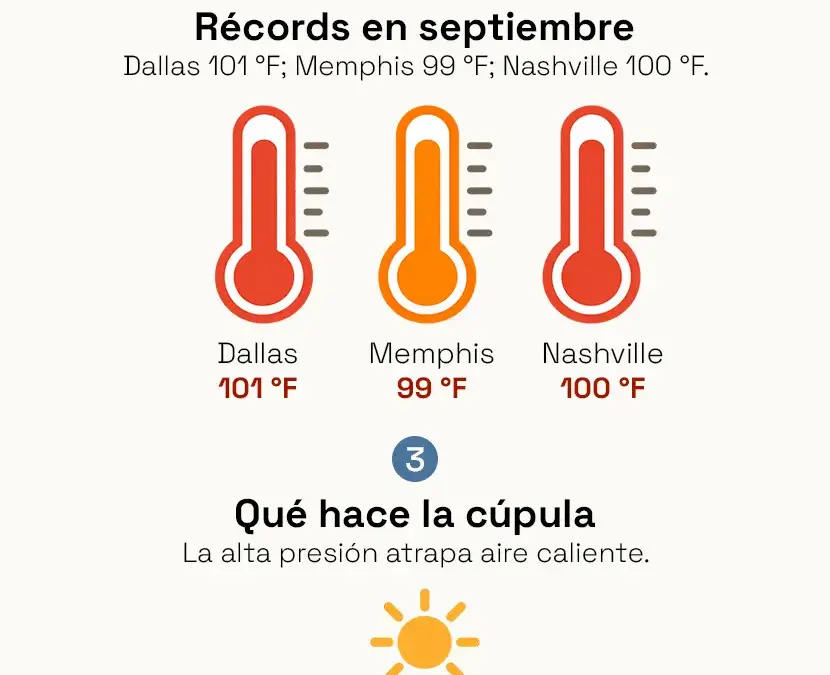
As the astronomical transition toward autumn approached in mid-September 2026, millions of residents across the central and southern United States braced not for crisp morning air and falling leaves, but for a suffocating wave of mid-summer heat. On September 15, 2026, standard meteorological calendars collided with a brutal atmospheric reality: Dallas reached 101°F (38°C), Memphis climbed to 99°F (37°C), and Nashville scorched at 100°F (38°C). These readings were not mere daily fluctuations; they shattered historical baselines, soaring at least 12 degrees Fahrenheit (nearly 7 degrees Celsius) above normal seasonal averages.
More than 41 million people—representing approximately 12 percent of the total U.S. population—woke up under extreme heat advisories, watches, and warnings issued by the National Weather Service (NWS). This was not a localized anomaly or a brief afternoon spike. It was a massive, stubborn atmospheric phenomenon gripping an entire geographic swath of the nation, defying the calendar and forcing cities unaccustomed to such extreme late-season thermal stress to activate emergency cooling measures.
The culprit behind this meteorological defiance was a classic yet intensely potent "heat dome." By trapping high-pressure systems in the upper atmosphere, the region was subjected to a stifling lid that suppressed cloud formation, maximized solar radiation, and turned the lower troposphere into an atmospheric oven. Coming on the heels of what federal agencies officially declared the hottest summer in 132 years of modern record-keeping, this September heat crisis highlighted an escalating global trend: seasons are blurring, summers are stretching deeper into the calendar, and extreme heat events are becoming more persistent, unpredictable, and dangerous.
Chronology of an Atmospheric Trap
To understand how the central and southern United States became locked in this unseasonable oven, climatologists trace a sequence of events that began long before the middle of September.
Early September 2026: The Persistence of Summer
Entering September, long-range forecasts predicted a slow tapering of the relentless summer temperatures that had scorched the nation since June. However, instead of the expected cold fronts pushing down from Canada to clear out the stagnant tropical airmasses, a stubborn high-pressure ridge began building over the Southern Plains and expanding eastward into the Mississippi River Valley.
September 12–14, 2026: The Ridge Strengthens
By the second week of the month, the high-pressure system intensified into a full-scale heat dome. Atmospheric circulation patterns stalled, creating a blocking pattern that prevented normal jet-stream dips from bringing relief. Surface winds dropped to a near-calm, and humidity levels remained stubbornly high due to moisture flowing inland from the Gulf of Mexico. This combination created soaring heat indices, making the air feel significantly hotter than the raw thermometer readings.
September 15, 2026: Records Fall and NASA Publishes the Map
The crisis reached its peak on September 15. At 4:00 p.m. Central Time, the National Aeronautics and Space Administration (NASA) released a stark air temperature map of the contiguous 48 states. Generated by combining space-based satellite observations with the Goddard Earth Observing System (GEOS) mathematical model, the visualization left no room for misinterpretation.

A massive blood-red swath—indicating temperatures approaching or exceeding 40°C (104°F)—covered Texas, Oklahoma, Arkansas, Missouri, and Tennessee. Major metropolitan areas recorded unprecedented numbers for the mid-September timeframe. Dallas hit 101°F, Memphis reached 99°F, and Nashville touched a staggering 100°F. Nashville’s high temperature broke a daily record that had stood for nearly a century, dating back to 1927. Compounding the daytime misery, Nashville also recorded a minimum nighttime low of 75°F (24°C), failing to provide residents with even nocturnal respite.
September 16–20, 2026: Protracted Suffering and Slow Decay
The high-pressure dome proved remarkably resilient, holding its ground for nearly a week past the initial peak. Urban centers activated public cooling centers, while local school districts in several states adjusted outdoor athletic schedules and recess times. It was not until late in the third week of September, as a weak upper-level trough finally managed to erode the edges of the high-pressure ridge, that temperatures slowly drifted back toward seasonal norms.
Supporting Data and Climatological Context
The mid-September heat event did not occur in a vacuum. It was the explosive climax of a historically warm year, backed by rigorous data from federal agencies and satellite observations.
The Hottest Summer in 132 Years
According to data released by the National Oceanic and Atmospheric Administration (NOAA), the three-month meteorological summer spanning June through August 2026 was officially the hottest observed across the contiguous United States in 132 years of record-keeping.
- Breaking Previous Benchmarks: The summer of 2026 surpassed previous record-holding years—specifically the Dust Bowl summer of 1936 and the recent high-heat year of 2021—by a margin of 0.4°F.
- Statistical Significance: While a fraction of a degree might seem negligible to the general public, climatologists emphasize that shifting the average temperature of an entire nation upward over a three-month span by nearly half a degree represents a massive injection of thermal energy into the climate system.
Satellite and Modeling Insights
The integration of NASA’s GEOS model with satellite radiometer data provided researchers with unprecedented insights into how heat domes evolve. Satellites measure outgoing longwave radiation and skin temperatures of the Earth’s surface, allowing scientists to track how trapped heat accumulates day after day in the absence of convective clouds. Without afternoon thunderstorms—nature’s primary air conditioner in the American South—the bare soil and urban asphalt baked continuously, recycling and magnifying the atmospheric heat through a process of surface-atmosphere feedback loops.
Official Responses and Public Health Implications
As millions of citizens found themselves under extreme heat alerts during a month traditionally associated with cooling weather, public health officials and emergency management agencies scrambled to respond to a hazard traditionally underestimated by the public in the fall.
Protecting Vulnerable Populations
Public health departments issued urgent advisories emphasizing that human physiology does not recognize the calendar. Heat stroke, heat exhaustion, and cardiovascular strain do not care whether it is July or September.

- High-Risk Groups: The elderly, homeless populations, individuals with chronic medical conditions, and outdoor laborers faced acute danger.
- The Energy Divide: Officials noted severe disparities in vulnerability, particularly among lower-income communities and renters lacking reliable air conditioning or facing prohibitive utility costs. In response, municipal governments in cities like Dallas and Nashville extended the operating hours of public cooling shelters, which are typically dismantled or scaled back after Labor Day.
Institutional Warnings and Preparedness
The National Weather Service, alongside academic researchers, utilized social media and mobile alert systems to combat "heat fatigue"—a psychological phenomenon where populations grow desensitized to frequent warnings after a long summer. Meteorologists stressed that late-season heat domes are exceptionally treacherous because populations naturally lower their guard as autumn approaches, often reducing hydration efforts or failing to check on elderly neighbors.
Implications for the Future: A New Normal
The September 2026 heat event serves as a glaring warning sign regarding the changing nature of regional climates in North America. As global temperatures continue to rise due to anthropogenic greenhouse gas emissions, the boundaries separating distinct meteorological seasons are blurring.
Lengthening Summers and Shifting Baselines
Climatological studies increasingly show that summers are beginning earlier in the spring and lingering much deeper into what historically counted as autumn. This phenomenon compresses the window for cold-weather recovery, strains regional power grids due to prolonged high electricity demand for air conditioning, and places immense pressure on agricultural sectors already dealing with soil moisture depletion and drought stress.
The Role of Advanced Monitoring
The ability of NASA and NOAA to map and track these heat domes in near-real time represents a critical technological triumph. Early detection systems allow meteorologists to pinpoint exactly where atmospheric blocks are forming, giving municipal leaders a window of days to prepare vulnerable communities. However, as experts continually point out, advanced satellite data and predictive models are only as effective as the ground-level infrastructure built to handle them.
Adapting Infrastructure for Unbounded Heat
Ultimately, the central and southern United States face a sobering structural question. If heat domes can effectively erase September and turn autumn into an extension of mid-summer, local infrastructure must evolve. Cities will need to rethink urban heat island mitigation—investing heavily in reflective roofing, expanded urban tree canopies, resilient power grids, and permanent, accessible cooling infrastructure.
Until such adaptations are fully realized, millions of Americans will remain vulnerable to weather patterns that continue to ignore the calendar, proving that the climate of the future has already arrived.



Leave a Reply