

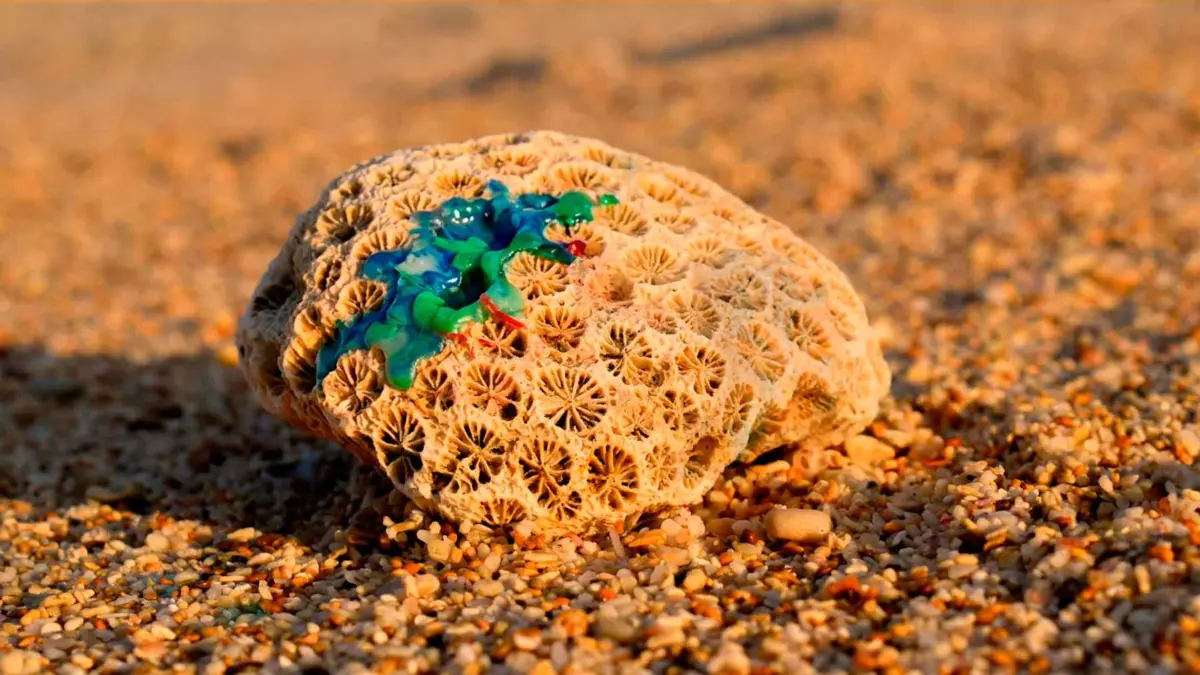
OKINAWA, JAPAN — In an era where the human footprint on Earth is increasingly written in synthetic compounds, marine scientists have uncovered a disturbing new geological anomaly along the pristine shores of Japan. Researchers analyzing debris on Okinawan beaches have discovered fragments of dead coral skeletons intricately fused with melted plastic—a hybrid material they have officially dubbed "plasticoral."
This startling discovery, documented by a collaborative team of researchers from the Okinawa Institute of Science and Technology (OIST) and international institutions, sheds light on the insidious ways anthropogenic waste is altering marine environments. Far from being a mere surface-level nuisance, this new form of biogenic-plastic agglutinate forces scientists to confront a sobering reality: even in death, coral reefs are being consumed by the relentless tide of global plastic pollution.
Main Facts: What is a Plasticoral?
The discovery centers on five small, unassuming fragments of dead coral collected across three distinct beaches in Okinawa, including Ibu and Sosu within the picturesque Yanbaru National Park. Ranging in size to roughly the breadth of an inch, these skeletal remnants initially caught the attention of researchers who were cataloging shoreline marine debris.
At first glance, the specimens appeared to be ordinary bleached coral fragments worn down by the elements. However, upon closer laboratory inspection, scientists made a chilling observation: bright, vibrant flashes of color were deeply embedded within the porous matrix of the coral calcium carbonate.
- The Composition: Advanced laboratory analyses revealed that common thermoplastics—specifically polyethylene and polypropylene—had penetrated the microscopic pores of the dead coral skeletons.
- The Fusion: The plastic was not merely adhered to the exterior; it had liquefied, flowing into the internal architecture of the coral almost like liquid wax before solidifying.
- Classification: Researchers have classified plasticorals as a novel type of plastiglomerate—a broader category of geological materials held together by molten plastic.
Crucially, scientists emphasize that this phenomenon does not involve plastic growing inside living reef organisms in the open ocean. Rather, it represents the physical amalgamation of discarded synthetic waste with dead, washed-ashore biogenic structures.
Chronology: How the Discovery Unfolded
The unearthing of plasticorals was a textbook example of serendipity meeting rigorous scientific inquiry.
- The Fieldwork: Marine debris monitoring programs routinely comb Okinawa’s coastlines to track the accumulation of trash washing ashore from East Asian currents and local sources. During one such routine survey, researchers noticed anomalous discolorations on white, weathered coral fragments.
- The Laboratory Phase: Suspecting something unusual, the team transported the specimens back to the laboratory. High-resolution imaging and spectroscopic analysis exposed the truth: the bright spots were not marine pigments or algae, but industrial polymers deeply integrated into the coral’s skeletal pores.
- The Hypothesis of Origin: Investigators immediately sought to understand how plastic could penetrate solid calcium carbonate in such a manner. The leading working hypothesis points to beach campfires. One of the critical coral specimens was recovered directly from the ash bed of an improvised fire pit on the sand.
- The Mechanism: Scientists theorize that when individuals burn beach debris—which frequently includes single-use plastic packaging, bottles, and bags—the intense heat liquefies the polymers. This molten plastic runs down into the ashes, where it encounters weathered coral fragments scattered on the beach, vacuuming into their microscopic pores under thermal pressure.
- Publication: The findings were formally detailed in a landmark study published in the Marine Pollution Bulletin (Volume 233, 2026), authored by I. Ilechukwu, M. Stoeltje, E. Conn, G. Mironenko Castelló, J. Jolly, K. Fujita, T. Ravasi, and J. D. Reimer.
Supporting Data and the Threat of the ‘Plasticene’
While only five plasticoral specimens have been formally described in this initial discovery, their existence opens a Pandora’s box of ecological and geological questions.
The implications stretch far beyond a localized litter problem. Geologists and environmental scientists increasingly argue that humanity has ushered in a new epoch: the "Plasticene." Because mass-produced synthetic polymers degrade at vanishingly slow rates—often persisting for centuries or millennia—they are destined to become permanent markers in the stratigraphic record. Future generations of geologists will find synthetic strata embedded in sedimentary layers worldwide; plasticorals represent a grotesque biological-industrial hybrid fossil of this epoch.
Furthermore, the physical nature of these fragments raises immediate ecological concerns. Dead coral skeletons on beaches are not ecological dead ends. When winter storms or shifting tides sweep these fragments back out into the marine environment, they serve vital ecological functions:
- Settling Substrates: Free-floating coral larvae actively seek out hard, textured surfaces upon which to settle and initiate new colonies.
- Marine Refugia: The porous cavities of coral fragments provide essential hiding spots and micro-habitats for juvenile fish, crabs, and invertebrates.
When these fragments return to the water carrying fused synthetic polymers, they introduce unknown variables directly into vulnerable coral reef ecosystems.
Official Responses and Scientific Caution
The research team at OIST has maintained rigorous scientific objectivity, explicitly noting that they did not directly measure the acute toxicological impacts of plasticorals on marine fauna during this initial study.
However, existing literature on marine plastic pollution provides ample cause for alarm. Numerous peer-reviewed studies have demonstrated that common plastics leach hazardous chemical additives—such as plasticizers, heavy metals, and flame retardants—into surrounding environments. When these chemicals come into contact with sensitive marine organisms, they can disrupt endocrine systems, impair fertilization, and bleach living corals.
Additionally, plastic debris in marine environments acts as a synthetic raft, frequently transporting invasive species and microbial pathogens across ocean basins. Whether the plasticorals found in Okinawa are currently leeching toxins or harboring pathogens remains an open question—and the primary focus of ongoing research.
"We have only scratched the surface of how anthropogenic polymers are integrating into natural marine structures," the research team noted in their study. "Questions regarding the true spatial distribution of plasticorals, the exact role of beach fires versus other thermal sources, and their ultimate fate upon returning to the reef remain critical gaps in our knowledge."
Broader Implications for Global Conservation
The discovery of plasticorals in Yanbaru National Park—a designated UNESCO World Heritage site celebrated for its rich biodiversity—serves as a stark reminder that no corner of the natural world remains untouched by human consumption.
Okinawa sits at a complex crossroads of ocean currents that deposit immense volumes of marine debris from across East Asia, compounding local litter issues caused by coastal recreation. The practice of burning beach trash, while often seen as a localized method of tidying up the shoreline, inadvertently creates a chemical alchemy, fusing petrochemical waste with the remnants of marine life in ways nature never intended.
As researchers prepare for follow-up studies to quantify the prevalence of plasticorals globally, the scientific community faces a mounting challenge. The boundary between the natural world and human waste is blurring at a molecular level.
For conservationists, policymakers, and coastal communities, the "plasticoral" is more than an odd laboratory curiosity; it is a physical manifesto of an epoch defined by excess—a permanent scar left by humanity on the very framework of the sea.


Leave a Reply