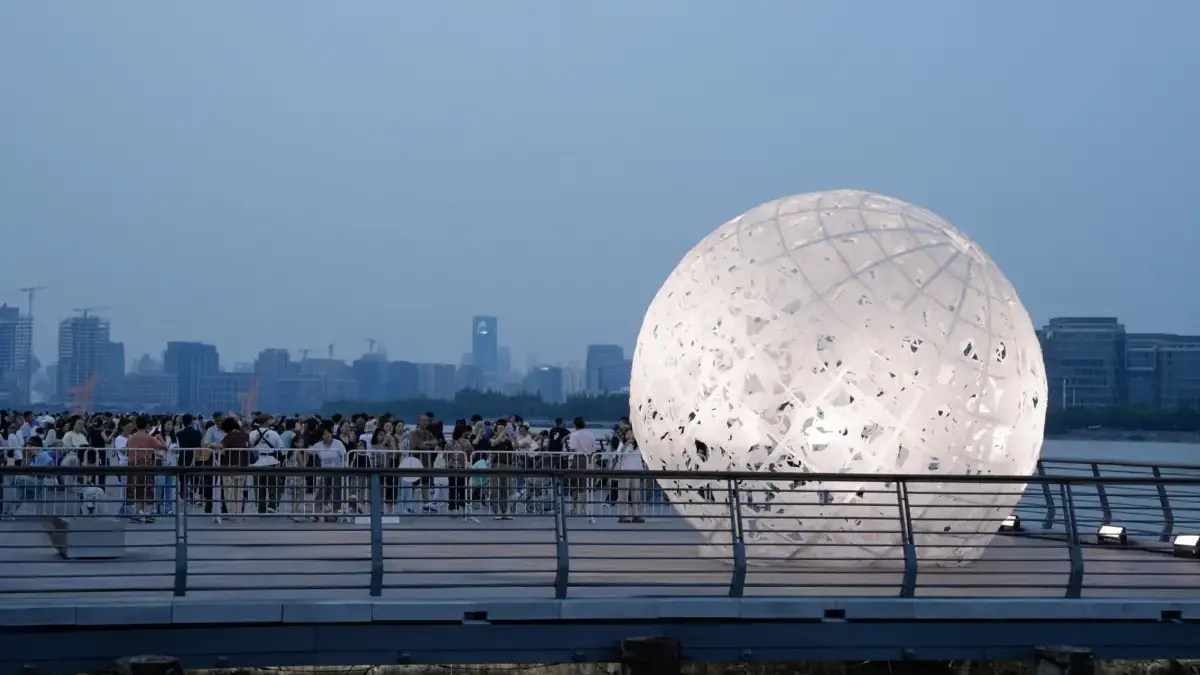
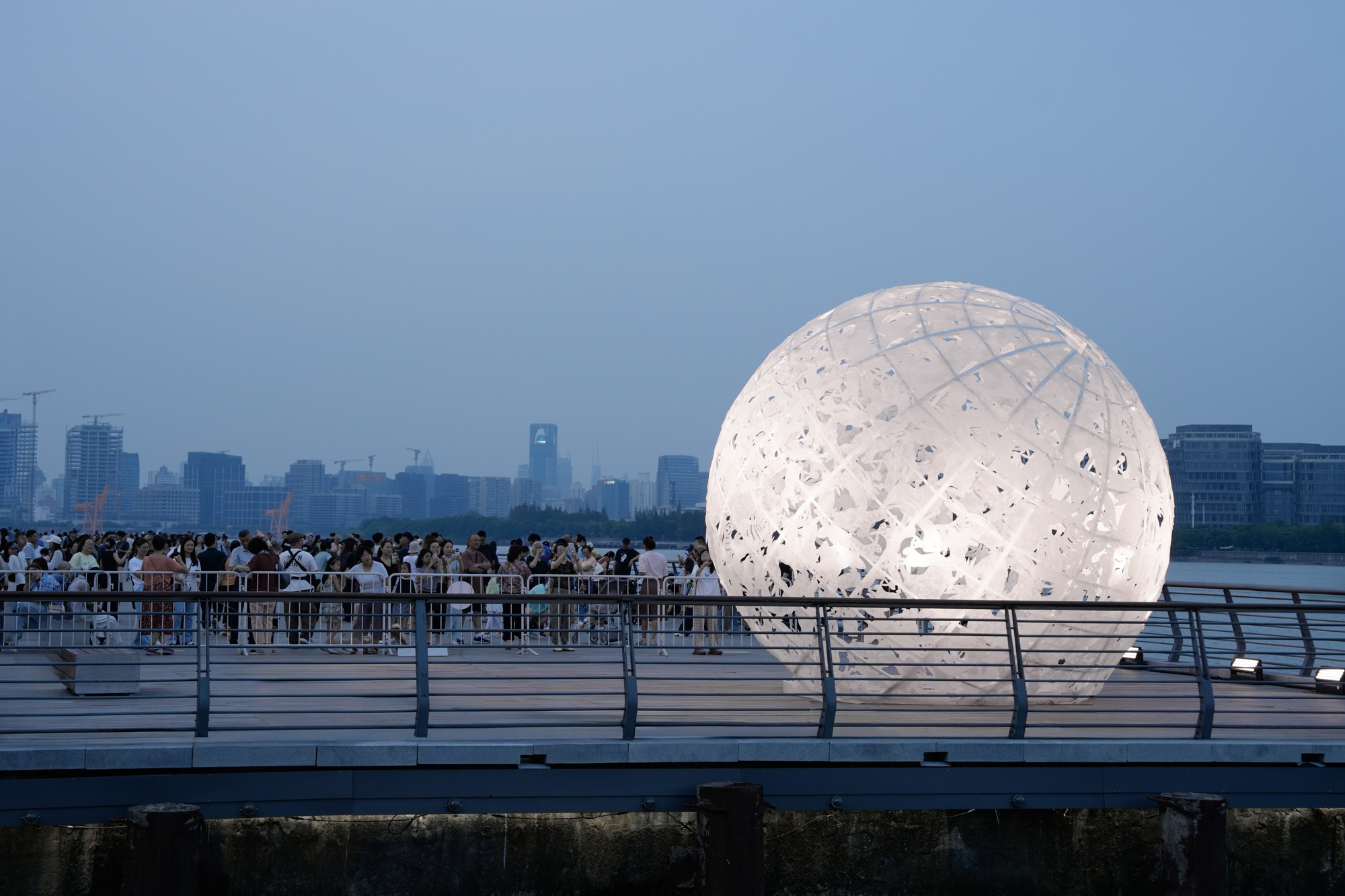
SHANGHAI — In the heart of Shanghai’s bustling West Bund district, amidst the towering industrial relics that have long defined the city’s modern cultural landscape, a luminous celestial body has descended to ground level. Invited by the prestigious Power Station of Art (PSA), the forward-thinking design practice SHISUO Design Office has unveiled its latest public art installation, The Full Moon.
Curated by HAN Shuang, the temporary yet deeply resonant installation serves as a contemporary urban meditation on the traditional Mid-Autumn Festival. By bridging ancient folklore, modern material science, and the intricate heritage of Shanghai-style paper-cutting (jianzhi), SHISUO has transformed a public plaza into a landscape of shared cultural memory, drawing massive crowds and sparking vital conversations about the role of temporary architecture and public art in hyper-densified modern metropolises.
Main Facts
Project The Full Moon
Design Office: SHISUO Design Office
Curator: HAN Shuang
Collaborator: Shi Qinling (Inheritor of Shanghai-style paper-cutting art)
Exhibition Venue: West Bund, adjacent to the Power Station of Art (PSA), Shanghai, China
Primary Materials: Crackle-textured acrylic panels, steel structural frameworks, and specialized illumination systems
Core Conceptual Motifs: The lunar cycle, the mythical lunar rabbit (Yutu), and intangible cultural heritage paper-cutting techniques
Exhibition Period: Debuted in conjunction with the Mid-Autumn Festival celebrations
Chronology of the Project: From Concept to Public Spectacle
The realization of The Full Moon was an intensive exercise in cross-disciplinary collaboration, fusing architectural design methodologies with delicate folk arts over a compressed timeline.
Phase 1: Conceptualization and Cultural Research (Early Planning)
The genesis of the project lay in an invitation extended by the Power Station of Art to SHISUO Design Office. The institution sought an installation that could engage directly with the public during the Mid-Autumn Festival—a holiday traditionally centered on family reunions, moon-gazing, and mythological reverence. SHISUO’s design team chose to move away from literal, nostalgic representations of the moon. Instead, they sought to investigate how architectural geometry and modern tectonics could evoke the cyclical nature of celestial bodies while paying homage to local craft.
Phase 2: Collaborative Craft Integration
A pivotal milestone in the timeline was the partnership established with Shi Qinling, a recognized master and inheritor of Shanghai-style paper-cutting. Unlike northern Chinese paper-cutting, which is often characterized by bold, symmetrical rustic patterns, Shanghai paper-cutting is renowned for its refined elegance, intricate linework, and integration of diverse artistic influences. SHISUO and Shi Qinling spent weeks translating these two-dimensional paper traditions into a three-dimensional spatial language, mapping out how perforated patterns could interact with light, shadow, and structural loads.
Phase 3: Fabrication and Material Prototyping
Moving from digital models to physical reality required rigorous prototyping. The design team experimented extensively with crackle-textured acrylic panels. These specialized panels were engineered not only to provide structural durability in an outdoor urban setting but also to diffuse light in a way that mimics the ethereal, cratered texture of the lunar surface. Simultaneously, internal steel frameworks were fabricated off-site to ensure structural integrity and safety for high-traffic public interaction.
Phase 4: Installation and Public Unveiling at the West Bund
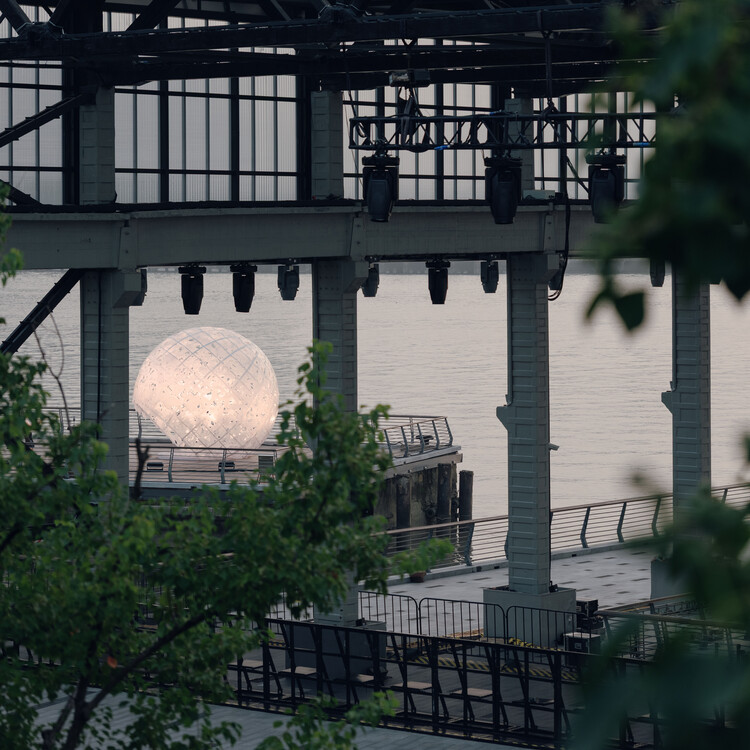
Assembled on-site adjacent to the iconic industrial smokestack of the Power Station of Art, the installation rapidly took shape in the days leading up to the festival. Upon its public opening, The Full Moon immediately captured the public imagination. Drawing large crowds of locals and international visitors alike, the installation transformed the concrete expanse of the West Bund into an interactive, luminous nexus, culminating in a vibrant celebration of art, architecture, and seasonal tradition.
Supporting Data & Architectural Analysis
To fully appreciate The Full Moon, one must examine the intersection of material science, spatial psychology, and urban sociology embedded within SHISUO’s design.
Materiality and Light Diffusion
The installation relies heavily on the interplay between modern plastics and natural or artificial illumination. The use of crackle-textured acrylic panels is central to this effect. Standard flat acrylic would have created a clinical, sterile surface; however, the crackle texture introduces microscopic fractures and refractive planes within the material. By day, these panels catch the natural sunlight, casting dappled, moon-like shadows onto the pavement. By night, internal programmable LED systems transform the installation into an ambient beacon, causing the structure to glow from within.
Spherical and hemispherical geometries are notoriously difficult to animate in urban settings without appearing monolithic. SHISUO addressed this by designing the installation to reveal different phases of the moon depending on the viewer’s exact vantage point. As pedestrians circulate around and through the structure, the visual perception shifts from a crescent to a waxing gibbous, and finally to a brilliant full moon.
Furthermore, the integration of the rabbit motif—rendered via precision-cut perforations in the acrylic—adds a layer of narrative depth. In classical Chinese folklore, the lunar rabbit is an inseparable companion of the moon. While the moon itself symbolizes the eternal cosmic cycle of waxing and waning, the rabbit serves as a metaphor for terrestrial vitality, biological growth, and the flourishing of all living beings.
Urban Context: The West Bund and the Power Station of Art
The choice of site is as critical as the physical object itself. The Power Station of Art, China’s first state-run contemporary art museum, occupies a repurposed industrial power plant. By placing The Full Moon in this post-industrial context, SHISUO establishes a poignant dialogue between heavy industry (symbolized by the PSA’s architecture) and delicate craftsmanship (symbolized by paper-cutting and the glowing lunar sphere). The installation demonstrates how temporary public art can activate underutilized post-industrial plazas, turning dead zones into vibrant communal living rooms.
Official Responses and Curatorial Insights
The reception of The Full Moon has highlighted the growing appetite for culturally grounded, interactive public installations in China’s major urban centers.
HAN Shuang, Curator of the project, noted in a statement:
"Public art in a contemporary metropolis like Shanghai cannot merely be an object placed in a square for passive viewing. It must function as an emotional anchor and a cultural catalyst. By inviting SHISUO Design Office and master artisan Shi Qinling to collaborate, we wanted to test whether ancient traditions—such as paper-cutting and Mid-Autumn folklore—could be reinterpreted through a spatial, architectural lens to resonate with a hyper-modern audience. The overwhelming public response at the West Bund proves that people are deeply hungry for installations that speak to both our technological present and our cultural roots."
Representatives from SHISUO Design Office added:
"Our approach to ‘The Full Moon’ was rooted in the idea of metamorphosis. The moon changes its face every night, yet remains fundamentally the same. Similarly, traditional crafts like paper-cutting are often viewed as static museum pieces, but when scaled up into architectural installations, they become living, breathing environments. Working with crackle-textured acrylic allowed us to capture the poetry of moonlight while meeting the rigorous safety and durability demands of a high-traffic public space."
Implications for Urban Design and Temporary Architecture
The success of The Full Moon carries several broader implications for the future of urban public spaces, temporary architecture, and the preservation of intangible cultural heritage:
1. The Rise of Experiential Placemaking
As cities worldwide grapple with the sterility of corporate plazas and over-commercialized public zones, temporary art installations like The Full Moon offer a blueprint for low-cost, high-impact placemaking. By introducing elements of surprise, shifting perspectives, and cultural storytelling, designers can temporarily rewrite the psychological narrative of a neighborhood, turning utilitarian transit corridors into destinations for community gathering.
2. Revitalizing Intangible Cultural Heritage Through Spatial Design
Traditional crafts—particularly delicate folk arts like paper-cutting—face severe existential threats in rapidly digitizing societies. Projects like this prove that intangible heritage need not be locked behind glass display cases. By collaborating with master artisans to scale down fine details into architectural components, designers can introduce younger generations to traditional techniques in an immersive, highly Instagrammable, and intellectually engaging format.
3. Sustainable Temporality
Because The Full Moon was conceived as an exhibition-specific installation for the Mid-Autumn Festival, it underscores the value of sustainable temporality in architecture. Rather than demanding permanent concrete interventions that alter a site forever, modular public art respects the evolving needs of the city. Components like the steel framework and acrylic panels can be disassembled, reconfigured, or recycled, setting a standard for environmentally conscious urban interventions.
In sum, SHISUO Design Office’s The Full Moon transcends its identity as a mere festive decoration. It stands as a sophisticated architectural experiment in light, material, and folklore—proving that even the oldest human myths can find fresh, luminous expression in the shadow of a modern metropolis.






Leave a Reply