

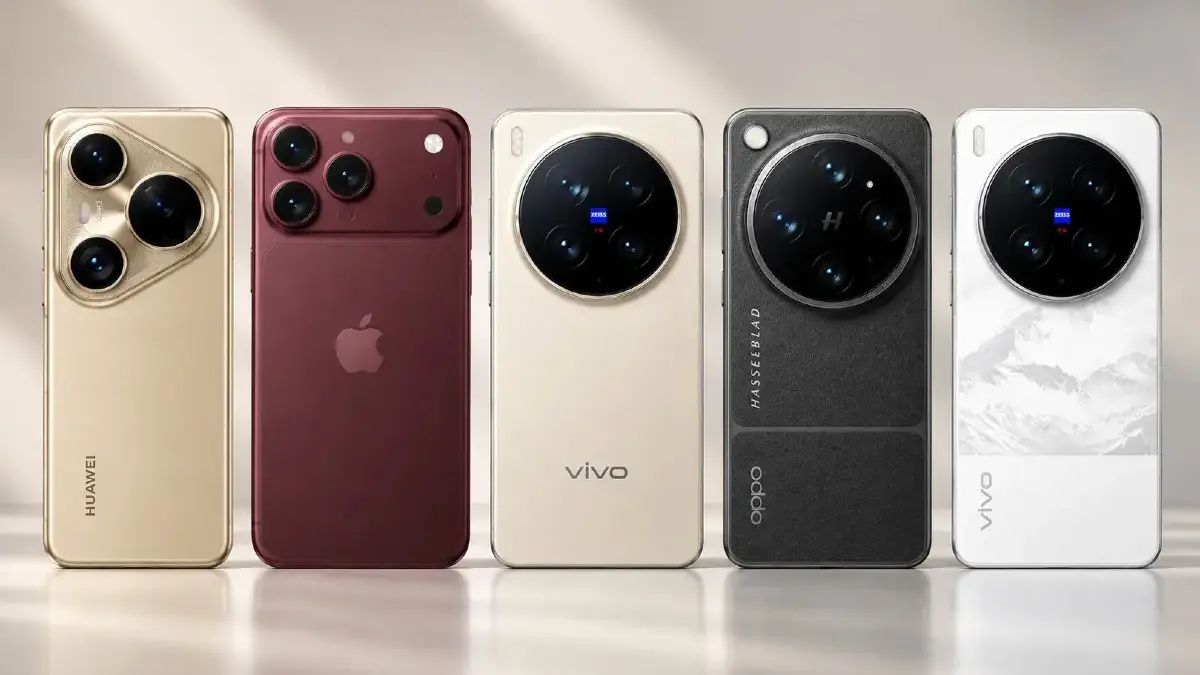
GLOBAL TECHNOLOGY DESK — In the hyper-competitive arena of mobile flagship photography, a razor-thin margin of just five points now separates the undisputed king from the fifth-place contender. According to the latest exhaustive benchmarking data released by DXOMARK, the global smartphone imaging hierarchy has shifted once again, introducing new titans while dismantling long-held consumer myths about megapixel counts and hardware dominance.
While the newly launched Apple iPhone 18 Pro stormed the rankings straight into the second-overall position, it failed to dethrone the reigning champion, the Huawei Pura 80 Ultra. Trailing closely behind Apple are the vivo X300 Pro, the OPPO Find X9 Ultra, and the vivo X300 Ultra, rounding out a top-five elite list where a cumulative score of 175 points sits at the apex and 170 marks the floor.
However, industry experts caution that global scores hide a more complex reality. When broken down into granular categories—such as photography, video, zoom capabilities, portraits, and ultra-wide-angle performance—the leaderboard shuffles dramatically. A device languishing lower on the overall podium can easily outperform the market leader in specific testing scenarios, proving that the ultimate smartphone camera depends entirely on the creator’s artistic needs.
Main Facts: The Elite Top Five at a Glance
The latest DXOMARK mobile camera evaluation offers a revealing snapshot of where mobile engineering stands today. The results highlight a fierce technological arms race among global manufacturers, where software algorithms, optical physics, and sensor sizing collide.
- The Leader: Huawei Pura 80 Ultra (175 points overall; 180 in photography).
- The Challenger: Apple iPhone 18 Pro (172 points overall; 176 in video).
- The Mid-Tier Elite: vivo X300 Pro (171 points overall; exceptional zoom capabilities).
- The Zoom Titan: OPPO Find X9 Ultra (170 points overall; 173 in telephoto).
- The Wide-Angle Specialist: vivo X300 Ultra (170 points overall; 175 in ultra-wide).
Despite impressive individual hardware specifications—ranging from 50-megapixel sensors with variable apertures to massive 200-megapixel telephoto and main modules—the overall gap between first and fifth place remains remarkably tight. This compression in scores demonstrates that diminishing returns are beginning to affect high-end smartphone development, forcing brands to compete on niche optical strengths rather than broad, sweeping hardware upgrades.
Chronology: How the Flagship Camera Race Unfolded
To understand how the current top five achieved their standing, one must look at the iterative timeline of mobile imaging evolution over recent product cycles:
Phase 1: The Pursuit of Sensor Size (2023–2024)
Manufacturers initially focused on scaling up physical sensor dimensions, moving from traditional 1/1.5-inch formats to massive 1-inch type sensors. Huawei pioneered variable aperture technology to mimic traditional DSLR flexibility, allowing mobile shooters to control depth of field and light intake physically rather than purely through software emulation.
Phase 2: The Resolution and Periscope Boom (2024–2025)
As physical space constraints limited further sensor expansion, brands turned to ultra-high-resolution sensors (50MP to 200MP) combined with advanced periscope telephoto architectures. Apple introduced its tetraprism design, while Chinese manufacturers like OPPO and vivo began deploying dual-telephoto systems to bridge the gap between mid-range zoom and extreme long-range magnification.
Phase 3: The Computational Era and the 2026 Stand-Off
The arrival of the iPhone 18 Pro and the latest Ultra-tier devices from Huawei, OPPO, and vivo marks the current phase: hyper-specialized computational photography. Hardware is no longer the sole differentiator; instead, the race is won or lost in real-time multi-frame processing, deep-learning noise reduction, and dedicated neural processing units (NPUs) that interpret skin tones, dynamic range, and motion artifacts on the fly.
Supporting Data: Deep Dive Into the Top Contenders
A surface-level score of 170 versus 175 tells only part of the story. A closer examination of DXOMARK’s sub-metrics reveals distinct engineering philosophies among the competing manufacturers.
1. Huawei Pura 80 Ultra: The All-Round Photography King (175 Points)
Holding firm at number one, the Huawei Pura 80 Ultra achieves an astounding 180 points in pure photography, with its main camera hitting 184 points.
- Hardware: Features a 50-megapixel 1-inch primary sensor equipped with a physical variable aperture, complemented by an ultra-wide sensor and two dedicated focal-length telephoto modules.
- Strengths: Exceptional dynamic range, precise exposure, faithful color reproduction, accurate skin tones, and meticulous detail preservation. Its dual telephotos span equivalent focal lengths of 83mm and 212mm.
- Weaknesses: Testing revealed occasional exposure and color instabilities, along with mildly unnatural skin textures in exceedingly difficult lighting environments.
2. Apple iPhone 18 Pro: The Undisputed Video Master (172 Points)
While Apple misses out on the top overall spot, it secures second place globally and claims the crown for motion capture.
- Hardware: Utilizes a triple 48-megapixel sensor array, including a newly optimized 100mm-equivalent telephoto lens built on a tetraprism design. Its primary camera scores a phenomenal 189 points—the highest in this cohort.
- Strengths: Unrivaled video stabilization, superior dynamic range during motion, and exceptional detail retention in cinematic workflows.
- Weaknesses: Zoom photography remains an Achilles’ heel. The telephoto setup scores just 143 points, lagging significantly behind its Asian competitors in long-range reach and magnification clarity.
3. vivo X300 Pro: The Versatile Zoom Contender (171 Points)
Landing in third place by a single point, the vivo X300 Pro offers a compelling balance of macro and telephoto prowess.
- Hardware: Equipped with a 50MP main shooter, a 50MP ultra-wide lens, and a staggering 200MP telephoto lens featuring optical image stabilization (OIS), 3.7x optical zoom, and native macro capabilities.
- Strengths: Outstanding zoom performance yielding 170 points (compared to the iPhone’s 143) and 180 points in background blur (bokeh) rendering. Stable exposures and low noise levels are constant highlights.
- Weaknesses: Occasional struggles with darker skin tones, color casts, and a drop in texture naturalness when ambient light levels plummet.
4. OPPO Find X9 Ultra: Reaching Further Than Ever (170 Points)
Tied for fourth, the OPPO Find X9 Ultra is an engineer’s dream for those who demand extreme focal lengths without sacrificing optical integrity.
- Hardware: A powerhouse array boasting a 200MP main camera, a 50MP ultra-wide, a 200MP telephoto (3x optical), and a secondary 50MP periscope lens providing 10x optical zoom.
- Strengths: Dominates the telephoto category with 173 points. It delivers clean details at extreme distances without relying heavily on aggressive, artificial intelligence-generated artifacts. Background blur scores a massive 185 points.
- Weaknesses: Stumbles in video recording, managing a low 161 points. Low-light video introduces noticeable noise, loss of fine detail, and sporadic autofocus tracking errors.
5. vivo X300 Ultra: The Ultra-Wide Specialist (170 Points)
Rounding out the top five, vivo’s second entry shares the 170-point threshold with OPPO, carving out its own identity through spatial breadth.
- Hardware: Features a 200MP main sensor with a unique 35mm equivalent focal length, a 50MP ultra-wide, and a 200MP telephoto with 3.7x optical zoom.
- Strengths: Captures the crown for ultra-wide photography with 175 points, offering a wider, cleaner field of view than its rivals. Telephoto performance remains exceptionally strong at 172 points.
- Weaknesses: Video performance mirrors the X300 Pro’s limitations, dropping to 162 points. Low-light video suffers from increased noise, sluggish autofocus, compressed dynamic range, and over-processed textures.
Official Responses and Industry Perspectives
The release of these benchmark results has sparked widespread debate across the mobile technology sector regarding the validity of synthetic scoring systems versus real-world utility.
Industry analysts note that traditional camera manufacturers are watching these developments with cautious fascination. While standalone mirrorless and DSLR cameras retain a distinct physical advantage due to sensor size and uncompressed optics, the gap in everyday casual and professional mobile journalism has narrowed to an almost imperceptible degree.
Representatives from consumer electronics firms emphasize that benchmark scores, while useful for marketing and high-level comparisons, fail to capture the subjective nature of photography.
"A score of 175 versus 170 is statistically significant in a laboratory, but in the hands of a creator, cultural preferences for color science, shutter lag response, and interface fluidity often outweigh raw numerical metrics," notes a leading mobile imaging consultant.
Furthermore, software developers maintain that computational photography is entering a new frontier where generative AI tools assist in low-light recovery—a practice that continues to divide purists who demand purely optical representations from those who prioritize a pleasing, ready-to-share digital asset.
Implications: Debunking the Megapixel Myth
The most profound takeaway from the latest DXOMARK data is the final collapse of the "megapixel myth." For years, marketing departments have convinced consumers that higher megapixel counts automatically equate to superior photographic quality. The new rankings decisively prove otherwise.
Consider the data:
- The Huawei Pura 80 Ultra, operating with a conservative 50-megapixel primary sensor, comfortably defeats or ties with competitors sporting massive 200-megapixel modules in core photographic evaluations.
- Conversely, sheer resolution does not guarantee video supremacy, as demonstrated by the OPPO Find X9 Ultra’s 200MP main sensor yielding a lower video score compared to Apple’s triple-48MP ecosystem.
What This Means for Consumers
- Stop Chasing Numbers: Consumers are advised to look past marketing hype centered on sensor resolution. Optical stabilization, lens aperture construction, software tuning, and dynamic range management play vastly more decisive roles in image quality.
- Match the Phone to the Use Case:
- Choose the Huawei Pura 80 Ultra if your priority is balanced, high-fidelity still photography across diverse environments.
- Choose the Apple iPhone 18 Pro if your workflow is heavily oriented toward professional video production and mobile journalism.
- Choose the OPPO Find X9 Ultra or vivo X300 series if extreme telephoto reach and wide-angle architectural framing are your primary artistic tools.
As mobile imaging technology marches toward the latter half of the decade, the barrier to entry for professional-grade pocket photography has never been lower—nor the competition so fiercely contested.



Leave a Reply