

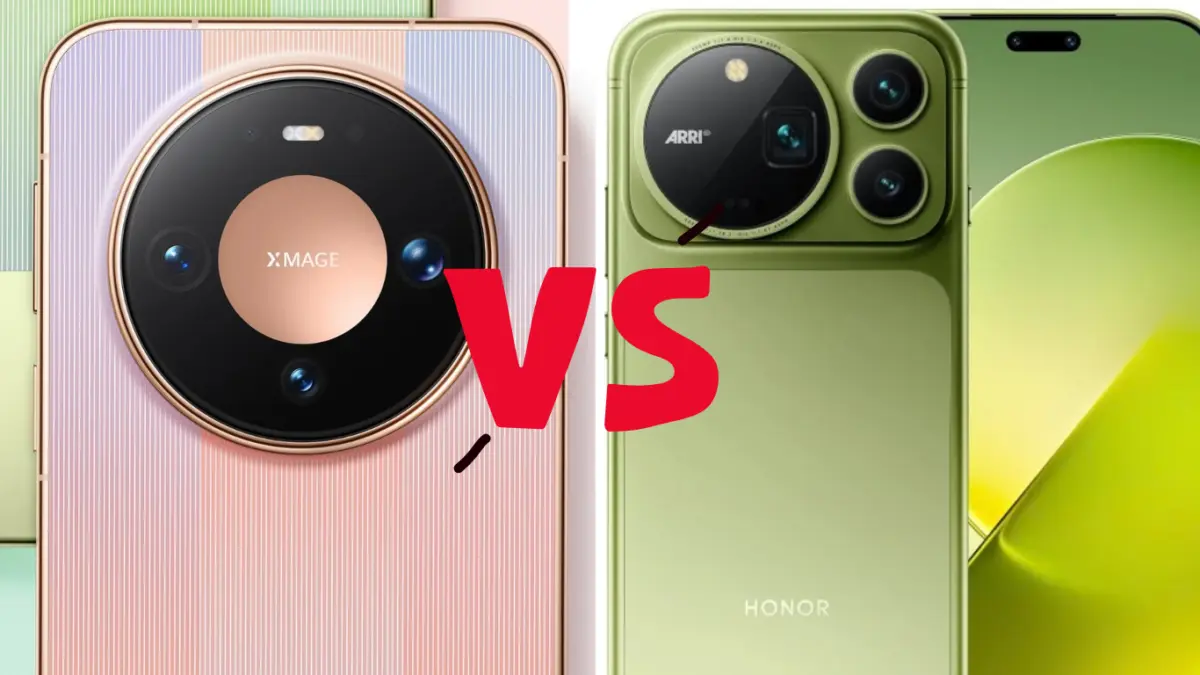
Global Technology Desk — The battle for supremacy in the mobile photography arena has long transcended simple sensor upgrades, evolving instead into a high-stakes ideological war between rival design philosophies. In one corner stands Huawei with its flagship approach, weaponizing proprietary RYYB sensor architecture, variable aperture mechanics, and the sophisticated XMAGE computational pipeline. In the other stands Honor, pushing the boundaries of raw hardware specifications with colossal dual 200-megapixel sensor arrays, massive physical footprints, and a groundbreaking imaging partnership with legendary cinema camera manufacturer ARRI.
Yet, as these two titans lock horns in the high-end smartphone market, a timeless mobile truth endures: a higher megapixel count does not automatically equate to a superior photograph.
To understand how these devices intend to redefine digital imagery, one must look beyond the spec sheets and examine the engineering, software processing, and real-world utility driving both the Huawei Mate 90 and the Honor Magic9 Pro Max.
1. Main Facts: Raw Specifications and Architectural Divide
At first glance, the comparative baseline reveals a stark divergence in engineering strategy, anchored by a headline-grabbing figure: 200 MP versus 50 MP.
+------------------------+-------------------------------------------------+-------------------------------------------------+
| Camera Component       | Honor Magic9 Pro Max                            | Huawei Mate 90 (Standard)                       |
+------------------------+-------------------------------------------------+-------------------------------------------------+
| Primary Sensor         | 200 MP (1/1.28", f/1.57, OIS, Gimbal-level)     | 50 MP (Variable f/1.4 - f/4.0, OIS, RYYB)       |
| Telephoto Sensor       | 200 MP (1/1.4", f/2.6, OIS, 3.5x Optical)       | 50 MP (OIS, ~4x Optical, ~8x Optical Quality)   |
| Ultra-Wide Sensor      | 50 MP (f/2.0, Autofocus)                        | 40 MP (f/2.2)                                   |
| Computational Imaging  | ARRI LogC3, Wide Gamut 3, 10-bit color, Looks   | XMAGE, 3rd-Gen Red Maple color system           |
+------------------------+-------------------------------------------------+-------------------------------------------------+
The Honor Magic9 Pro Max Arsenal
Honor has spared no expense in outfitting its premier device. The Magic9 Pro Max features a primary 200-megapixel shooter built upon a substantial 1/1.28-inch sensor. Paired with a wide f/1.57 aperture, optical image stabilization (OIS), and a stabilization equivalent to a physical gimbal system, it is engineered to capture blistering amounts of detail.
More remarkably, Honor extended this ultra-high-resolution philosophy to the telephoto lens. The device incorporates a 200-megapixel periscope telephoto sensor measuring 1/1.4 inches, featuring an f/2.6 aperture and OIS. On paper, Honor’s hardware dominance in the telephoto category is nearly impossible to ignore.
The Huawei Mate 90 Approach
Huawei takes a more nuanced, hardware-conservative route with the standard Mate 90. It relies on a 50-megapixel primary sensor governed by a mechanical variable aperture that transitions seamlessly between f/1.4 and f/4.0. Bolstered by OIS and Huawei’s signature RYYB (Red-Yellow-Yellow-Blue) color filter array—which replaces green pixels with yellow to ingest significantly more light—the setup is rounded out by a 40-megapixel ultra-wide lens and a 50-megapixel telephoto lens. Huawei promises roughly four times optical zoom and up to eight times optical-quality zoom through sensor cropping and fusion.
At a glance, Honor appears to sweep the category. However, mobile photography refuses to be judged by sheer metrics alone.
2. Chronology of Mobile Imaging Evolution: How We Got Here
To appreciate the gravity of the Mate 90 and Magic9 Pro Max rivalry, it is crucial to trace the historical progression of smartphone photography over the past decade:
- 2014–2016 (The Megapixel Stagnation): The industry settled around 12 MP to 16 MP, realizing that larger individual pixels captured better low-light data than crammed, smaller ones. Computational photography began taking its first major steps.
- 2018–2020 (The RYYB and Periscope Revolution): Huawei disrupted the market by introducing RYYB sensors on the P-series and Mate-series, drastically improving light intake. Simultaneously, periscope lenses unlocked true optical zoom beyond 5x.
- 2021–2023 (The Multi-Sensor Era & High-Res Jump): Brands began utilizing 48 MP, 64 MP, and eventually 108 MP sensors, leveraging pixel-binning to combine multiple pixels into a single, high-clarity image.
- 2024–Present (Cinematic Collaboration and Ultra-High-Res Arrays): The current landscape features a split in high-end design. Manufacturers are either doubling down on physical light manipulation (variable apertures and custom color arrays) or pushing ultra-high-resolution sensors across multiple focal lengths alongside deep partnerships with legendary legacy cinema brands like Leica, Hasselblad, and ARRI.
3. Supporting Data & Detailed Performance Analysis
The 200 MP Advantage: Fact Versus Fiction
A 200-megapixel sensor offers an undeniable physical advantage: it records an immense volume of data when environmental conditions allow. This dense information matrix grants photographers vast latitude to crop deep into an image frame without sacrificing structural integrity or descending into pixelated mush.
For the Magic9 Pro Max, this shines when capturing architectural details, distant landscapes, or subjects occupying a minor fraction of the viewfinder. Because Honor placed a 200-megapixel sensor on both the main camera and the periscope telephoto lens, it effectively solves the historical Achilles’ heel of mobile zoom: the catastrophic loss of clarity past the optical threshold.
The Magic9 Pro Max delivers 3.5x optical zoom natively, extending digitally up to a staggering 200x. Honor also supports modular hardware accessories—including physical cage expansion systems and external telephoto lenses—pushing native focal equivalents up to 200mm and 500mm.
However, users must maintain realistic expectations: a "200x" label denotes maximum digital reach, not optical equivalence. Usability at extreme ranges remains tied to environmental lighting, atmospheric distortion, hand stability, and image signal processor (ISP) algorithms.
Night Photography: The Triumph of Light Physics
When the sun sets, the narrative shifts back to Huawei.
The Mate 90’s primary camera employs an RYYB sensor coupled with a mechanical variable aperture capable of opening to a blazing f/1.4. This physical opening allows raw light to flood the sensor naturally before digital amplification is required. When lighting conditions change, the physical blades close down to f/4.0 to control exposure and preserve sharpness.
In contrast, Honor utilizes an f/1.57 aperture paired with a large 1/1.28-inch sensor, relying heavily on multi-frame computational stacking and advanced stabilization to illuminate dark environments.
While Honor’s sensor size is commendable, it would be incorrect to assume it automatically wins nocturnal scenarios simply due to its higher pixel count. In the dark, the laws of physics dictate that the sheer volume of photons hitting the photosites, combined with optical glass quality and multi-exposure fusion, matters infinitely more than pixel density. Huawei’s conceptual integration of variable mechanics and light-hungry RYYB architecture makes for a fierce competitor in low-light fidelity.
Portraits and Skin Tones: Resolution Takes a Backseat
Megapixels hold virtually no sway in the realm of portraiture. The true test of a portrait system lies in its algorithmic understanding of depth, edge detection around flyaway hairs, facial geometry rendering, skin-tone accuracy, and natural bokeh falloff.
- Huawei’s Philosophy: Huawei integrates its third-generation Red Maple camera system alongside XMAGE processing. This pipeline is specifically tuned to honor natural human skin tones, avoiding the overly smoothed, artificial look common in early computational photography.
- Honor’s Philosophy: Honor leverages image processing code co-developed with ARRI. This collaboration extends far beyond simple color filters; it introduces professional tools like ARRI LogC3, ARRI Wide Gamut 3, 10-bit color depth, and dedicated ARRI Looks profiles.
Consequently, Honor pulls ahead when the operator’s goal transcends casual snapshots, moving into the territory of intentional, grade-ready capture.
4. Official Responses and Industry Implications
Industry analysts view the Mate 90 and Magic9 Pro Max clash as a watershed moment for mobile imaging branding.
Executives from Huawei have repeatedly emphasized that their RYYB and variable aperture systems represent a commitment to optical purity. By controlling light at the physical lens level rather than over-relying on heavy software reconstruction, Huawei aims to deliver images that retain organic texture.
Conversely, Honor’s leadership has championed the democratization of cinema-grade workflows. By bridging the gap between consumer hardware and professional filmmaking tools—crystallized through their partnership with ARRI—Honor is positioning its Pro Max line not merely as a smartphone, but as a pocket-sized digital cinema camera.
The ultra-wide angle matchup further highlights these divergent paths: Huawei fields a 40-megapixel f/2.2 ultra-wide sensor, while Honor counters with a 50-megapixel f/2.0 sensor complete with autofocus. While the spec sheet favors Honor, real-world edge distortion, chromatic aberration control, and corner sharpness remain the ultimate arbiters of quality in landscape and architectural photography.
5. Implications: Video Production and the Pro Max Paradigm
Perhaps the most profound differentiator between these two flagships lies in video recording.
The Magic9 Pro Max was engineered from the silicon up to support a professional cinematic workflow. It natively records in ARRI Cinema formats up to 4K at 60 frames per second, complete with LogC3 encoding, 10-bit color, and ARRI Wide Gamut 3. With 14 distinct ARRI Looks and an onboard library of 87 color profiles, it bridges the divide between mobile devices and professional cinema rigs.
Huawei’s Mate 90 offers robust 4K recording and advanced capture features, but its software architecture remains tethered to mobile-first social sharing and XMAGE styling, rather than a total cinematic workflow overhaul.
Final Verdict: Which Camera Reigns Supreme?
If evaluated strictly through the lens of hardware specifications, the Honor Magic9 Pro Max holds the undeniable upper hand. Its dual 200-megapixel arrays, massive primary sensor, exceptional zoom capabilities, and deep ARRI-driven video integration make it a powerhouse of versatility.
However, the standard Huawei Mate 90 proves that hardware checklists do not tell the whole story. For low-light capture, its variable aperture and RYYB sensor architecture offer a masterclass in optical light gathering. For everyday portraiture and organic color rendering, Huawei’s XMAGE and Red Maple systems remain formidable.
Furthermore, context is paramount: the Magic9 Pro Max is Honor’s absolute pinnacle offering, whereas this Huawei Mate 90 is the baseline model in a family that also includes higher-tier Pro and Pro Max variants.
Ultimately, if the question is which device features the most aggressive and feature-rich camera hardware configuration between these specific models, the answer points to Honor. But if the question is which device takes the better photograph in every conceivable scenario, megapixels alone cannot provide the answer. The true test rests in the hands of the user, navigating the eternal tug-of-war between raw computational force and classical optical engineering.



Leave a Reply