

The global labor market is undergoing one of the most rapid and profound transformations in modern economic history. Driven by the exponential advancement and integration of artificial intelligence (AI), the qualities that make a candidate employable are being fundamentally rewritten. It is no longer enough to possess static, specialized technical knowledge or a prestigious degree. Instead, the modern workforce demands a dynamic toolkit centered on "AI fluency"—the ability to work effectively alongside intelligent systems—and an unprecedented capacity for cognitive adaptability.
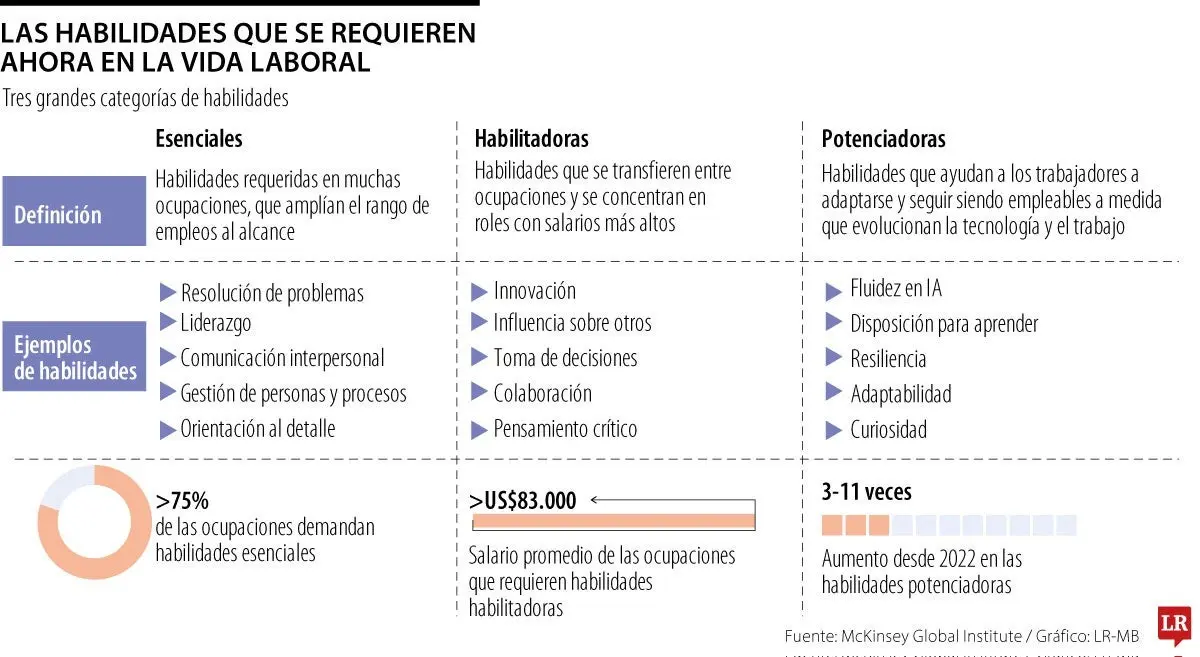
A seminal study by the McKinsey Global Institute has shed light on the sheer velocity of this shift. Analyzing the United States job market between 2022 and 2026, the report reveals that the demand for AI fluency in analyzed occupations skyrocketed by approximately 11 times. This surge is accompanied by a dramatic rise in the value of human-centric, adaptable skills. As technology automates routine cognitive and manual tasks, the premium on how workers learn, pivot, and collaborate has reached historic heights.
1. Main Facts: The Restructuring of Workforce Demand
The McKinsey Global Institute’s research paints a clear picture of a labor market in transition. The core finding is that AI is not merely a tool to be learned once, but an evolving ecosystem that requires continuous cognitive alignment.
GROWTH IN DEMAND FOR KEY SKILLS (2022–2026)
==================================================
AI Fluency:      █████████████████████████ 11x
Adaptability:    ███████████ 5x
Curiosity/Learn: ███████ 3x
==================================================
The study highlights several critical realities defining the current employment landscape:
- The Explosion of AI Fluency: The elevenfold increase in demand for AI fluency between 2022 and 2026 demonstrates that basic digital literacy is no longer sufficient. AI fluency is defined as the practical capability to co-pilot tasks with generative AI, interpret machine-learning outputs, and seamlessly integrate automated systems into daily workflows.
- The Premium on Adaptability: Technical skills are depreciating faster than ever. Consequently, the demand for worker adaptability increased fivefold over the same four-year period. Employers are actively seeking professionals who can navigate ambiguity and transition between tasks as automated tools absorb traditional responsibilities.
- The Tripling of Psychological Capital: Traits that were once dismissed as "soft skills"—such as curiosity, resilience, and a continuous readiness to learn—have virtually tripled in demand.
- A New Taxonomy of Skills: To help organizations and policymakers navigate this shift, McKinsey categorizes modern professional capabilities into three distinct buckets: Essential Skills, Enabling Skills, and Empowerment Skills. Each category serves a unique function in determining a worker’s career trajectory and earning potential.
2. Chronology of the Tech-Labor Shift (2022–2026)
To understand how the market arrived at this point, it is necessary to trace the trajectory of AI integration and its immediate impact on hiring practices over the last four years.
2022 ──────────────────► 2023 ──────────────────► 2024 ──────────────────► 2025/2026
Launch of GenAI          Corporate Integration   AI Agent Workforces     AI Fluency as a
& initial hype           & workflow redesign     & specialized roles     baseline requirement
2022–2023: The Shockwave of Generative AI
The late 2022 release of highly accessible generative AI models triggered an immediate reassessment of white-collar work. Initially met with a mixture of skepticism and existential panic, 2023 became a year of rapid experimentation. Organizations rushed to understand how large language models (LLMs) could automate writing, coding, and basic customer service. At this stage, "prompt engineering" emerged as a highly sought-after, albeit speculative, skill.
2024: From Experimentation to Enterprise Integration
By 2024, the narrative shifted from speculative experimentation to structured integration. Enterprises began embedding AI copilots directly into proprietary software, customer relationship management (CRM) systems, and enterprise resource planning (ERP) platforms. The job market stopped looking for "AI hobbyists" and began demanding professionals who could use these tools to double their output. Basic AI literacy became a standard expectation in job postings for marketing, software development, and administrative roles.
2025: The Rise of Autonomous Agents and Systemic Work Redesign
In 2025, the focus evolved from simple chat interfaces to autonomous AI agents capable of executing multi-step workflows with minimal human supervision. This transition altered the human role from "doer" to "editor and supervisor." Consequently, the demand for critical thinking, verification, and risk management spiked. The ability to manage, audit, and guide these AI systems became a core differentiator for high-earning professionals.
2026: The Maturity Phase and the "Skills-First" Paradigm
By 2026, the transition achieved maturity. The data analyzed by McKinsey confirms that AI fluency is no longer a niche technical skill but a baseline requirement across virtually all high-paying sectors. The focus has firmly shifted toward a candidate’s broader cognitive architecture—specifically their resilience and willingness to undergo continuous retraining as underlying technologies undergo rapid update cycles.
3. Supporting Data: The Three-Tier Skill Framework
The McKinsey Global Institute structured its analysis around three critical skill categories that define modern career mobility and earning power: Essential, Enabling, and Empowerment skills.
Essential Skills: The Foundation of the Workplace
Essential skills represent the baseline competencies required to function in a modern corporate environment. According to McKinsey’s analysis, more than 75% of all occupations in the United States demand these skills. They include:
- Complex problem-solving
- Leadership and team coordination
- Interpersonal and cross-cultural communication
- People and process management
- High orientation to detail and quality control
While these skills are highly durable, they are increasingly viewed by employers as prerequisite baselines rather than competitive differentiators.
Enabling Skills: The High-Wage Accelerators
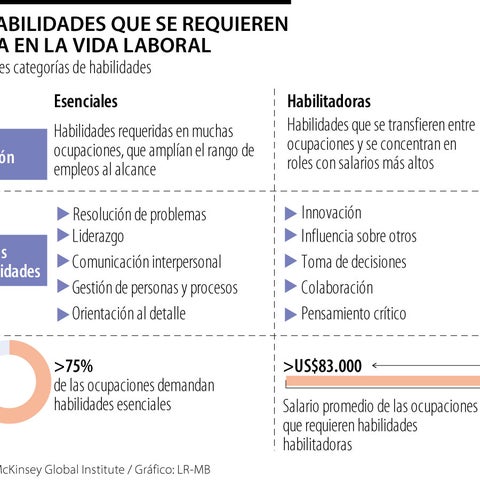
Enabling skills are highly transferable across different industries and are heavily concentrated in high-compensation brackets. McKinsey’s data reveals that occupations requiring strong enabling skills command an average annual salary exceeding $83,000. These cognitive competencies include:
- Systemic innovation and creative strategy
- The ability to influence stakeholders and negotiate
- Complex, data-driven decision-making
- Cross-functional collaboration
- Structured critical thinking
These skills act as a shield against automation; they represent the highly contextual, strategic human interventions that AI cannot easily replicate.
Empowerment Skills: The Engine of Career Longevity
Empowerment skills are those experiencing the sharpest upward trajectory in demand as the fundamental nature of labor changes. This category is directly tied to a worker’s capacity to survive and thrive amid ongoing disruption. It includes:
- AI Fluency: Navigating, utilizing, and optimizing AI tools (11x demand increase).
- Adaptability: Embracing structural and operational changes without loss of productivity (5x demand increase).
- Continuous Learning Readiness, Resilience, and Curiosity: The psychological and cognitive capacity to actively seek out new knowledge and recover from setbacks (tripled in demand).
4. Official and Corporate Responses
The findings of the McKinsey report have triggered a wave of reactions from labor economists, corporate executives, and human resource leaders, all of whom agree that traditional talent acquisition and development models are obsolete.
The Corporate Shift to "Skills-Based Hiring"
In response to the rapid devaluation of static credentials, progressive companies are abandoning traditional hiring metrics, such as specific university degrees or linear career histories. McKinsey advocates for a systemic transition toward skills-based hiring.
To implement this, forward-thinking organizations are adopting:
- Structured Interview Criteria: Evaluating candidates based on standardized situational behavioral questions rather than subjective cultural fit.
- Practical, Real-Time Assessments: Requiring candidates to demonstrate their AI fluency and problem-solving abilities through live simulations or case studies during the interview process.
- Internal Mobility Frameworks: Mapping the existing skill sets of current employees to identify hidden talent that can be reskilled for high-growth roles, rather than relying exclusively on external recruitment.
The Warning on the "Reskilling Divide"
Labor economists and authors of the report have issued strong warnings regarding socioeconomic stratification. The report notes that workers do not start from the same position.
Individuals employed in low-wage, highly specialized, or execution-centric roles (such as administrative data entry, basic assembly, or repetitive retail tasks) possess far fewer transferable skills. Without targeted intervention, these workers face displacement with very few pathways to high-growth, high-wage occupations. Experts argue that this segment of the workforce requires urgent institutional support, including structured corporate retraining programs, state-sponsored credentials, and accessible vocational conversion frameworks.
5. Broader Implications for the Future of Work
The structural shifts highlighted by the McKinsey Global Institute carry profound implications for every stakeholder in the global economy.
IMPLICATIONS OF THE AI-DRIVEN LABOR SHIFT
┌────────────────────────────────────────────────────────────────────────┐
│  For Professionals:                                                    │
│  - Shift from "one-and-done" education to lifelong micro-credentialing │
│  - Cultivation of high-value "Enabling Skills" to secure high salaries │
├────────────────────────────────────────────────────────────────────────┤
│  - Implementation of "Skills-Based Hiring" over traditional degrees    │
│  - Heavy investment in continuous internal reskilling pathways        │
├────────────────────────────────────────────────────────────────────────┤
│  - Subsidizing adult vocational training and technical education       │
│  - Creating safety nets for displaced workers in execution-heavy roles │
└────────────────────────────────────────────────────────────────────────┘
For the Individual: The Death of the Static Career
The concept of completing an education in one’s early twenties and relying on that knowledge base for a forty-year career is officially dead. Professionals must now view themselves as dynamic portfolios of skills that require continuous updating. Career mobility is no longer about making massive, disconnected leaps into entirely different fields, but about leveraging a core foundation of transferable "enabling" and "empowerment" skills to slide laterally into higher-value, tech-augmented roles.
For Education: Overhauling the Academic Pipeline
Higher education institutions face an existential crisis. If the demand for specific technical skills can shift elevenfold in a matter of four years, traditional multi-year academic curricula are too slow to remain relevant. Universities must integrate AI fluency across all disciplines—from humanities to engineering—while emphasizing the development of critical thinking, resilience, and adaptability. Micro-credentials and continuous adult education programs will likely supersede traditional postgraduate degrees in practical value.
For Society: Preventing Structural Unemployment
The widening gap between workers who possess transferable enabling skills and those locked in execution-heavy roles represents a significant threat to social stability. If the transition to an AI-driven economy is left entirely to market forces, the divide between high-wage knowledge workers and displaced low-wage workers will widen.
Preventing this outcome requires a coordinated effort between the public and private sectors. Governments must incentivize corporate reskilling initiatives, update public educational standards, and build robust safety nets that facilitate rapid vocational retraining.
Ultimately, the rise of artificial intelligence does not signal the obsolescence of the human worker. Instead, it elevates the value of our most distinctively human traits: our curiosity, our capacity to learn, our ability to connect, and our resilience in the face of change. In the age of AI, the most valuable skill of all is the ability to continuously learn how to learn.



Leave a Reply