

By Environmental Science Correspondent
Updated and Expanded Investigation
Main Facts
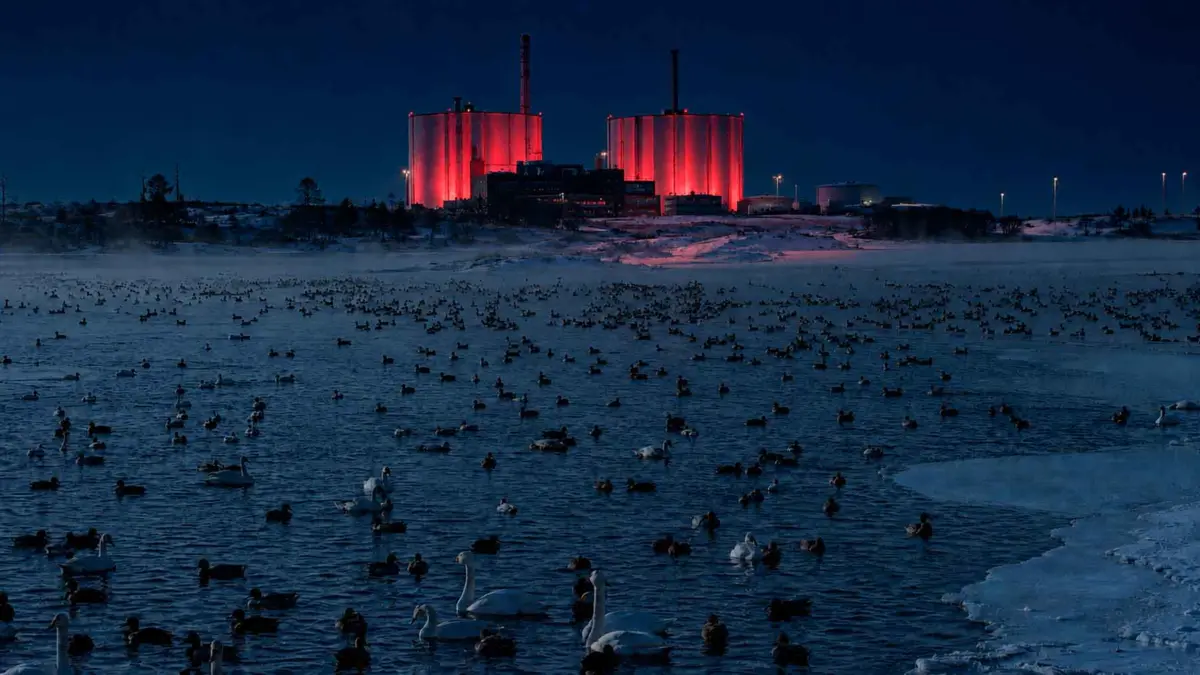
Along the stark, windswept coastline of the Baltic Sea in Sweden lies one of the most paradoxical ecosystems in modern ornithology. The Forsmark Nuclear Power Plant, operational since 1980 and one of the Scandinavian nation’s premier electricity generators, has inadvertently engineered a thriving winter sanctuary for thousands of aquatic birds.
While the surrounding maritime environment freezes solid under harsh sub-zero Nordic winters, segments of the coastal waters near Forsmark remain remarkably temperate, ice-free, and rich in marine life. The catalyst for this ecological anomaly is the plant’s massive cooling system. To cool its heavy industrial condensers, Forsmark draws millions of gallons of frigid seawater from the Baltic Sea daily. After circulating through the reactor facilities, this water is expelled back into the environment at temperatures between 7 and 9 degrees Celsius (roughly 13 to 16 degrees Fahrenheit) warmer than when it was captured.
A significant portion of this thermal effluent is channeled directly into Biotestsjön, an artificial coastal lagoon engineered specifically at the time of the plant’s construction to study the biological effects of heated water discharge. Today, Biotestsjön and adjacent areas like Asphällafjärden—where water is drawn in and kept moving dynamically—form an oasis of liquid water, abundant vegetation, and active fish populations.
A landmark six-year scientific study published in the prestigious journal Ibis has shed light on this phenomenon, confirming that waterfowl such as ducks, swans, herons, and cormorants heavily concentrate in these thermally modified zones during the winter months. However, while the immediate visual evidence points to a wildlife haven, environmental scientists are urging caution. Beneath the surface of this warm-water refuge lies a complex web of ecological questions, long-term survival unknowns, and potential traps that science is only beginning to unravel.
Chronology: The Evolution of an Accidental Ecosystem
The story of the Forsmark sanctuary is not one of intentional conservation, but rather a slow, multi-decade progression of industrial footprint overlapping with natural wildlife adaptation.
- 1980: The Forsmark Nuclear Power Plant officially commences operations on the Uppland coast along the Baltic Sea. Designed to bolster Sweden’s energy independence, the plant incorporates a massive once-through cooling system requiring continuous access to cold marine water.
- Early 1980s (The Construction of Biotestsjön): During the plant’s establishment, engineers and environmental regulators carve out an artificial enclosure known as Biotestsjön (The Biotest Lake). Enclosed by artificial dikes with controlled flow gates, the lagoon is initially designated as an experimental enclosure to monitor how marine ecosystems react to thermal elevation from industrial operations.
- 1980s–2000s (Gradual Ecological Shift): As the decades pass, local wildlife begins to notice the microclimate. While the rest of the Gulf of Bothnia and local archipelagos freeze over—cutting off foraging grounds for migratory and resident waterbirds—the Biotestsjön lagoon and surrounding discharge zones consistently remain ice-free. Microalgae, benthic organisms, and small fish populations adapt to the elevated temperatures, creating a year-round pantry.
- Mid-2010s (Targeted Scientific Monitoring): Recognizing the massive accumulation of birds in the industrial zone, an international team of researchers launches a comprehensive, multi-year monitoring project. Over a six-year period, ornithologists systematically count, map, and categorize waterfowl distributions across seven distinct coastal sectors surrounding the Forsmark facility.
- Recent Findings (Publication in Ibis): The culmination of the six-year tracking study is published in the journal Ibis. The data provides concrete, quantitative proof that waterbirds actively select the thermal discharge zones over pristine, control areas along the coastline, setting off a debate among ecologists about the true nature of industrial "rewilding."
Supporting Data and Ornithological Findings
The research published in Ibis moves the conversation past anecdotal observation by employing rigorous, comparative methodologies. Scientists monitored seven distinct coastal sectors near Forsmark over six winter seasons, juxtaposing the thermally altered environments against untouched control zones in the wider Baltic region.
The Numbers and the Species
The data revealed an undeniable preference among specific avian guilds:
- Waterfowl Diversity: Mallards, goldeneyes, mute swans, grey herons, and great cormorants showed the highest concentrations in the warmed zones.
- Micro-Habitat Specialization: Different species partitioned the artificial zones based on their specific physiological and foraging needs. For instance, Biotestsjön—which receives the direct, warmest effluent—attracted species dependent on abundant vegetative growth and dense small-fish populations. Meanwhile, Asphällafjärden, the intake area kept clear by powerful water currents and mechanical movement rather than extreme heat, attracted diving ducks and opportunistic fish-eaters.
- The Control Contrast: In contrast to the teeming waters of the thermal discharge channels, nearby control sectors featuring natural, ice-bound winter conditions recorded drastically lower bird densities and diversity index scores.
Energetic Economics in Winter
From an evolutionary biology perspective, the behavior of these birds makes immediate sense. Winter survival is an intense exercise in energetic budgeting. Maintaining body temperature in sub-zero environments requires massive caloric intake. When coastal ice locks up shallow bays and mudflats, birds must expend significant energy flying vast distances to find open water, or risk starvation.
By providing a localized, reliable source of open water laden with easy prey, the Forsmark facility effectively subsidizes the winter energy budgets of thousands of birds. For these animals, the energetic cost of foraging drops dramatically, theoretically increasing their immediate winter survival rates.
Official Responses and Perspectives
The intersection of nuclear energy infrastructure and wildlife conservation has drawn commentary from various stakeholders, ranging from energy operators to independent ecologists and regulatory bodies.
Industry and Operator Perspective
Representatives from Vattenfall, the state-owned Swedish multinational power company that operates the Forsmark plant, have historically viewed the environmental footprint of their cooling systems through a lens of regulatory compliance and localized monitoring.
"Our primary mandate is the safe, reliable generation of low-carbon electricity," notes a Vattenfall environmental liaison statement regarding coastal operations. "However, we maintain active ecological monitoring programs around our coastal facilities. The presence of wildlife in our discharge channels is a well-documented phenomenon that highlights the resilience and adaptability of nature, even in proximity to heavy industrial installations."
Scientific and Conservationist Concerns
While acknowledging the fascinating nature of the adaptation, independent ornithologists and marine biologists emphasize a more cautious, nuanced interpretation. Dr. Helena Lindström, an avian ecologist unaffiliated with the Ibis study, points out the danger of confusing "habitat use" with "habitat quality."
"Just because thousands of birds choose to spend their winters in a warm industrial lagoon does not mean it is a net positive for their populations," Lindström explains. "Ecological traps are well-documented in conservation science. An artificial environment can trick an animal’s evolutionary cues into believing a location is optimal, while exposing them to hidden, long-term costs."
Implications: The Ecological Trap Dilemma
The central question raised by the Forsmark phenomenon is whether this accidental sanctuary represents a true conservation win or a sophisticated ecological trap. Researchers have identified several critical areas of concern that warrant long-term study:
1. The Deceptive Metric of Abundance
High bird counts in Biotestsjön do not automatically equate to high reproductive success or robust long-term survival. Scientists point out that while birds survive the winter months successfully due to the warmth and food, they may suffer from downstream physiological consequences. For example, constant exposure to elevated water temperatures can disrupt natural molting cycles, immune system competence, and hormonal triggers that dictate spring migration timing.
2. Pathogen and Parasite Amplification
Warm, nutrient-rich, stagnant or semi-enclosed water bodies often serve as breeding grounds for pathogens, bacteria, and avian parasites. In natural winter conditions, freezing temperatures act as a biological reset, killing off many waterborne bacteria and parasite vectors. The perpetual summer-like microclimate of Biotestsjön could inadvertently foster disease outbreaks, such as avian botulism or microbial infections, among dense aggregations of waterbirds.
3. Bioaccumulation and Industrial Contaminants
Although nuclear plants operate under stringent environmental safety protocols and do not discharge radioactive cooling water into open systems (as the secondary cooling water is strictly isolated from the reactor core), industrial cooling systems process massive volumes of coastal water. Heavy metals, microplastics, and industrial pollutants present in the Baltic Sea are concentrated and cycled through these systems. Birds foraging exclusively in these restricted areas may experience higher bioaccumulation rates of toxins compared to wild counterparts foraging across broader, cleaner marine ecosystems.
4. The "Cliff-Edge" Vulnerability
Perhaps the most profound philosophical and practical question posed by the Forsmark sanctuary is the issue of dependency. Thousands of birds have adapted their wintering strategies around a localized, highly artificial energy infrastructure.
What happens when the plant eventually decommissions?
Energy transition policies, grid modernizations, and the eventual end-of-life cycle for nuclear reactors mean that Forsmark will not operate indefinitely. If the plant scales down operations or permanently shuts its doors, the thermal effluent will cease overnight. The artificial lagoon will freeze over, the local food web supported by the warmth will collapse, and thousands of dependent birds could face a catastrophic winter survival crisis if they have lost their traditional, migratory survival instincts or distant alternative routes.
Conclusion
The accidental sanctuary at the Forsmark Nuclear Power Plant stands as a compelling testament to the adaptability of wildlife in an increasingly human-dominated world. It bridges the gap between industrial heavy engineering and natural ecology in a way few other sites do.
Yet, as scientists continue to dissect the six-year dataset from the Ibis study, the overriding lesson is one of humility. Transforming an industrial byproduct into a winter haven for swans, ducks, and herons solves an immediate seasonal problem for the birds, but it weaves a complex web of ecological dependency. Until long-term demographic and health tracking can prove whether these warm-water refuges are stepping stones to thriving populations or modern ecological traps, Forsmark’s feathered residents will remain suspended in a fragile, man-made balance between survival and uncertainty.




Leave a Reply