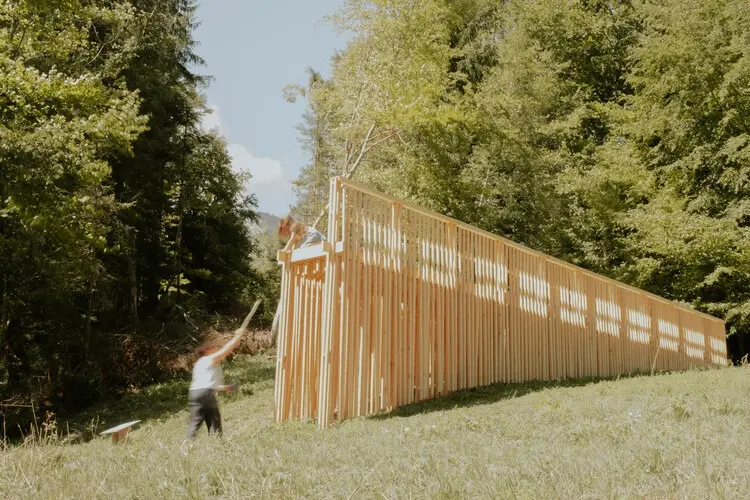
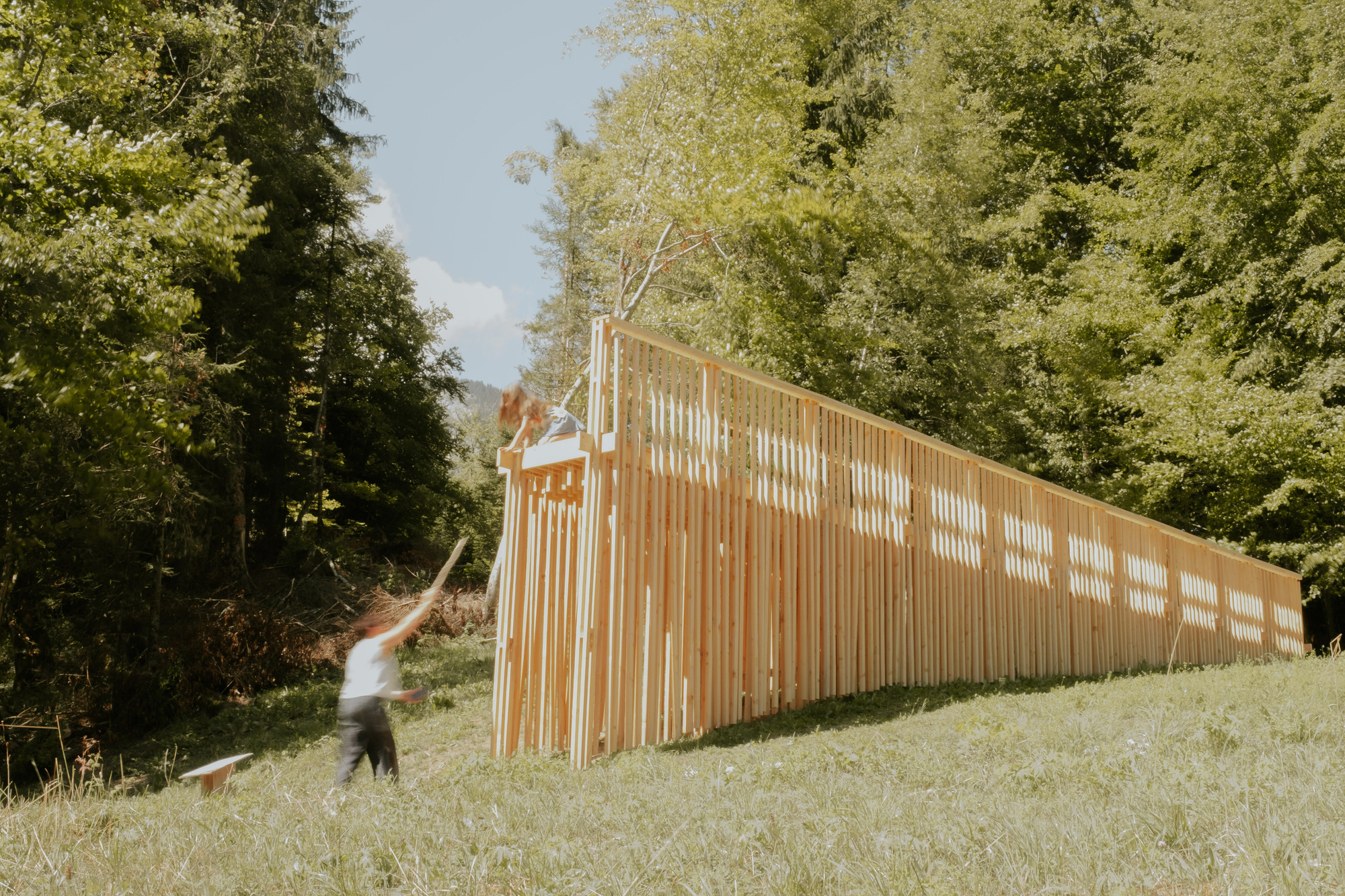
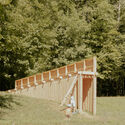
Nestled deep within the embrace of an imposing mountain valley, a newly completed architectural marvel is redefining how we think about materiality, acoustics, and landscape integration. Titled "The Sound of Wood" (Le Bruit du Bois), this striking project is the collaborative vision of architects Antoine Aunave, Flora Peyrot, Mathilde Steenhaut, and Luc Loviton. Curated by Nina Vuga, the project has quickly garnered international attention for its poetic yet rigorous approach to building in extreme environments.
Rather than imposing a foreign geometry upon the pristine topography, the design team has conjured a structure that listens to its environment, responding to the seasonal shifts of the valley with a sensitivity that bridges contemporary construction techniques and vernacular heritage.
Main Facts
Project The Sound of Wood (Le Bruit du Bois)
Architectural Team: Antoine Aunave, Flora Peyrot, Mathilde Steenhaut, and Luc Loviton
Curator: Nina Vuga
Location: Alpine Mountain Valley (Unclosed regional enclave)
Primary Material: Locally sourced regional timber
Typology: Rural/Alpine Architectural Intervention
Publication Date: September 20, 2026
The project sits in the hollow of a valley where the mountains act as natural guardians, shielding the enclave from the relentless commotion of the outside world. Here, the air carries a distinct density, saturated with a constant chill that the sun struggles to melt away from behind the soaring peaks. The architecture acts as both an observation post and an acoustic amplifier—capturing the profound silence of winter snowdrifts and the cautious, continuous humming of summer life on the slopes.
Chronology of the Project
The realization of The Sound of Wood is a tale of patience, community engagement, and meticulous planning across several years.
Phase 1: Conceptualization and Site Discovery (2022–2023)
The project began as an exploratory research initiative by Aunave, Peyrot, Steenhaut, and Loviton. Drawn to the stark contrasts of alpine settlements, the architects spent months camping and studying the microclimates of various remote mountain valleys. They sought a site where architecture could engage directly with natural acoustic phenomena—specifically, how valleys naturally amplify the resonance of wood during temperature transitions.
Phase 2: Material Sourcing and Community Collaboration (2023–2024)
Rejecting industrial supply chains that rely on imported, carbon-heavy materials, the design team partnered with local foresters and regional carpenters. Every log utilized in the primary structure was hand-selected from sustainably managed forests within a 20-kilometer radius. This phase also involved extensive town-hall style consultations with local residents to ensure the scale and positioning of the structure honored traditional land-use practices.
Phase 3: Construction and Climatic Adaptations (2024–2025)
Building in an alpine valley presents immense logistical hurdles, including heavy snowfall, narrow access roads, and short construction windows bounded by harsh winters. The team opted for prefabricated timber framing modules assembled on-site with minimal heavy machinery to preserve the fragile topsoil and root systems. The structural skeleton was completed just before the onset of the 2025 winter, allowing the wood to "settle" and acclimate to the sub-zero temperatures.
Phase 4: Final Curatorial Integration and Public Unveiling (2026)
Under the curation of Nina Vuga, interior spaces were finished to emphasize tactile qualities, light filtering, and acoustic resonance. The project officially opened its doors to researchers, artists, and the public in mid-2026, quickly establishing itself as a benchmark for contemporary rural architecture.
Supporting Data & Technical Specifications
To understand the engineering behind The Sound of Wood, one must look at the quantitative data that supports its sustainable footprint and structural resilience:
Carbon Footprint Reduction: Utilizing localized timber and low-impact foundations resulted in an estimated 74% reduction in embodied carbon compared to standard reinforced concrete structures of a similar size.
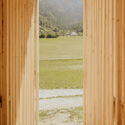
Thermal Performance: The building achieves a passive thermal envelope through deep-set triple-glazed windows and dense wood-fiber insulation, maintaining stable interior temperatures despite external swings from -20°C in winter to 25°C in summer.
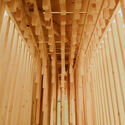
Acoustic Engineering: Interior wall panels are milled with variable micro-perforations designed to diffuse high-frequency mountain winds while amplifying the low, resonant tones of settling timber—giving literal meaning to the project’s title.
Site Footprint: The structure rests on adjustable screw-pile foundations, ensuring zero permanent excavation and allowing the landscape to be completely restored to its original state if required in the future.
Official Statements and Design Intentions
In a joint statement released by the architectural collective, the team elaborated on the philosophical core of their work:
"We did not want to build a monument that speaks over the landscape. Instead, we wanted to construct an instrument—a shelter that tunes itself to the rhythms of the valley. Wood is not merely a structural medium here; it is a living archive of the forest it came from. When the wind sweeps down the ridge, the building breathes, creaks, and sings. It reminds its inhabitants that they are part of a larger, living ecosystem."
Curator Nina Vuga emphasized the socio-cultural importance of the project in contemporary architectural discourse:
"In an era dominated by glass towers and homogenous urban development, Antoine Aunave, Flora Peyrot, Mathilde Steenhaut, and Luc Loviton have proposed a radical alternative. ‘The Sound of Wood’ demonstrates that high design does not require high-tech detachment from nature. By listening to the materials and the topography, they have created a timeless sanctuary that speaks softly yet carries immense cultural resonance."
Local municipal leaders have similarly praised the initiative, noting that the project has revitalized interest in traditional regional carpentry trades and sustainable forestry management.
Implications for Future Alpine and Rural Architecture
The completion of The Sound of Wood arrives at a critical juncture for architectural practice globally. As climate change alters weather patterns in mountainous regions and rural depopulation threatens local crafts, projects of this nature offer a roadmap for sustainable development.
1. Re-evaluating Materiality
The success of the project challenges the hegemony of concrete and steel in difficult terrains. By demonstrating that engineered local timber can meet stringent structural and thermal standards, the architects have provided a scalable model for eco-conscious building in fragile ecosystems.
2. Architecture as an Acoustic Interface
Historically, architecture has treated sound as a nuisance to be blocked out through insulation. The Sound of Wood flips this paradigm on its head, treating sound as a spatial dimension. By designing spaces that interact harmoniously with environmental noise (wind, rain, thermal expansion), the project opens new avenues for sensory-driven architectural design.
3. Sustainable Regionalism
The collaboration between international designers and local artisans highlights a path forward that avoids the pitfalls of both globalization (which erodes local identity) and insular regionalism (which rejects innovation). This hybrid approach ensures that rural enclaves can benefit from cutting-edge design intelligence while preserving their ecological and cultural integrity.
As visitors and architectural critics continue to journey into the valley to experience The Sound of Wood firsthand, the project stands as a testament to what can be achieved when architects stop shouting at their environments and, instead, learn how to listen.




Leave a Reply