

By Global Environmental Desk
Published: March 2026
Main Facts
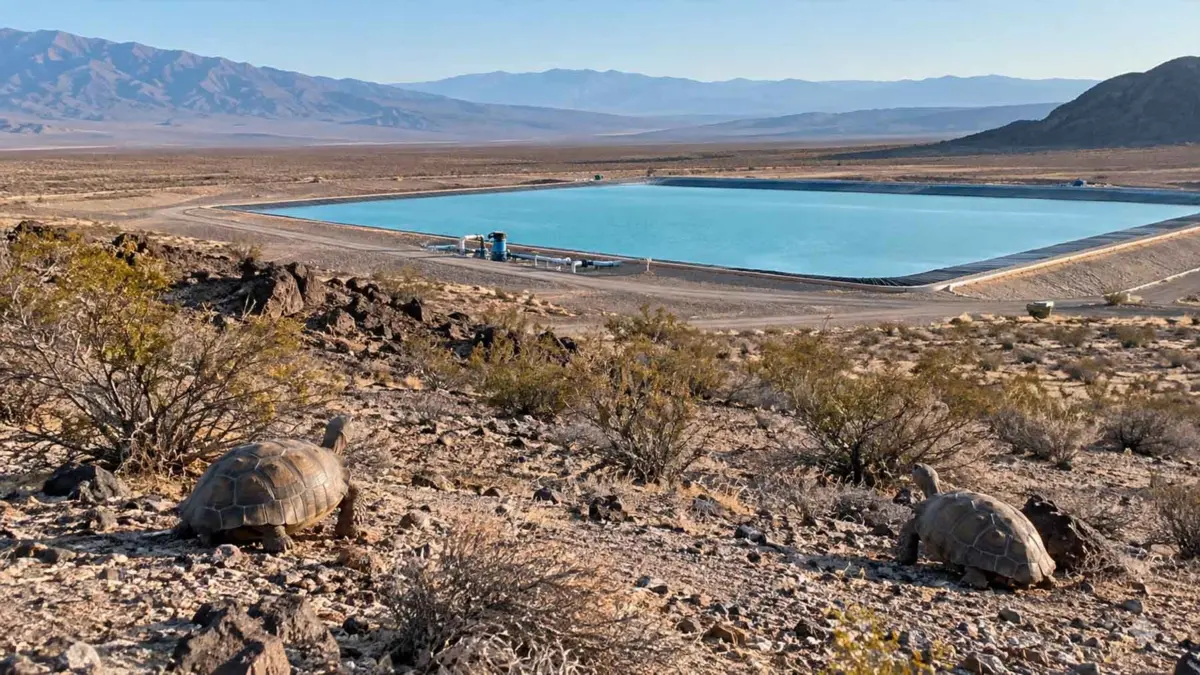
The global transition toward a green economy and electric mobility has unleashed an unprecedented scramble for "white gold"—lithium. As the United States pushes to secure domestic supply chains for electric vehicle batteries, the arid landscapes of Nevada and California have become Ground Zero for mineral extraction.
However, a landmark scientific study published in Global Ecology and Conservation (Clifford et al., 2025) has laid bare a profound ecological paradox: the very regions slated for expansive lithium mining overlap dangerously with fragile, irreplaceable desert ecosystems. Far from being empty, lifeless expanses of sand, the Great Basin and surrounding deserts harbor delicate wetlands, hydrothermal springs, and isolated micro-habitats that support rare species found nowhere else on Earth.
Researchers cross-referenced 55 proposed lithium extraction projects spanning 1.33 million acres across Nevada and California with the ranges of vulnerable, threatened, or endangered wildlife and plant species. The results are alarming:
- 54 vulnerable or endangered species could face direct or indirect threats if all proposed projects move forward.
- 20 species are acutely compromised due to their tight geographic overlap with extraction sites.
- 17 of these 20 species depend entirely on desert wetlands (springs, seeps, and marshes)—fragile micro-environments easily disrupted by drops in subterranean water tables.
- 7 species have 100% of their known global distribution confined within the boundaries of proposed lithium projects.
While the mapping study does not imply that all 55 projects are currently operational—nor that environmental damage is an absolute certainty—it serves as a critical early warning system. It highlights the acute vulnerability of localized species whose entire existence hangs by a thread across just a few acres of desert soil.
Chronology: The Escalating Conflict Over the Desert
The collision course between renewable energy development and biodiversity conservation has been decades in the making, but recent milestones highlight a fast-accelerating crisis:
- Early 2020s: As federal policies in the United States prioritize domestic critical mineral production to combat climate change, staking claims for lithium exploration across Nevada and California surges exponentially.
- 2024: The controversial Rhyolite Ridge lithium and boron mining project in Nevada receives vital federal approval, sparking fierce pushback from environmental groups and Indigenous nations concerned over the fate of the Tiehm’s buckwheat (Eriogonum tiehmii), a rare wildflower whose entire global population is confined to roughly 10 acres of the project site.
- Late 2024 / Early 2025: A multidisciplinary team of scientists—comprising researchers from institutions such as M. J. Clifford, S. S. Parker, L. Saito, B. S. Cohen, N. S. Fraga, K. Heintz, and D. Saftner—completes and publishes a comprehensive spatial risk assessment mapping 55 proposed lithium projects against biodiversity hotspots.
- March 2026: A federal judge formally rejects a legal challenge brought by conservationists and Indigenous groups seeking to overturn the federal approval of the Rhyolite Ridge project, ruling that current mitigation strategies are legally sufficient.
- April 2026: Environmental coalition plaintiffs swiftly appeal the federal court’s decision, ensuring that the legal battle over the delicate balance between green energy infrastructure and endangered species protection will continue in higher courts.
Supporting Data and Geographic Scope
To understand the scale of the potential conflict, it is necessary to examine the metrics compiled by the 2025 research team. The study evaluated an area covering 1.33 million acres dedicated to 55 distinct lithium mining and extraction proposals.
The Water Factor in an Arid Landscape
Lithium extraction in the American West typically relies on one of two methods: hard-rock open-pit mining or direct lithium extraction (DLE) and conventional brine pumping. Both methodologies are water-intensive. In the Great Basin, aquifers are delicate, ancient, and often interconnected.
The study’s data reveals a stark ecological dependency:
- Out of the 20 most highly compromised species, 85% (17 species) rely directly on desert aquatic habitats—including thermal springs, alkaline meadows, and desert wetlands.
- These wetlands represent a fraction of a percent of the total desert landscape, yet they act as evolutionary arks for aquatic snails, desert pupfish, endemic amphibians, and specialized halophytic (salt-tolerant) plants.
- When brine or groundwater is pumped out to extract lithium, surrounding water tables can drop. Even a minor drawdown can permanently desiccate a spring-fed wetland, causing localized extinctions in a matter of months.
The Micro-Habitat Trap
Traditional conservation biology often deals with wide-ranging mammals or migratory birds that can theoretically relocate if their habitat is disturbed. The species threatened by Great Basin lithium projects face a different reality: evolutionary isolation.
Because Nevada and California were shaped by ancient inland seas and changing tectonic activity, many species evolved in extreme isolation. Trapped in single valleys or isolated mountain ranges, these organisms have nowhere else to migrate. If their micro-habitat is destroyed by industrial footprints, roads, evaporation ponds, or toxic dust plumes, the species vanishes entirely from the planet.
Official Responses and Stakeholder Perspectives
The clash between green technology and ecological preservation has divided policymakers, industry leaders, conservationists, and local communities.
The Energy Sector and Federal Regulators
Proponents of the lithium boom argue that the extraction of critical minerals is an absolute national security and ecological imperative. Without domestic lithium, transitioning away from fossil fuels and meeting aggressive decarbonization targets to halt global warming becomes mathematically impossible.
Federal agencies and mining companies maintain that modern environmental reviews under the National Environmental Policy Act (NEPA) are rigorous. They emphasize that projects like Rhyolite Ridge incorporate multi-million-dollar mitigation plans, including plant translocation experiments, fenced buffer zones, and strict groundwater monitoring, designed to allow green energy production and biodiversity to coexist.
Environmentalists and Indigenous Communities
Conversely, environmental advocates and tribal nations argue that sacrificing irreplaceable ecosystems in the name of fighting climate change is a false dichotomy.
In the case of the Tiehm’s buckwheat at Rhyolite Ridge, conservation groups point out that moving a plant whose entire global distribution fits into a few suburban backyards is a high-stakes gamble with poor odds of success. Indigenous groups have repeatedly raised concerns about cultural heritage sites, sacred springs, and the long-term degradation of traditional lands. They argue that true sustainability cannot involve wiping out native species or destabilizing fragile desert hydrology.
Implications: A Roadmap for Responsible Transition
The research by Clifford et al. (2025) does not suggest that society must choose between a livable climate and a living natural world. Rather, it exposes a critical blind spot in current regional planning: where we look determines what we protect.
1. Proactive Spatial Planning Over Reactive Litigation
Historically, mining projects are evaluated in isolation, one-by-one, without a cumulative regional view of how dozens of concurrent operations might stress a shared ecosystem. The spatial mapping approach demonstrates the necessity of cumulative impact assessments. Policymakers must identify "no-go" zones where ecological irreplaceability outweighs mineral value before capital is invested and permits are issued.
2. Redefining "Green" Energy
If a green transition destroys endemic biodiversity, its claim to sustainability is fundamentally compromised. True sustainability must account for biodiversity loss, hydrological integrity, and environmental justice.
3. Valuing the Unseen Desert
To the human eye driving across Nevada or California on Interstate 80, the desert can appear to be an empty, expendable wasteland. But science reminds us that beneath the surface crust and within hidden desert springs lies a vibrant tapestry of life that took millions of years to evolve. As the demand for lithium continues to skyrocket, the ultimate test for modern civilization will be whether it can power the future without erasing the ancient past.
Reference Study:
Clifford, M. J., Parker, S. S., Saito, L., Cohen, B. S., Fraga, N. S., Heintz, K., & Saftner, D. (2025). Potential impacts to biodiversity of rare and vulnerable species from proposed lithium extraction. Global Ecology and Conservation, 64, e03974. https://doi.org/10.1016/j.gecco.2025.e03974

Leave a Reply