
By Special Investigative Desk
Published in partnership with regional monitoring reports
Main Facts
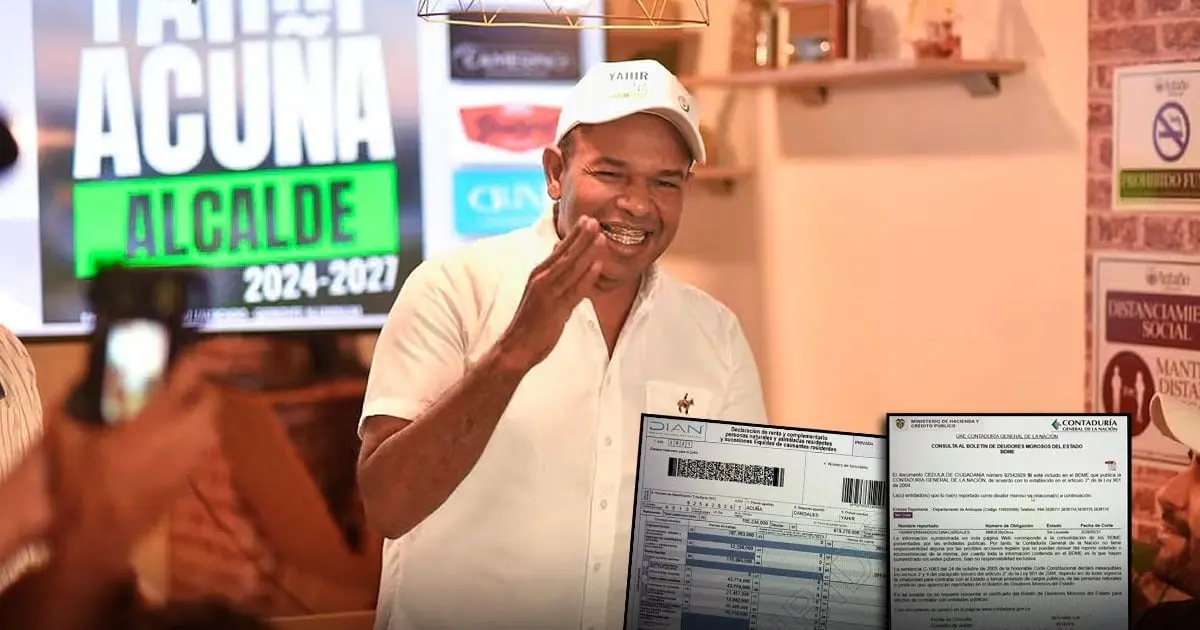
The political and financial landscape of Yahir Acuña Cardales, the current mayor of Sincelejo, Sucre, has become the epicenter of a national controversy following severe public scrutiny over his personal wealth and administrative transparency. A comprehensive cross-examination of public databases—including the National Electoral Council (CNE), the Unique Information System for Public Function (SIGEP II), the National Directorate of Taxes and Customs (DIAN), the General Accounting Office of the Nation (CGN), and private credit bureaus—has revealed a stark contradiction between Acuña’s declared electoral expenditures and his official financial declarations.
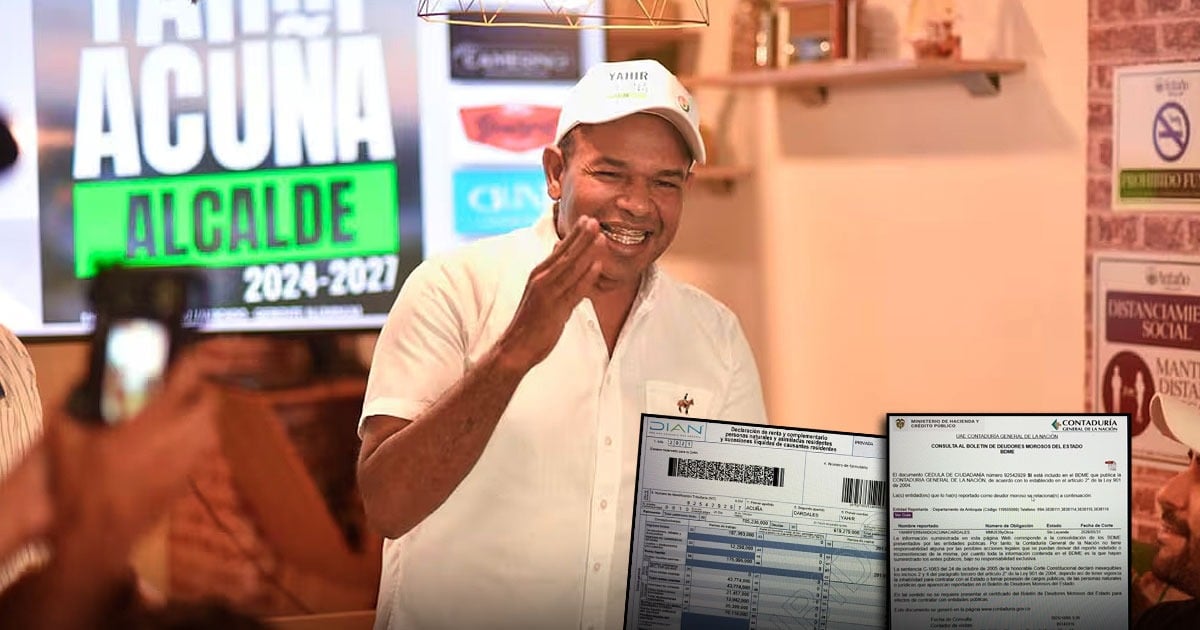
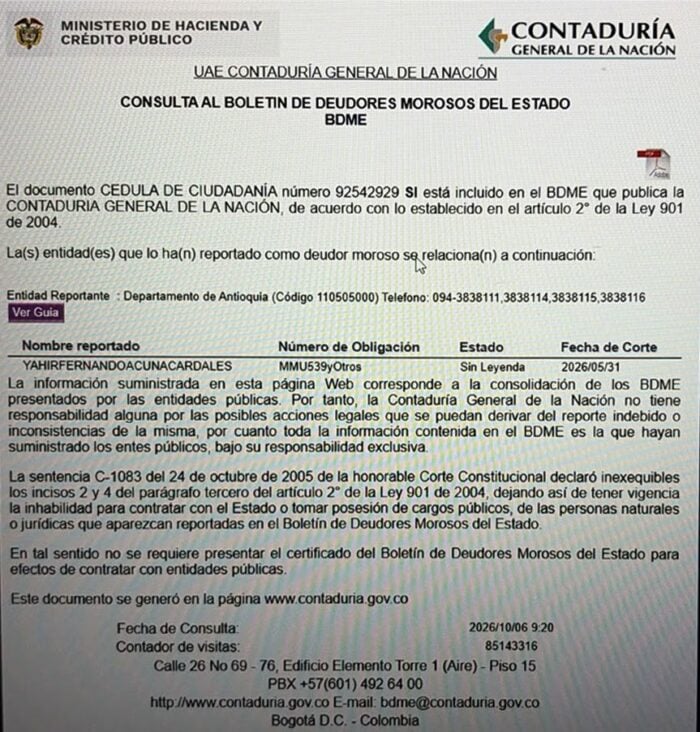
According to his public declarations of assets and income, Mayor Acuña currently reports liabilities exceeding $1,003,000,000 COP coupled with a net worth of $0 COP. Furthermore, his name appears on the General Accounting Office’s Registry of State Debtors (BDME) due to unpaid traffic and transit infractions totaling more than $10,000,000 COP registered in the department of Antioquia.
This financial puzzle emerged into the national spotlight following direct statements from the executive branch, notably when high-level warnings were issued regarding the administration of public resources under Acuña’s leadership, citing thirteen active preliminary investigations against him, including one for alleged public enrichment. While the mayor has vehemently defended himself by invoking the constitutional presumption of innocence and dismissing the accusations as a political "false positive," the mounting documentary evidence has invited unprecedented public and institutional scrutiny into his asset evolution, campaign funding, and real estate transactions.

Chronology of Events and Political Trajectory
To understand the current financial paradox surrounding Mayor Yahir Acuña, it is essential to trace his political movements and asset declarations over the past several electoral cycles:
- October 2021: A political and judicial storm erupts in the Sucre savanna when a campaign caravan associated with Acuña’s political circle is intercepted by authorities. Inside one of the vehicles, law enforcement discovers $500 million COP in cash. At the time, his then-wife, Milene Jarava, was running for the departmental governorship. Acuña later claimed the funds originated from real estate transactions, though the Prosecutor General’s Office noted that the corresponding deeds were notarized the day after the cash seizure, fueling allegations of potential vote-buying investigated by the Electoral Observation Mission (MOE). The investigation was ultimately archived.
- 2019 Gubernatorial Campaign: Acuña runs for the Gobernación de Sucre, reporting total campaign income of $830 million COP, of which 74.7% ($620 million COP) derived from personal or family loans and contributions, while 25.3% ($210 million COP) came from private donations. No commercial bank loans were registered.
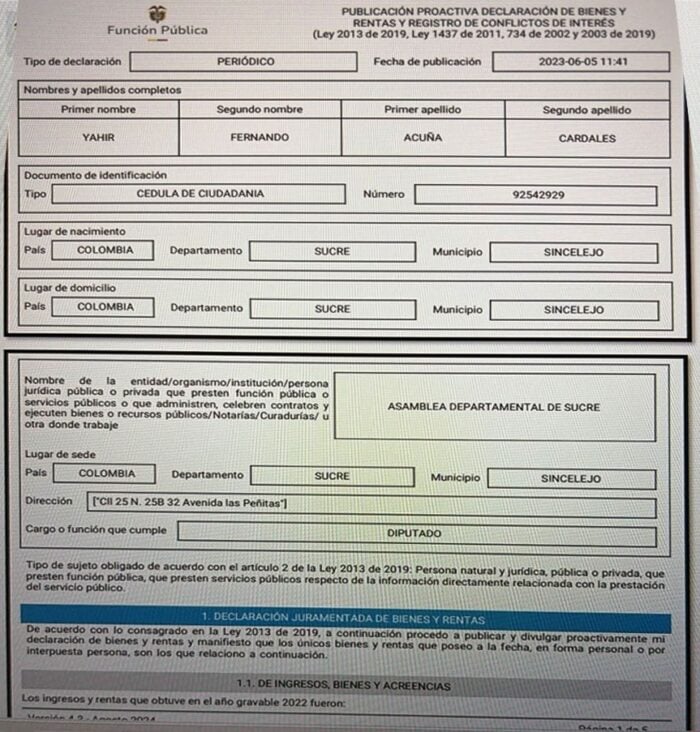
- June 2023 (As Deputy of Sucre): In his official asset declaration for the 2022 taxable year, Acuña reports a savings account containing $32.1 million COP, a property in Coveñas valued at $850 million COP, and total debts amounting to $67.7 million COP.
- October 2023 Mayoral Campaign: Acuña finances his successful campaign for the Mayoralty of Sincelejo under the Partido de la U, officially reporting $888 million COP in total revenues. Crucially, 100% of these funds are reported as originating from his own patrimonio and that of his family, with zero commercial bank financing, state contributions, or third-party donations. Campaign expenses totaled $887,963,320 COP, primarily concentrated on electoral propaganda ($526.6 million COP) and public events ($202 million COP).
- April 2024–2025 (As Mayor of Sincelejo): In his mayoral asset declaration for the 2023 taxable year (published in April 2025), the exact same property in Coveñas drops in declared value by 50%, down to $425 million COP. Total liabilities skyrocket to over $1.003 billion COP, resulting in a declared net worth (patrimonio líquido) of $0 COP.
- March 17, 2025: Acuña contracts a new marriage with Sofía Isabella Méndez Torres, registered at Notary 3 of Sincelejo. Questions immediately arise regarding whether this marital union and its associated conjugal partnership have been factored into current asset transparency and anti-corruption inquiries.
- August–October 2026: Financial intelligence reports flag multiple active credit obligations, including a blocked BBVA savings account and a Bancoomeva credit card past due by more than 60 days, running concurrently with his tenure as chief executive of the capital of Sucre.
Supporting Data and Financial Analysis
The friction points in Yahir Acuña’s financial profile are best understood through a granular look at the data retrieved from state transparency portals and financial system registries:
1. The Real Estate Depreciation Mystery
The sudden halving of the valuation of Acuña’s real estate asset in the coastal municipality of Coveñas remains one of the most glaring discrepancies in his public record:
- 2022 Declaration (As Assemblyman): Coveñas property valued at $850,000,000 COP.
- 2023 Declaration (As Mayor): The identical property is revalued at $425,000,000 COP—a sudden loss of 50% ($425 million COP) in value within a single fiscal year, defying standard real estate market trends in desirable Caribbean resort towns.
2. The Income-Debt Paradox
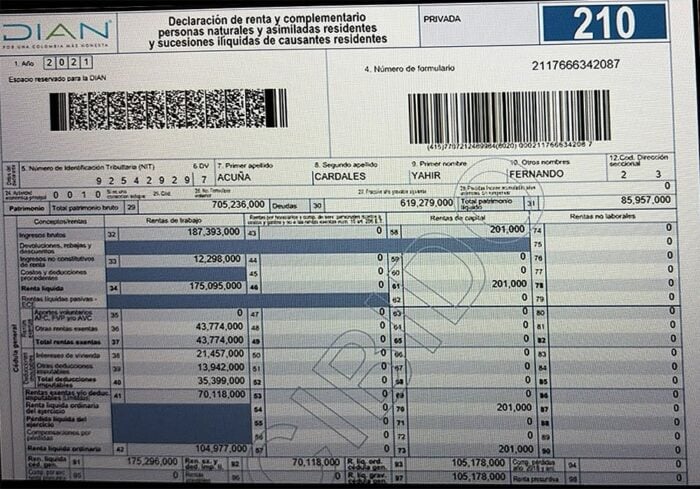
Acuña’s tax returns submitted to the DIAN and the SIGEP II system outline a precarious, yet curiously funded, financial existence:

- Gross Patrimony: Declared at $620,049,000 COP.
- Total Debts: Reported at $1,003,211,000 COP (comprising a $107 million bank loan and nearly $896 million in other credits).
- Net Worth: $0 COP.
- Business Holdings: Consistent negative results when cross-referenced with the Single Registry of Business and Social Cooperatives (RUES); Acuña reports zero active commercial enterprises, private economic activities, or foreign investments.
3. State Debtor Registry and Transit Infractions
Acuña’s appearance on the Boletín de Deudores Morosos del Estado (BDME) managed by the General Accounting Office stems from an unresolved financial obligation tied to a motor vehicle bearing license plate MMU539, registered in the department of Antioquia. The debt involves unpaid traffic tickets, transit penalties, and associated local taxes exceeding $10,000,000 COP. Notably, historical records show a vehicle with this exact license plate was linked to political campaigns in the Sucre region.
While historical legal frameworks once barred individuals on the BDME list from holding public office or contracting with the state, the Colombian Constitutional Court’s Sentence C-1083 of 2005 established that inclusion on this list does not inherently strip a citizen of their political or administrative eligibility.
Official Responses and Institutional Positions
The executive branch and local authorities have adopted markedly divergent postures regarding the unfolding situation:
- The Federal Administration: High-ranking government officials, including statements echoed by presidential representatives, have publicly questioned the moral and institutional fitness of regional leaders facing multiple active criminal and disciplinary investigations. By withholding direct discretionary public funds or expressing a lack of institutional trust, the national government has signaled a zero-tolerance approach toward executives dogged by corruption inquiries.
- Mayor Yahir Acuña’s Defense: Acuña has forcefully rejected the allegations, categorizing the scrutiny and the public airing of his administrative and financial background as political persecution or a "false positive." He has repeatedly emphasized his legal right to the presumption of innocence, arguing that pending investigations do not equate to judicial convictions and maintaining that his private and public financial movements have complied with the letter of the law.
- Control and Electoral Entities: Agencies such as the National Electoral Council (CNE), the Prosecutor General’s Office (Fiscalía General de la Nación), and the General Accounting Office continue to maintain active databases and historical inquiries. While previous high-profile cash seizures involving his political network were ultimately archived due to legal technicalities surrounding retroactive paperwork, watchdog organizations like the Electoral Observation Mission (MOE) continue to call for tighter, more transparent cross-auditing of campaign financing in the Caribbean coast.
Implications for Governance and Transparency
The case of Sincelejo’s mayor transcends local politics, carrying profound implications for institutional integrity and democratic accountability in Colombia:
- The Integrity of Campaign Financing: The revelation that a major municipal campaign ($888 million COP in 2023) was financed 100% through self-reported personal and familial wealth—while the candidate simultaneously declares a net worth of zero and over a billion pesos in debt—raises systemic questions about the efficacy of CNE’s Cuentas Claras monitoring system. It underscores the vulnerability of local elections to opaque financial engineering.
- Public Trust in Decentralized Administration: When a municipal executive is locked in financial precarity—evidenced by personal bank accounts under embargo, credit card defaults, and state debtor registry listings—questions naturally arise regarding conflicts of interest, executive distraction, and the proper stewardship of public budgets.
- The Limit of Declarations of Assets: The drastic, unexplained devaluation of real estate assets between fiscal years highlights persistent flaws in self-reporting accountability mechanisms. If public officials can substantially alter asset valuations without immediate challenge from oversight bodies like SIGEP II or the DIAN, the transparency intended by public asset declarations risks becoming an empty formality.
As investigative reports continue to map out Acuña’s real estate holdings, marital assets, and credit behaviors, pressure mounts on Colombia’s judicial and fiscal control bodies to provide definitive legal clarity on whether the mayor’s financial declarations reflect legitimate economic hardship, administrative restructuring, or systemic obfuscation of illicit wealth.