

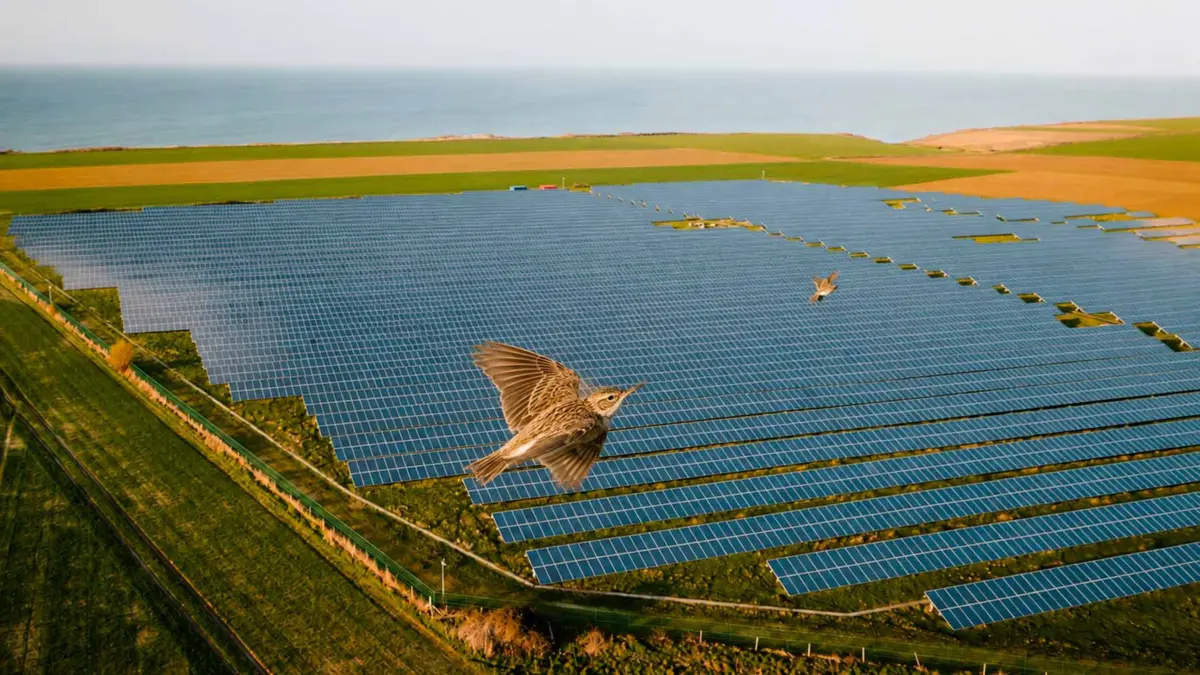
LAUTERBACH, HESSEN — For decades, the landscape in the central German region of Hesse was defined by the relentless rumble of heavy agricultural machinery, the sharp scent of synthetic fertilizers, and the sterile monotony of intensive crop farming. Today, however, a profound and inspiring acoustic transformation has taken root. Where chemical-driven monocultures once suppressed most forms of non-crop wildlife, the air is now filled with the complex, trilling songs of dozens of protected bird species.
This dramatic shift is the result of an innovative 55-hectare photovoltaic installation in Lauterbach. Developed and operated by the renewable energy firm Enerparc, this modern solar park challenges a long-standing environmental dilemma: the friction between land-intensive green energy infrastructure and the preservation of natural habitats. By intentionally integrating ecological management into the core design of the facility, the Lauterbach project demonstrates that clean energy production and biodiversity conservation do not merely coexist—they can actively reinforce one another.
As global demand for renewable energy accelerates land acquisition, this German case study offers a compelling blueprint for how the energy transition can be engineered to benefit, rather than burden, local ecosystems.
1. Main Facts: The Lauterbach Paradigm
At first glance, the Lauterbach solar park looks like many other utility-scale photovoltaic installations proliferating across Europe. Rows of dark, gleaming silicon panels tilt toward the sun, soaking up solar radiation to power thousands of homes with clean electricity. Completed in 2022, the 55-hectare site was engineered to maximize energy yield.
However, the true innovation of the Lauterbach facility lies not in what it generates above ground, but in how the ground itself is treated.
Traditional agricultural practices on the plot involved frequent tilling, heavy machinery, and the widespread application of pesticides and chemical fertilizers. These methods created a biological desert, hostile to ground-nesting birds and sensitive fauna. When Enerparc acquired the land to construct the solar park, the agricultural cycle was permanently halted.
In place of crops and chemicals, the operators introduced a regenerative land-management strategy. Vegetation was allowed to regenerate naturally between and beneath the solar modules, supplemented by the targeted sowing of native flowering plants. The intentional spacing between rows of panels was widened to ensure sufficient open corridors—not just for maintenance vehicles, but crucially, to provide the flight paths and nesting territories required by grassland bird species.
The results have stunned even seasoned conservationists. The cessation of intensive farming, combined with the structural shelter and shade provided by the elevated panels, transformed a degraded agricultural tract into a thriving ecological sanctuary.
2. Chronology of a Transformation: From Agriculture to Acoustic Monitoring
To truly understand the magnitude of the ecological change at Lauterbach, researchers and environmental consultants had to track the site across a multi-year timeline, moving from baseline mapping to cutting-edge technological evaluation.
2018–2019: The Baseline Assessment
Before a single photovoltaic module was erected, the environmental consultancy firm Plan Ō was commissioned to conduct a comprehensive fauna mapping of the 55-hectare plot. Given the history of heavy pesticide use and industrial tilling, the findings were predictable and sparse. The land offered virtually no cover, food security, or safe breeding grounds for native wildlife. During this baseline period, field observers identified a paltry four to five breeding territories of the Eurasian skylark (Alauda arvensis) across the entire expanse.
2022: Construction and Commissioning
Physical construction of the photovoltaic plant began and concluded in 2022. During the build-out, planners kept ecological restoration in mind, ensuring minimal soil compaction and laying the groundwork for low-impact vegetation management. As the last cables were laid and the inverters switched on, the soil was given its first season to rest, recover, and revert to a wild state.
2023–2024: Early Recovery and Annual Censos
In the immediate years following construction, annual environmental impact assessments were initiated. Field biologists noted an immediate, spontaneous return of diverse weed and grass species. Insects, previously suppressed by agricultural chemicals, rebounded exponentially, providing an abundant food source for insectivorous birds and small reptiles.
2025: The AI-Powered Acoustic Revolution
To eliminate human bias and capture a more accurate, continuous picture of the park’s ecology, a groundbreaking monitoring system was deployed in 2025. Provided by environmental tech firms Hula Earth and AviCon, this next-generation system utilized advanced artificial intelligence and acoustic sensors distributed strategically across the solar park.
Rather than relying solely on sporadic human spot-checks, acoustic sensors recorded the ambient soundscape of the installation 24/7. Sophisticated algorithms analyzed thousands of hours of audio data, recognizing the unique vocalizations, mating calls, and territorial songs of local avian species.
The findings, processed through this automated monitoring network, revealed an extraordinary leap in biodiversity. Most notably, the skylark population had not merely survived the industrialization of the land—it had exploded. The latest acoustic census registered an astounding 20 distinct skylark territories within the solar park boundaries, marking a quadrupling of the population compared to the pre-construction baseline.
3. Supporting Data and Broader Biodiversity Findings
While the skylark (Alauda arvensis) serves as the flagship species for the success of the Lauterbach project due to its specific habitat requirements, it is far from the only beneficiary of the park’s ecological management.
Data compiled from both traditional field surveys and the 2025 AI acoustic monitoring campaign highlight a rich mosaic of returning wildlife. Species of high conservation concern—many of which are listed on regional red lists or face severe habitat loss across Central Europe—have established permanent footholds within the fenced, protected perimeter of the solar farm.
Key Species Documented in the Lauterbach Solar Park:
- Eurasian Skylark (Alauda arvensis): Increased from 4–5 territories pre-construction to 20 territories post-restoration. The birds utilize the open spaces between panel rows for their elaborate vertical display flights and ground-nesting.
- Northern Wheatear (Oenanthe oenanthe): A ground-dwelling migratory songbird that favors open, stony, or sparsely vegetated terrain, finding ideal micro-habitats around the base structures of the solar mounts.
- Common Quail (Coturnix coturnix): A secretive, ground-nesting game bird that benefits greatly from the cessation of mechanical harvesting and the dense, undisturbed cover of natural meadow grasses.
- Whinchat (Saxicola rubetra) and European Stonechat (Saxicola rubicola): Perching birds that utilize the elevated tips of solar infrastructure and tall native weeds as vantage points to hunt insects.
- Reptile Populations: Various indigenous lizard species have been recorded thriving on the sun-baked, pesticide-free gravel beds and rocky outcrops surrounding the inverter stations.
The convergence of solar energy generation and ecological diversity yields a mutual benefit: the panels provide intermittent shade that prevents soil from drying out entirely during intense summer heatwaves, creating micro-climates that support drought-resistant flora and the insects that depend on them. In turn, the vegetative cover prevents soil erosion and manages stormwater runoff far more effectively than bare agricultural earth.
4. Official Responses and Industry Perspectives
While the data emerging from Lauterbach is undeniably promising, industry analysts and environmental scientists urge a balanced, critical perspective when evaluating the broader implications of the project.
A key nuance in the reporting of these results is their origin. A significant portion of the monitoring data and ecological assessments has been publicized and supported by Enerparc, the private developer and commercial operator of the Lauterbach solar park. Corporate-backed environmental studies, while often methodologically rigorous, must always be contextualized within the corporate interest of demonstrating green credentials and satisfying regulatory ESG (Environmental, Social, and Governance) requirements.
Independent ornithologists and ecologists have weighed in on the findings, offering a consensus that balances optimism with caution.
"The Lauterbach project provides a clear proof-of-concept that solar parks can function as biodiversity refuges," notes Dr. Sabine Weber, an independent landscape ecologist based in Frankfurt. "However, we must be careful not to generalize this single success story across all terrain types. The ecological outcome depends entirely on how the land is managed. If a solar park is paved with gravel, sprayed with herbicides, or intensely grazed by livestock without management limits, it remains an ecological dead zone."
Specialists emphasize that these positive biodiversity outcomes are not a passive byproduct of putting up solar panels. They are the direct result of an active, long-term commitment to ecological land management. If operators cut corners, reduce monitoring, or revert to aggressive weed-clearing techniques, the fragile gains made by species like the skylark and northern wheatear could easily be reversed.
Enerparc representatives have publicly acknowledged this responsibility, stating that the company views ecological stewardship not as an optional corporate social responsibility checkbox, but as an integral component of modern solar asset management. By partnering with tech firms like Hula Earth and AviCon, the company aims to set a new benchmark for transparent, data-driven environmental monitoring across its portfolio.
5. Future Implications: Redesigning the Global Energy Landscape
As nations worldwide race to meet aggressive decarbonization targets under the Paris Agreement, the demand for utility-scale solar energy continues to skyrocket. This expansion inevitably triggers land-use conflicts, often pitting renewable energy developers against agricultural lobbies and environmental protection groups concerned about habitat fragmentation.
The experience at Lauterbach, Hesse, points toward a harmonious resolution of this conflict: agrivoltaics and ecologically integrated solar design.
By reimagining solar farms not as industrial power plants isolated from nature, but as dual-purpose landscapes capable of generating clean electrons while simultaneously restoring native flora and fauna, society can bypass the false dichotomy between climate action and biodiversity preservation.
Key Takeaways for the Future of Solar Development:
- Mandatory Ecological Baselines: Future solar projects should be required to conduct thorough pre-construction fauna mapping, identifying sensitive native species and tailoring site design to protect their specific behavioral needs (such as open flight corridors for skylarks).
- Abandonment of Chemical Regimes: The total elimination of synthetic pesticides, chemical fertilizers, and constant tilling within solar installations is a non-negotiable prerequisite for soil and insect recovery.
- Technological Integration: The deployment of AI-driven acoustic monitoring systems, as tested in Lauterbach in 2025, represents the future of environmental auditing. Continuous, non-invasive acoustic sensors allow operators to track ecological health in real time without disturbing wildlife.
- Long-Term Corporate Commitment: Biodiversity management cannot be a short-term marketing stunt. Long-term agreements between energy operators, ecological consultants, and local authorities are essential to guarantee decades of responsible land stewardship.
Conclusion
In a world increasingly gripped by the dual crises of climate change and biodiversity loss, the transformation of a chemically scarred tractor field in Lauterbach into a vibrant songscape of protected birds offers a rare and powerful note of hope. It proves that human ingenuity can build infrastructure that heals the earth rather than exploits it.
If policymakers, energy developers, and conservationists can scale the lessons learned in Hesse, the future global energy transition will do more than simply power our homes with clean electricity—it will actively rebuild the wild heart of our natural world, one solar panel at a time.


Leave a Reply