

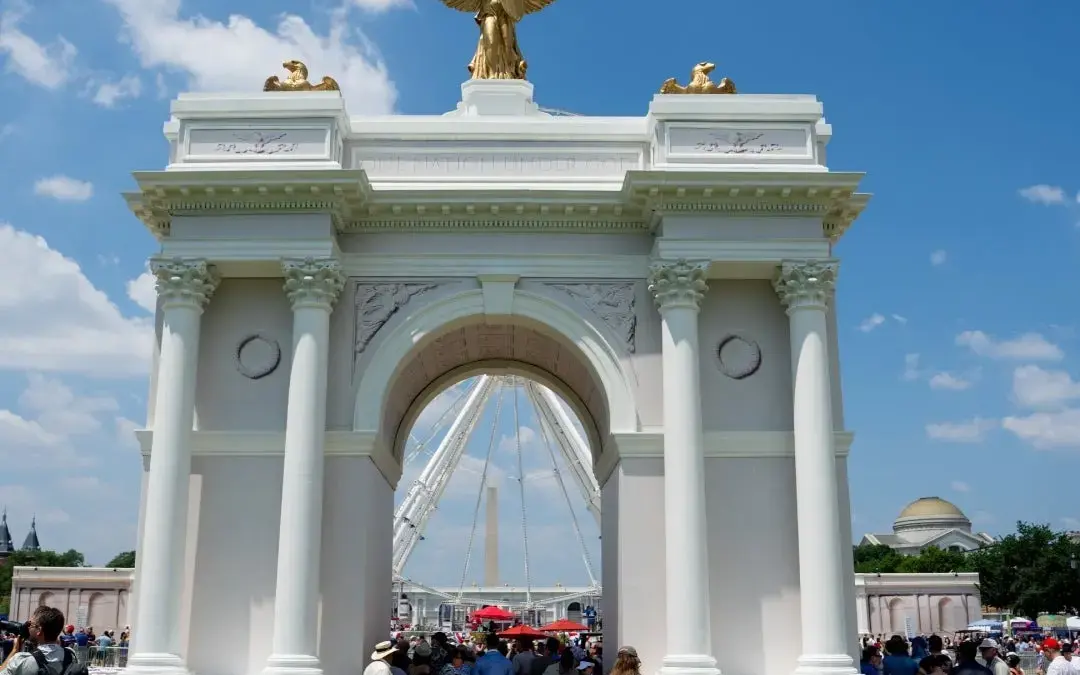
WASHINGTON, D.C. — In a move that has reignited intense debates over the architectural and security landscape of the nation’s capital, President Donald Trump has proposed a radical redesign of his planned triumphal arch. Under the new proposal, the monument would be transformed into a dual-use facility named the "Military Complex/Arc de Triomphe." According to the President, the structure would not only serve as a monument but also function as an active military installation equipped to store and deploy combat drones, host sniper nests, and stockpile high-caliber ammunition.
The proposal represents the latest and most dramatic shift in President Trump’s ongoing effort to leave a permanent, monumental imprint on Washington, D.C. However, the introduction of active military capabilities to a public monument has raised profound questions among urban planners, aviation safety experts, and national security analysts. Critics question whether the project will compromise the aesthetic integrity of the capital’s historic core, violate airspace regulations near Ronald Reagan Washington National Airport, or unnecessarily militarize the symbolic heart of American democracy.
Main Facts: The "Military Complex/Arc de Triomphe"
The controversy stems from a social media post published by President Trump, in which he outlined a revised, highly militarized vision for the grand triumphal arch he has long advocated building at Memorial Circle.
According to the President’s post, the redefined "Military Complex/Arc de Triomphe" would feature:
- Drone Infrastructure: Dedicated facilities to house, store, and rapidly deploy a substantial fleet of unmanned aerial vehicles (UAVs).
- Tactical Sniper Positions: Designated sniper zones located on both the roof of the arch and within the surrounding plaza areas.
- Ammunition Depots: Integrated secure storage units designed to hold large quantities of specialized sniper ammunition.
The proposed location for the monument is Memorial Circle, a highly sensitive geographic node situated on the Virginia side of the Arlington Memorial Bridge. This location places the structure directly between two of the nation’s most revered landmarks: Arlington National Cemetery and the Lincoln Memorial.
Furthermore, the site sits in close proximity to Ronald Reagan Washington National Airport (DCA), placing it directly beneath critical flight paths. While the Federal Aviation Administration (FAA) had previously granted a preliminary green light to the arch project—on the condition that it include high-visibility obstruction lighting—the sudden addition of active drone operations and military storage introduces a host of new regulatory and safety complications.
Chronology of the Project
The concept of erecting a triumphal arch in Washington, D.C., has evolved over several years, reflecting President Trump’s long-standing interest in classical architecture and military pageantry.
[2017: Bastille Day Inspiration]
       │
[First Term: Initial proposals for military-style monument in D.C.]
       │
[Second Term: Push for Memorial Circle Triumphal Arch]
       │
[Mid-Second Term: FAA issues conditional approval based on safety lighting]
       │
[Recent: Proposal for White House Ballroom with rooftop drone port]
       │
[Present: Social media announcement of "Military Complex/Arc de Triomphe"]
The Genesis of the Arch
The President’s fascination with grand monumentality first became prominent during his first term, particularly following his attendance at the 2017 Bastille Day parade in Paris. Impressed by the French military display and the historic Arc de Triomphe, Trump repeatedly expressed a desire to bring similar architectural grandeur and military celebrations to the United States.
The Second-Term Push for Permanent Legacy
During his second term, President Trump has accelerated efforts to reshape the capital’s physical landscape. The administration has pushed federal planning agencies to approve a series of classical monuments, arguing that Washington’s modern architectural additions lack the gravity and permanence of its older neoclassical landmarks. The Memorial Circle arch emerged as the centerpiece of this legacy-building campaign.
The White House Ballroom Parallel
The militarization of the proposed arch mirrors a similar development regarding another of Trump’s pet architectural projects: a proposed grand ballroom for the White House. Initially conceived as a venue for state dinners and high-society galas, the President recently began emphasizing the defensive and military utility of the proposed ballroom. Specifically, he suggested incorporating a fortified rooftop drone port into the ballroom’s design, establishing a precedent for blending public or ceremonial spaces with active defense infrastructure.
The Sudden Pivot to Tactical Utility
The transition from a traditional ceremonial arch to the "Military Complex/Arc de Triomphe" occurred abruptly on Sunday. The President’s social media announcement caught many federal planners and defense officials off guard, signaling a shift from a purely symbolic tribute to the military to an active tactical installation.
Supporting Data and Geographic Context
The physical and operational parameters of the proposed "Military Complex/Arc de Triomphe" place it at the center of a complex web of geographic, logistical, and safety challenges.
| Parameter | Details / Specifications |
|---|---|
| Proposed Location | Memorial Circle (Potomac River transit corridor) |
| Aesthetic Proximity | Directly between Arlington National Cemetery and the Lincoln Memorial |
| Aviation Proximity | Less than 2 miles from Ronald Reagan Washington National Airport (DCA) |
| Airspace Class | Class B Airspace / Washington, D.C. Flight Restricted Zone (FRZ) |
| Initial FAA Status | Conditionally approved (requires obstruction lighting) |
| New Security Features | Rooftop/plaza sniper nests, drone launchpads, ammo storage |
The Aviation Challenge
Reagan National Airport (DCA) is famous for its highly challenging river visual approach, which requires commercial aircraft to navigate a tight corridor along the Potomac River to avoid restricted airspace over federal buildings.
A massive arch at Memorial Circle would sit directly adjacent to these flight paths. The FAA’s initial approval was contingent upon strict height limitations and the installation of safety lighting to prevent collisions during low-visibility conditions. However, operating a drone launch and recovery facility within the Washington, D.C. Flight Restricted Zone (FRZ)—one of the most heavily restricted airspaces in the world—presents unprecedented regulatory hurdles.
Historical Context of Washington’s Design
The proposed location at Memorial Circle is highly symbolic. Designed as part of the 1901 McMillan Plan, the Arlington Memorial Bridge and its surrounding plazas were intended to symbolize the reconciliation between the North and the South following the Civil War, physically and visually linking the Lincoln Memorial with Arlington House. Introducing a highly fortified, militarized structure into this specific vista would fundamentally alter a design that has remained preserved for over a century.
Official Responses and Public Reaction
The President’s proposal has drawn sharp criticism and sparked intense debate across various sectors, from urban planners to military strategists.
Historic Preservationists and Urban Planners
The National Coalition to Save Our Mall and various historic preservation societies have expressed alarm over the proposal.
"The National Mall and its surrounding commemorative works are designed to celebrate democratic values, unity, and historic achievements," said a spokesperson for a leading historic preservation trust. "Turning a monument into an active military garrison with sniper nests and drone bays contradicts the open, democratic character of our nation’s capital. It threatens to turn a space of reflection into a symbol of fortification."
Aviation and Security Experts
Aviation safety analysts have expressed deep skepticism regarding the feasibility of operating drones in such close proximity to a commercial airport.
"The airspace around DCA is incredibly congested and highly sensitive," noted a retired FAA airspace manager. "Even small consumer drones are strictly banned in this area. Operating military-grade drones from a fixed monument situated right next to the airport’s approach path is an air traffic control nightmare. It introduces an unacceptable risk of mid-air collisions or signal interference."
Military and Defense Perspectives
While some defense commentators suggest the proposal could provide a unique vantage point for securing the National Mall during high-profile events like inaugurations or State of the Union addresses, others within the military establishment view the plan as impractical.
"The military already has highly sophisticated, discreet methods for securing the capital," a retired Army officer commented. "Establishing a highly visible, permanent sniper nest and ammunition depot on top of a tourist attraction is tactically unnecessary and creates an obvious target for adversaries."
Implications: Aesthetics, Security, and the Capital’s Future
The proposal to build the "Military Complex/Arc de Triomphe" carries deep implications that extend far beyond architectural taste.
The Militarization of Civic Space
For over two centuries, Washington, D.C. has balanced the need for robust security with the desire to remain an open, accessible capital city. While security measures have increased significantly since the September 11 attacks, they have largely been designed to blend into the landscape.
The integration of active military operations directly into a monumental arch represents a departure from this philosophy. It suggests a new model of civic architecture where monuments double as defensive fortifications, potentially altering how both citizens and foreign visitors perceive the American capital.
Jurisdictional and Legal Battles
The realization of the President’s vision faces a daunting gauntlet of federal bureaucracy. Any modification to structures in this area requires approval from multiple federal agencies, including:
- The National Capital Planning Commission (NCPC)
- The Commission of Fine Arts (CFA)
- The National Park Service (NPS)
- The Federal Aviation Administration (FAA)
These agencies operate under strict statutory mandates to preserve the historic, aesthetic, and environmental qualities of the capital. A proposal to store ammunition and operate military drones at Memorial Circle would likely face protracted legal and administrative challenges from these bodies, setting up a major confrontation between executive ambition and established federal planning processes.
The Legacy of the Second Term
Ultimately, the "Military Complex/Arc de Triomphe" serves as a powerful symbol of President Trump’s broader approach to his second term. By pushing boundaries on monument design, aviation safety, and the use of military force within domestic spaces, the administration is challenging long-standing norms. Whether the arch is built in this highly militarized form or remains a provocative concept, the proposal has permanently altered the conversation surrounding presidential legacies, national security, and the symbolic identity of the United States capital.



Leave a Reply