

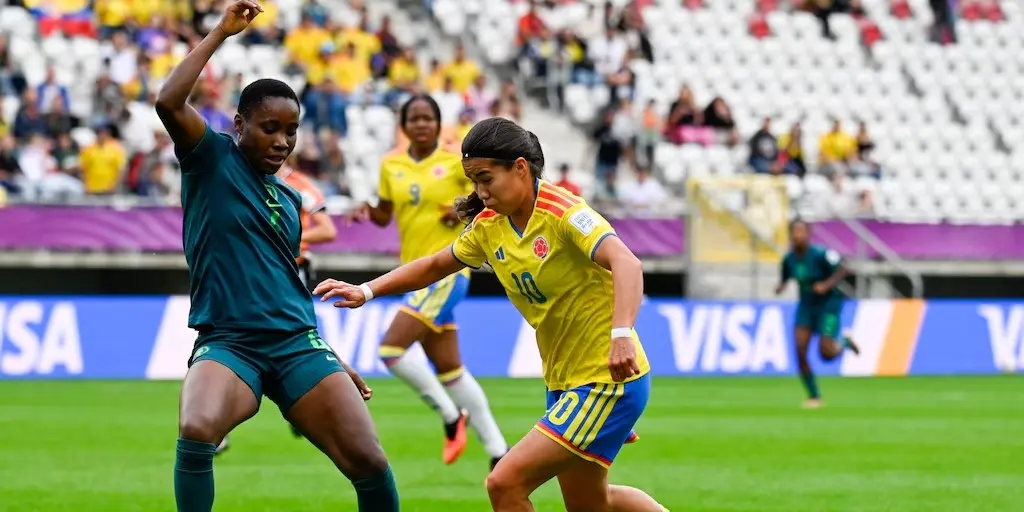
BOGOTÁ / POLAND — In what has rapidly evolved into a defining chapter for the nation’s burgeoning footballing landscape, the Colombia Under-20 women’s national team takes to the pitch today at 11:30 a.m. (local time) to face the formidable squad of North Korea. The high-stakes fixture, corresponding to the semifinals of the prestigious FIFA U-20 Women’s World Cup currently taking place in Poland, represents far more than a mere athletic contest; it is a battle for continental pride, psychological redemption, and a coveted ticket to the global tournament’s ultimate match.
The journey of the Cafeteras to this advanced stage has captured the imagination of millions back home, serving as a testament to resilience, tactical evolution, and the relentless growth of women’s football in South America. Yet, as the squad prepares for the most important ninety minutes of their young careers, they do so under the weight of severe squad limitations, tactical dilemmas, and the haunting memory of a heavy group-stage defeat against the very opponents standing in their way today.
Main Facts
The core narrative heading into this semifinal fixture is defined by the sheer magnitude of the achievement coupled with the immediate logistical hurdles facing the technical staff. Colombia has secured its place among the final four teams of the tournament—a feat that solidifies the nation’s status as a rising superpower in youth development—following a grueling and emotional path through the knockout rounds.
However, the road to the final is paved with significant obstacles. The Colombian technical director, Carlos Paniagua, will be forced to orchestrate a tactical masterclass without two of his most influential leaders on the field. Captain and midfield anchor Juana Ortegón, alongside defensive stalwart Sintia Cabezas, have been ruled out of the semifinal clash due to suspension. Both players received crucial yellow cards during the tense quarterfinal victory over Nigeria, accumulating the tournament threshold that mandates a one-match ban.
Compounding the defensive puzzle is the return of central defender Lina Arboleda. Arboleda has completed a mandatory three-match suspension stemming from a red card shown during the group-stage encounter against Portugal. Her absence was deeply felt across the matches against South Korea in the group phase, Poland in the Round of 16, and Nigeria in the quarterfinals. Her reintegration into the starting lineup provides a much-needed physical presence at the back, though integrating her back into a high-stakes defensive line after a prolonged absence presents its own tactical risks.
Furthermore, the psychological dimension of this fixture cannot be overstated. Colombia and North Korea are already intimately familiar with one another, having crossed paths during the third matchday of the group stage. On that occasion, the Asian powerhouse delivered a clinical, sobering 3-0 defeat to the South Americans. That match serves as the primary historical baseline for today’s encounter, establishing North Korea as the tactical benchmark and the heavy favorite on paper, while leaving Colombia with the arduous task of drastically reinventing their approach to alter the outcome.
Chronology
To fully comprehend the gravity of today’s semifinal, it is essential to retrace the chronological evolution of Colombia’s campaign in Poland—a tournament characterized by steep learning curves, dramatic turnarounds, and emotional crescendos.
The campaign began with cautious optimism. Expectations surrounding the squad were tempered by the sheer quality of the global field, with many pundits doubting whether this particular generation could replicate or surpass the exploits of previous Colombian youth teams. The group stage opened with structural tests that required immediate adjustments from Paniagua and his coaching staff.
The defining fracture of the group phase occurred during the third matchday against North Korea. Matched against an opponent renowned for suffocating tactical discipline, relentless physical stamina, and clinical precision in the final third, the Colombian side unraveled. North Korea dismantled the South American defense, capitalizing on transitional errors and capitalizing on set-pieces to secure a comprehensive 3-0 victory. Compounding the sporting disaster was the disciplinary crisis that saw Lina Arboleda receive a red card, leaving her teammates to navigate the subsequent defensive crisis without one of their primary anchors.
Despite the heavy blow, the team recalibrated. Forced to navigate the Round of 16 against host nation Poland without Arboleda, the Cafeteras displayed a resilient defensive shell and a newfound tactical pragmatism. They absorbed intense pressure from the partisan Polish crowd, weathered physical duels, and ultimately secured a hard-fought victory that propelled them into the elite bracket of the tournament.
The momentum carried over into the quarterfinals, where Colombia met a fiercely athletic and unpredictable Nigerian side. In what many analysts have described as the most emotionally charged match of the tournament for the South Americans, the players dug deep into their reserves. Despite accumulating the yellow cards that would ultimately rob them of Ortegón and Cabezas for the semifinals, Colombia secured a monumental victory, prevailing through sheer force of will, tactical discipline, and decisive moments in front of goal. This triumph not only etched their names into the history books but also set the stage for today’s dramatic rematch against their group-stage tormentors.
Supporting Data
A granular examination of the tournament statistics reveals both the vulnerabilities and the astonishing efficiencies that have characterized Colombia’s run to the semifinals.
Offensively, the team has relied on explosive individual brilliance coupled with collective defensive grit. However, the numbers from the group-stage encounter against North Korea paint a stark picture of the tactical mismatch that occurred weeks ago. In that fixture, North Korea dominated possession in critical zones, limiting Colombia to a meager number of shots on target while dictating the tempo through superior circulatory passing and high-intensity pressing.
- Group Stage Encounter Metrics (Colombia vs. North Korea):
- Final Score: North Korea 3 – 0 Colombia
- Possession Share: North Korea 58% – 42% Colombia
- Shots on Target: North Korea 9 – 2 Colombia
- Disciplinary Record (Colombia): Multiple yellow cards, 1 Red Card (Lina Arboleda)
Conversely, the knockout phases showcased a transformed Colombian defensive block. Against Nigeria in the quarterfinals, despite conceding territorial dominance, the backline—operating under immense stress—blocked numerous attempts and capitalized on transitional phases.
- Disciplinary and Squad Impact Data for Today’s Match:
- Suspended Players: Juana Ortegón (Captain/Midfielder), Sintia Cabezas (Defender) — Accumulated yellow cards.
- Returning Player: Lina Arboleda (Defender) — Eligible after serving a 3-match suspension (Portugal red card).
- Tournament Stage: Semifinal (Winner advances to the FIFA U-20 Women’s World Cup Final; Loser enters the Third-Place Playoff).
These data points underscore the razor-thin margins error confronting the coaching staff today. The absence of Ortegón deprives the team of its primary midfield metronome and defensive shield, while the reintegration of Arboleda requires instant cohesion against an Asian side known for exploiting any momentary lapse in defensive synchronization.
Official Responses
The atmosphere within the Colombian camp following their quarterfitting triumph was a mixture of unbridled joy, spiritual relief, and hyper-focused determination. Speaking to the press in the immediate aftermath of securing their semifinal berth, head coach Carlos Paniagua offered candid reflections on the journey so far and the mentality required to face the challenges ahead.
"We are very happy, thrilled by everything we are experiencing, happy for the players because this has been a humble group that came to this World Cup," Paniagua stated, his voice carrying the emotional weight of a grueling campaign. "Perhaps people didn’t believe much in us at the start, and now we are in a semifinal. But right now, we are going for more."
Acknowledging the extreme difficulty of the task at hand—particularly given the context of their previous encounter against North Korea and the crippling absence of key starters—the manager emphasized preparation and psychological resilience.
"It will not be easy," Paniagua admitted, addressing the media with characteristic pragmatism. "They are an exceptionally well-prepared opponent with distinct tactical advantages, but we will prepare for the match in the absolute best possible way. The girls know what is at stake, and our focus has immediately shifted to executing our game plan with absolute discipline."
Players echoed their coach’s sentiments, emphasizing that the 3-0 defeat in the group stage served as a profound educational experience rather than a permanent psychological scar. Within the closed doors of the team hotel, leadership groups—even in the absence of the suspended captain Juana Ortegón—have stepped up to foster an environment of collective responsibility, vowing to leave every ounce of energy on the Polish turf.
Implications
The ramifications of today’s semifinal clash extend far beyond the immediate confines of the tournament in Poland, holding monumental significance for the future of Colombian football, gender equality in regional sports investment, and the international prestige of South American women’s athletics.
A victory today would propel the Colombia U-20 team into the global final, a milestone that would eclipse previous generations and fundamentally alter the expectations placed upon upcoming female cohorts. It would validate the long-term structural investments—however incremental—made by the Colombian Football Federation (FCF) and various regional leagues in recent years, providing undeniable proof that elite-level success is attainable on the world stage with proper development pathways.
Conversely, a defeat would not erase the historic nature of reaching the final four, but it would starkly highlight the developmental gap that still exists between South American tactical systems and the hyper-industrialized, highly disciplined athletic frameworks found in nations like North Korea. Should the tactical blueprint of their group-stage defeat repeat itself, it will trigger intensive technical reviews regarding youth academy conditioning, tactical adaptability under pressure, and squad depth.
Furthermore, the individual performances in this match carry severe market implications for the players themselves. Scouts from elite European and North American clubs are densely populated in the stands across Poland. Young talents navigating today’s high-pressure environment are auditioning for professional contracts that could transform their personal livelihoods and elevate the competitive level of the senior Colombian national team (La Tricolor) for the upcoming Olympic cycles and World Cups.
As the clock ticks down to 11:30 a.m., an entire nation pauses. In living rooms, public squares, and sports bars across Colombia, eyes are locked on the television screens. The girls in yellow, blue, and red step out onto the field not just as players, but as pioneers carrying the hopes of a football-obsessed country, ready to rewrite history against all odds.

Leave a Reply