

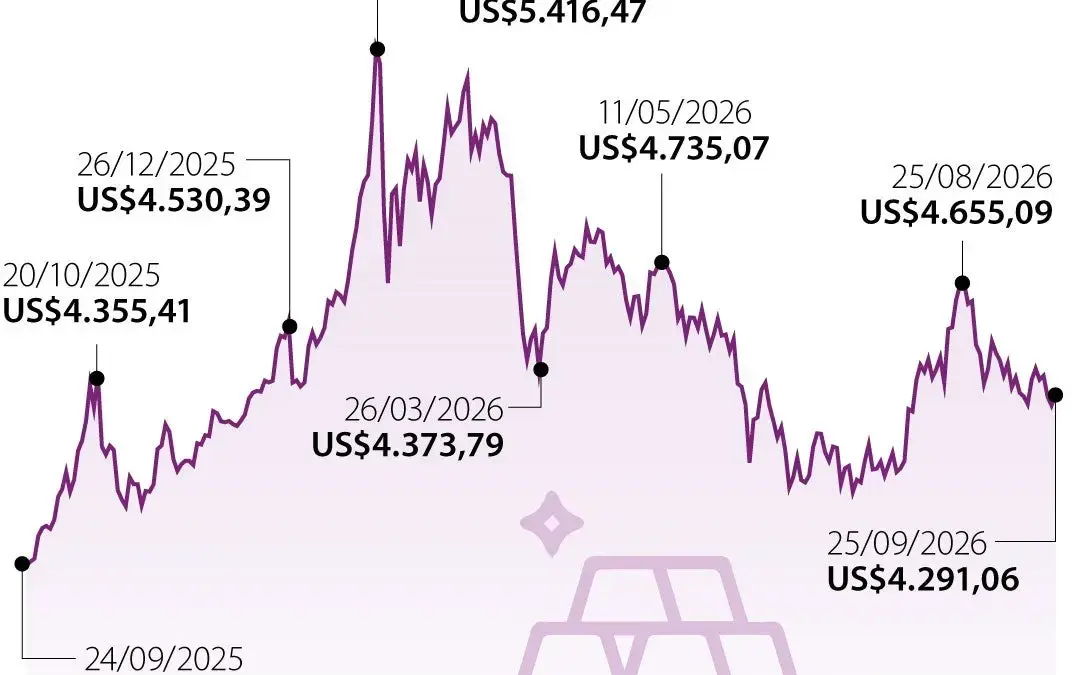
GLOBAL MARKETS — Gold prices edged up slightly during Friday’s European trading session, attempting a minor technical correction after days of heavy selling pressure. However, the precious metal remains firmly on track to register a substantial weekly decline. The overarching market narrative continues to be dictated by surging yields on United States Treasury bonds and aggressive monetary tightening expectations from the U.S. Federal Reserve, which have severely dented the appeal of non-yielding bullion assets.
At 08:44 GMT, spot gold registered a modest gain of 0.3%, trading at $4,291.06 per ounce. Despite this intraday uptick, the precious metal accumulates a steep decline of nearly 2% over the course of the week. Concurrently, U.S. gold futures (GCcv1) advanced 0.7%, reaching $4,326.60 per ounce.
Market analysts point out that while spot prices showed intermittent resilience, the broader macroeconomic environment remains hostile to gold and other precious metals, driven by relentless inflation prints, shifting geopolitical dynamics in the Middle East, and a resolute U.S. central bank determined to cool economic activity.
Main Facts
- Spot Gold Performance: Spot gold rose 0.3% to $4,291.06 per ounce at 08:44 GMT on Friday, but remains down by approximately 2% for the week.
- Futures Market: U.S. gold futures increased 0.7% to $4,326.60 per ounce.
- Yield Pressure: Yields on U.S. Treasury bonds held near multi-decade highs, directly increasing the opportunity cost of holding non-yielding bullion.
- Monetary Policy Expectations: Markets are pricing in a high probability of consecutive rate hikes by the Federal Reserve in the upcoming months, fueled by persistent inflation tied to energy and geopolitical strains.
- Geopolitical Backdrop: Diplomatic talks between U.S. and Iranian officials in New York are focusing on the critical Strait of Ormuz and potential economic sanctions relief.
- Broader Precious Metals Market: Silver, platinum, and palladium all posted minor intraday gains on Friday but are similarly tracking toward negative weekly finishes.
Chronology of Market Events and Economic Drivers
The trajectory of gold prices this week has been shaped by a rapid accumulation of macroeconomic and geopolitical catalysts that have progressively shifted investor sentiment.
Early Week: The Bond Yield Shock
At the onset of the week, gold faced immediate downward pressure as benchmark U.S. Treasury yields surged to levels not witnessed in nearly two decades. The aggressive repricing of fixed-income assets caught many equity and commodities traders off guard. As yields climbed, the opportunity cost associated with holding physical gold—which yields no interest or dividends—spiked dramatically. Investors increasingly reallocated capital away from safe-haven bullion into high-yielding government debt instruments, triggering a wave of long liquidation in gold futures and spot markets.
Mid-Week: Inflation Realities and Central Bank Rhetoric
As the week progressed, mid-week economic releases reinforced fears that inflation would remain stubbornly above the Federal Reserve’s target rate. Commodities markets reacted violently to ongoing supply chain bottlenecks and energy market disruptions originating from the Middle East. Analysts noted that market participants quickly abandoned hopes of a prolonged monetary policy pause by the Fed. Instead, trading desks began pricing in an accelerated path of rate hikes to combat entrenched price pressures.
Late Week: Geopolitical Friction and Minor Technical Bounce
By Friday, trading volumes concentrated on diplomatic developments in New York, where high-stakes negotiations between Washington and Tehran sought to address maritime security in the Strait of Ormuz. While these geopolitical negotiations offered intermittent safe-haven demand, they were largely overshadowed by the entrenched reality of higher-for-longer interest rates. During Friday morning European hours, spot gold managed a 0.3% recovery to $4,291.06 per ounce, driven largely by short-covering ahead of the weekend, though insufficient to erase the week’s cumulative 2% deficit.
Supporting Data and Quantitative Analysis
The quantitative underpinnings of the current commodities sell-off reveal deep structural shifts in investor positioning and monetary expectations.
According to data compiled from the CME Group’s FedWatch tool, market participants have drastically altered their outlook regarding the trajectory of the federal funds rate. Following the Federal Reserve’s decision last week to implement a quarter-point rate hike—its first policy tightening move in three years—officials signaled that additional increases would likely be necessary to cool the economy.
- October Rate Hike Probability: Current FedWatch probabilities indicate a 71% consensus among traders that the Federal Reserve will implement another rate increase at its October policy meeting.
- December Rate Hike Probability: Expectations for further monetary tightening deepen further toward year-end, with the probability of a subsequent rate hike in December surging to 95%.
- Opportunity Cost Metrics: With U.S. Treasury yields holding near two-decade highs, the real yield environment has turned increasingly positive. Historically, a rising real yield environment exerts significant downward pressure on gold prices, as the metal loses its relative attractiveness as a pure inflation hedge when cash and fixed-income assets offer substantial guaranteed nominal returns.
Performance metrics across the broader precious metals complex reflect a unified weekly downtrend:
- Silver: Spot silver managed a 1.1% gain on Friday, trading at $64.62 per ounce, yet remains locked in negative weekly territory.
- Platinum: Spot platinum rose 0.6% to $1,758.54 per ounce, but faces a similar weekly loss.
- Palladium: Spot palladium advanced 1.1% to $1,254.73 per ounce, rounding out a broadly bearish week for industrial-precious hybrids.
Official Responses and Expert Commentary
Financial market strategists and macroeconomic experts have offered varying perspectives on how the convergence of monetary policy, energy markets, and geopolitical negotiations will dictate the path of bullion in the medium term.
Nitesh Shah, Commodities Strategist at WisdomTree, emphasized the direct link between geopolitical chokepoints, inflation, and central bank behavior. In a note to clients, Shah stated:
"The continuous inflationary pressures are fueling anxieties regarding further rate hikes. These policy actions will likely persist until we see a definitive resolution regarding the logistical issues surrounding the Strait of Ormuz and the broader Middle Eastern region."
Shah’s commentary highlights how energy security remains fundamentally intertwined with global inflation metrics. Disruptions in Middle Eastern shipping lanes directly impact crude oil and refined product prices, which subsequently feed into headline Consumer Price Index (CPI) reports, compelling central bankers to maintain a restrictive monetary stance.
Concurrently, central bank officials have maintained a unified communications strategy. In statements following last week’s quarter-point rate increase, Federal Reserve governors stressed that while incoming economic data has shown pockets of resilience, price stability remains the absolute mandate. Officials noted that premature policy easing would risk unanchoring inflation expectations, a policy error from the 1970s that modern central bankers are eager to avoid. This uncompromising rhetoric has effectively capped upside rallies in gold, as traders realize that any sustained economic slowdown will be met with prolonged high interest rates rather than immediate monetary stimulus.
Implications for Global Markets and Investors
The current environment presents complex challenges and strategic adjustments for institutional investors, central banks, and retail market participants alike.
1. The Erosion of the Traditional Inflation Hedge Narrative
For decades, gold has occupied a sacrosanct position in institutional portfolios as the ultimate hedge against currency debasement and rising consumer prices. However, the current economic cycle has exposed a critical nuance: when inflation is combated by aggressive, rapid monetary tightening, the opportunity cost of holding a non-yielding asset often outweighs its inflation-mitigating benefits. Investors are increasingly forced to weigh the protective qualities of physical gold against the tangible, compounding returns offered by short-term government debt and money market funds.
2. Geopolitical Vulnerability and Energy Markets
The heavy reliance of precious metals pricing on geopolitical outcomes—specifically concerning the Strait of Ormuz—underscores the fragility of current supply chains. Should diplomatic efforts between the United States and Iran in New York yield a breakthrough that normalizes maritime transit and lifts sweeping economic sanctions, energy prices could experience a sharp downward correction. Such a de-escalation would likely relieve inflationary pressures, potentially causing markets to reprice Federal Reserve rate expectations and offering much-needed relief to bullion bulls. Conversely, a breakdown in negotiations could trigger renewed supply shocks, driving inflation expectations higher and locking the Fed into an even more aggressive tightening cycle.
3. Tactical Positioning in the Precious Metals Complex
While gold, silver, platinum, and palladium all face immediate weekly losses, industrial precious metals like silver, platinum, and palladium are navigating a dual reality. In addition to acting as safe-haven assets, these metals are critical industrial inputs for green energy technologies, automotive manufacturing, and electronics. Consequently, any broader macroeconomic slowdown engineered by central bank rate hikes poses a dual-edged threat: dampening both monetary investment demand and underlying industrial consumption.
Conclusion
As the trading week draws to a close, gold finds itself at a formidable macroeconomic crossroads. Trapped between the gravitational pull of multi-decade high Treasury yields, resolute Federal Reserve hawkishness, and volatile Middle Eastern geopolitics, the precious metal must navigate a treacherous financial landscape. Whether bullion can regain its upward momentum will depend almost entirely on incoming inflation prints, the tangible success of ongoing New York diplomatic talks, and whether global bond markets finally show signs of stabilization. Until these key variables find equilibrium, market volatility across the precious metals complex is widely expected to persist.




Leave a Reply