

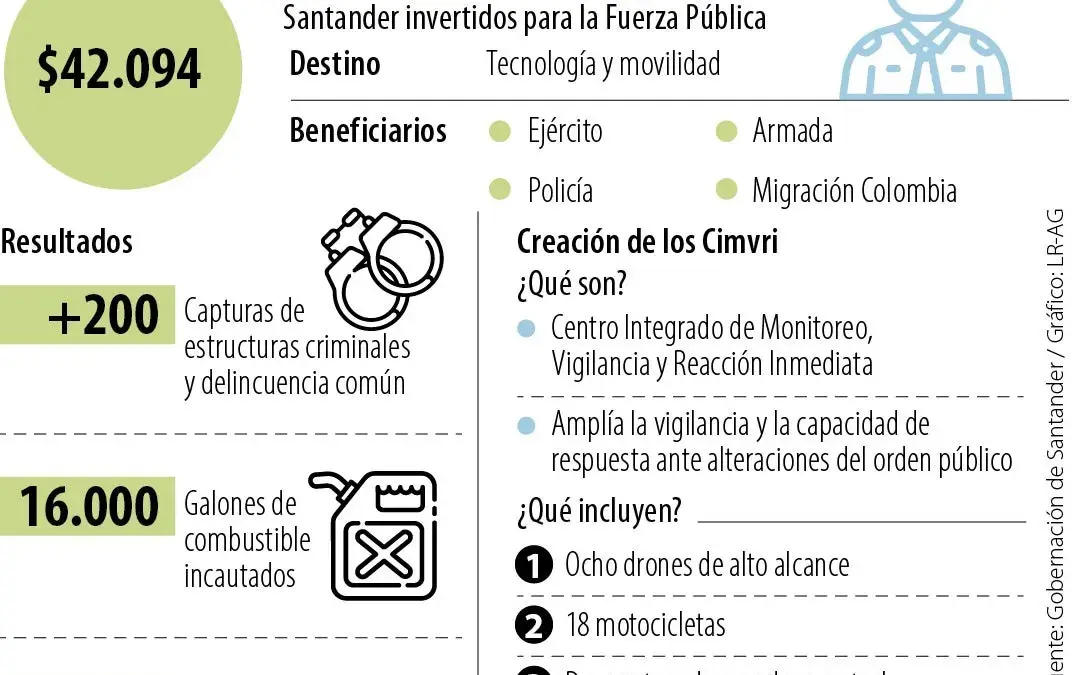
BUCARAMANGA, Colombia — In a bid to fortify its regional economy, stimulate private investment, and secure critical industrial and tourism assets, the Government of Santander (Gobernación de Santander) has launched a sweeping security offensive. Backed by a self-funded investment exceeding COP 42,094 million (approximately USD 10.5 million), the departmental administration is rolling out advanced technology, tactical mobility, and specialized logistics to bolster the operational capabilities of Colombia’s Public Forces (Fuerza Pública).
This strategic capital injection represents a milestone in regional governance, as the department utilizes its own resources (recursos propios) to bypass national bureaucratic delays. By equipping the National Army, the National Police, the Navy, Migration Colombia, and the prison system with state-of-the-art surveillance and rapid-response assets, Santander aims to create an ironclad environment of safety. The ultimate objective is clear: to cultivate deep-seated confidence among business leaders, domestic and foreign investors, and the millions of citizens who drive the department’s diverse economy.
Main Facts: The Anatomy of Santander’s Security Upgrade
At the heart of Santander’s upgraded security apparatus is the deployment of Integrated Monitoring, Surveillance, and Immediate Reaction Centers (Centros Integrados de Monitoreo, Vigilancia y Reacción Inmediata — CIMVRI). These high-tech hubs are designed to bridge the gap between real-time aerial intelligence and rapid ground-level tactical intervention, significantly expanding the territorial reach of state forces.
The CIMVRI Technological Package
Each CIMVRI is a self-contained, high-tech tactical unit designed to operate in both urban centers and rugged rural terrains. The standardized configuration of each center includes:
- High-Range Tactical Drones: Eight state-of-the-art unmanned aerial vehicles (UAVs) equipped with thermal imaging, high-definition optical zoom, and long-range telemetry. These drones can operate in adverse weather conditions, providing real-time aerial feeds to commanders on the ground.
- Tactical Ground Mobility: Eighteen high-displacement motorcycles optimized for rapid deployment and pursuit across difficult terrains, ensuring that response times to security breaches are kept to a minimum.
- Mobile and Fixed Command Centers: Interconnected control stations equipped with satellite communications, secure radio frequencies, and multi-screen displays to process live data feeds from the field.
- All-Terrain Drone Carrier: A specialized 4×4 vehicle engineered to transport drone operators, launch platforms, and auxiliary power supplies deep into remote areas, allowing for off-grid aerial operations.
Strategic Regional Placement
To maximize the impact of this investment, the departmental administration has focused its deployments on high-stakes economic corridors:
- Barrancabermeja: As the industrial heart of Colombia’s oil refining sector, this port city on the Magdalena River received the first CIMVRI to protect energy infrastructure and combat urban crime syndicates.
- San Vicente de Chucurí: Nestled in an agricultural and ecological hub, the second CIMVRI was delivered directly to the National Army’s Luciano D’Elhuyar Infantry Battalion. This unit secures the agricultural heartlands and key ecological assets.
- Cimitarra (Planned): The administration has confirmed that the third CIMVRI will be established in Cimitarra. This placement is strategically calculated to cover the volatile Magdalena Medio region, a historical transit corridor for illegal trade and armed groups.
Chronology of the Security Deployment
The rollout of Santander’s security strategy has been executed in carefully planned phases to ensure immediate operational integration and minimal disruption to ongoing security campaigns.
[Phase 1: Capital Allocation] -> [Phase 2: Barrancabermeja Launch] -> [Phase 3: San Vicente de Chucurí Deployment] -> [Phase 4: Palogordo Prison Expansion] -> [Phase 5: Planned Cimitarra Integration]Phase 1: Capital Allocation and Procurement (Early Stages)
The Gobernación de Santander authorized the diversion of over COP 42,094 million from its independent treasury. This decision allowed the local government to procure specialized military-grade and police-grade equipment without relying on national-level funding cycles, accelerating the acquisition of drones, vehicles, and tactical gear.
Phase 2: The Barrancabermeja Launch
Recognizing the critical vulnerability of Colombia’s largest oil refinery and the surrounding municipal port, the first CIMVRI was assembled and deployed in Barrancabermeja. This phase focused on integrating naval assets on the Magdalena River with aerial drone surveillance to curb illegal fuel tapping and riverine piracy.
Phase 3: Deployment to the Luciano D’Elhuyar Battalion
The second CIMVRI was officially handed over to the National Army in San Vicente de Chucurí. This deployment marked the transition of the technology from purely urban policing to counter-insurgency and rural asset protection, specifically targeting the security perimeter of the Topocoro Reservoir.
Phase 4: Expansion to the Palogordo Rural Zone in Girón
Recognizing a critical vulnerability in the regional penitentiary system, the administration extended the tactical capabilities of the San Vicente de Chucurí CIMVRI to cover the rural sector of Palogordo in the municipality of Girón. This sub-phase was designed to provide immediate, real-time aerial intelligence to the National Penitentiary and Prison Institute (INPEC) to secure the perimeter of the high-security prison located there.
Phase 5: The Upcoming Cimitarra Integration
The final phase of the current roadmap involves the installation of the third CIMVRI in Cimitarra. This upcoming deployment will seal the security ring around the Magdalena Medio region of Santander, establishing a continuous digital and physical surveillance net across the department’s western border.
Supporting Data: Operational Milestones and Economic Metrics
The financial commitment made by the Government of Santander is backed by concrete operational results. The coordination between the newly deployed technology and traditional military and police maneuvers has yielded significant blowback against organized crime.
| Security Metric / Asset | Quantified Value / Result | Strategic Impact |
|---|---|---|
| Total Financial Investment | COP 42,094,000,000+ (~USD 10.5M) | Funded entirely from departmental recursos propios |
| Criminal Apprehensions | 200+ Arrests | Targets both organized criminal structures and common offenders |
| Stolen/Contraband Fuel Seized | 16,000+ Gallons | Severely disrupts the illicit fuel market (paspas) |
| Illegal Pipeline Valves Destroyed | 66 Valves | Neutralizes direct tapping into Ecopetrol’s oil pipelines |
| Confiscated Transport Assets | 22 Vehicles | Restricts logistical and smuggling mobility of criminal gangs |
| Topocoro Dam Annual Tourism | 50,000+ Visitors | Protected by the San Vicente de Chucurí CIMVRI |
| Operational CIMVRI Units | 2 Active, 1 Planned (Cimitarra) | Combines aerial drone fleets, 4x4s, and motorcycles |
The seizure of over 16,000 gallons of fuel and the destruction of 66 illegal valves are particularly telling. In the Magdalena Medio region, illegal tapping of state-owned oil pipelines is a primary source of funding for illegal armed groups, including guerrilla factions and drug-trafficking cartels. By hitting these illegal tapping points, the security forces are directly dismantling the financial machinery of these organizations.
Official Responses and Strategic Alignment
The executive leadership of Santander has framed this security push not merely as a law-and-order campaign, but as a foundational economic policy.
The Gubernatorial Perspective
According to official statements from the Gobernación de Santander, the primary obstacle to sustained economic growth in the department has been the persistent threat of extortion, cargo theft on rural roads, and the vulnerability of industrial assets.
"Protesting and protecting the roads, our urban centers, our rural communities, our strategic assets, and our tourist destinations is synonymous with protecting employment, safeguarding businesses, and securing the supply chains that drive our departmental economy," the administration stated in a recent progress report. "With cutting-edge technology, expanded operational capacity, and seamless institutional coordination, our goal is to consolidate territories where people can produce, invest, and thrive without fear."
The "Acción Unificada" (Unified Action) Framework
To ensure that these technological assets are not wasted in administrative silos, the department has adopted the doctrine of Acción Unificada (Unified Action). This strategic framework synchronizes the intelligence-gathering and operational capacities of:
- The National Army (Ejército Nacional): Conducting deep-rural patrols and protecting critical infrastructure.
- The National Police (Policía Nacional): Managing urban security, judicial intelligence, and immediate response in municipal centers.
- The National Navy (Armada Nacional): Securing the navigable waterways of the Magdalena River.
- Migration Colombia (Migración Colombia): Monitoring transit corridors and regulating foreign national status to prevent transnational crime.
- INPEC: Ensuring that high-security detention facilities do not become command-and-control centers for extortion rings operating from behind bars.
Implications: Economic Revitalization, Tourism, and Infrastructure Protection
The aggressive deployment of the CIMVRIs and the associated COP 42 billion investment carry profound implications for the future of Santander, echoing across its agricultural, industrial, and tourism sectors.
Rebuilding Investor and Corporate Confidence
Santander is a powerhouse of poultry production, cacao farming, oil refining, and heavy manufacturing. However, these industries rely heavily on secure logistics. Highway robberies and rural extortion can quickly erode profit margins. By deploying highly mobile units capable of responding in real time to highway incidents, the department is actively lowering the "security premium" that local companies pay to operate. This reduction in risk is expected to attract fresh domestic and international corporate capital.
Improved Security -> Lower Operational Risk -> Increased Business Investment -> Job Creation & Economic GrowthSafeguarding the Tourism Boom at Topocoro
The Sogamoso Hydroelectric Dam created the Topocoro Reservoir, a stunning 5,000-hectare body of water that has rapidly transformed into an eco-tourism magnet, drawing over 50,000 visitors annually.
However, the rugged geography surrounding the reservoir makes it a challenging terrain to police. The allocation of the second CIMVRI to the Luciano D’Elhuyar Battalion ensures that the water body, its surrounding hotels, and the critical hydroelectric infrastructure of the Sogamoso Dam are under constant aerial surveillance. This visible security presence acts as a powerful deterrent against kidnapping and extortion, preserving Santander’s reputation as a safe, premium eco-tourism destination.
Fortifying the Penitentiary Perimeter in Girón
The extension of drone and rapid-reaction capabilities to the rural sector of Palogordo in Girón addresses a historically neglected security flank. High-security prisons are often flashpoints of tension, with prison guards (INPEC officials) frequently targeted by criminal organizations seeking to compromise prison security.
By utilizing high-range drones to monitor the external perimeter of the Palogordo facility and keeping an 18-motorcycle rapid-reaction force on standby, the state is providing a critical layer of protection for prison staff. This system allows authorities to detect smuggling attempts via drones, spot suspicious gatherings in the rural surroundings, and respond to escape attempts or coordinated attacks on prison transports in real time.
The Geopolitical Shield of Magdalena Medio
Cimitarra and the wider Magdalena Medio region have historically served as a strategic corridor for illegal armed groups moving between the interior of Colombia and the Caribbean coast. By placing the third CIMVRI in Cimitarra, Santander is establishing a technological gateway. This placement will allow security forces to choke off illegal trafficking routes, protect the vital Ruta del Sol highway, and insulate the department’s thriving interior from external security threats.
Through this calculated blend of multi-agency coordination, robust local funding, and cutting-edge aerial technology, Santander is redefining how departmental governments in Colombia approach regional security. Rather than waiting for national solutions, the Gobernación de Santander has taken its security—and by extension, its economic future—firmly into its own hands.


Leave a Reply