

The Royal Swedish Academy of Sciences announced the recipient of the 2026 Sveriges Riksbank Prize in Economic Sciences in Memory of Alfred Nobel on Monday, October 12, 2026. American economists Robert E. Hall and Michael Woodford were jointly awarded the prestigious honor for their foundational contributions to modern macroeconomic theory—specifically, their development of advanced analytical models that significantly enhance how policymakers understand and execute macroeconomic stabilization.
The 2026 prize includes a total cash monetary award of approximately US$1.1 million (11 million Swedish kronor), which will be divided equally between the two scholars, alongside gold medals and diplomas. The recognition places Hall, a senior fellow at Stanford University, and Woodford, a professor at Columbia University, among an elite group of 101 scholars honored since the prize’s inception in 1969.
Main Facts: Pioneering Frameworks for Economic Stabilization
The work of Robert E. Hall and Michael Woodford addresses one of the fundamental challenges in economics: how aggregate decisions made by millions of households and firm managers translate into overall economic fluctuations, and how governments and central banks can design policies to dampen these business cycles.
+-------------------------------------------------------------------------------+
|                        2026 ECONOMIC SCIENCES LAUREATES                       |
+-----------------------------------+-------------------------------------------+
| ROBERT E. HALL                    | MICHAEL WOODFORD                          |
| Stanford University               | Columbia University                       |
+-----------------------------------+-------------------------------------------+
| Primary Focus:                    | Primary Focus:                            |
| Household consumption behavior,   | New Keynesian macroeconomic synthesis,    |
| labor market dynamics, and        | interest rate rules, and central bank     |
| economic fluctuations.            | forward guidance.                         |
+-----------------------------------+-------------------------------------------+
| Core Impact:                      | Core Impact:                              |
| Integrated micro-foundations into | Transformed central bank operational      |
| macroeconomic stabilization theory.| frameworks for inflation targeting.       |
+-----------------------------------+-------------------------------------------+
Key Contributions of the 2026 Laureates
- Robert E. Hall (Stanford University): Pioneered empirical and theoretical analyses showing how forward-looking consumption decisions respond to income shocks. His research demonstrated that aggregate consumption behavior resembles a "random walk," establishing that households adjust spending based on long-term expectations rather than temporary income shifts. Hall also provided crucial frameworks for understanding labor market slack and persistent unemployment during downturns.
- Michael Woodford (Columbia University): Developed the modern theoretical architecture underpinning modern central banking, often called the "New Keynesian" synthesis. His landmark research showed how monetary policy operates effectively through interest rate rules and expectations management—establishing the theoretical basis for inflation targeting and forward guidance utilized by central banks globally.
By combining rigorous micro-foundations—the study of individual agent decisions—with aggregate policy objectives, Hall and Woodford reshaped macroeconomic theory. Their combined methodologies allow researchers and policymakers to evaluate how fiscal adjustments and monetary interventions propagate through complex market dynamics.
Chronology: The Evolution of the Economic Sciences Prize
While the Nobel Prizes in Physics, Chemistry, Physiology or Medicine, Literature, and Peace were established by Alfred Nobel’s 1895 will, the economics award was instituted decades later.
1968 ── Sveriges Riksbank establishes the Prize in Economic Sciences
 │
1969 ── First Prize awarded to Ragnar Frisch and Jan Tinbergen
 │
2007 ── Leonid Hurwicz becomes oldest laureate at age 90
 │
2009 ── Elinor Ostrom becomes first female laureate
 │
2019 ── Esther Duflo becomes youngest laureate at age 46
 │
2023 ── Claudia Goldin awarded for labor market gender studies
 │
2025 ── Joel Mokyr, Philippe Aghion, and Peter Howitt win for innovation models
 │
2026 ── Robert E. Hall and Michael Woodford awarded for stabilization models
Key Historical Milestones
- 1968: Sveriges Riksbank (Sweden’s central bank) celebrates its 300th anniversary by establishing the Sveriges Riksbank Prize in Economic Sciences in Memory of Alfred Nobel.
- 1969: The inaugural award is granted jointly to Dutch economist Jan Tinbergen and Norwegian economist Ragnar Frisch for their pioneering development of dynamic economic models.
- 2007: Leonid Hurwicz becomes the oldest recipient in history at age 90, recognized alongside Eric S. Maskin and Roger B. Myerson for establishing mechanism design theory.
- 2009: Political scientist and economist Elinor Ostrom breaks ground as the first female recipient, awarded for her analysis of economic governance and common pool resources.
- 2019: Esther Duflo becomes the second female laureate and the youngest person ever to receive the economics prize at age 46, shared with Abhijit Banerjee and Michael Kremer for experimental approaches to global poverty alleviation.
- 2023: Claudia Goldin becomes the third female laureate—and the first woman to win the prize as a solo recipient—for advancing the understanding of women’s labor market outcomes.
- 2025: The prize is conferred upon Joel Mokyr, Philippe Aghion, and Peter Howitt for their models analyzing innovation-driven economic growth and technological creative destruction.
- 2026: Hall and Woodford are named the recipients of the 58th edition of the award for their contributions to macroeconomic stabilization models.
Supporting Data: Demographics, Breakdown, and Prize Statistics
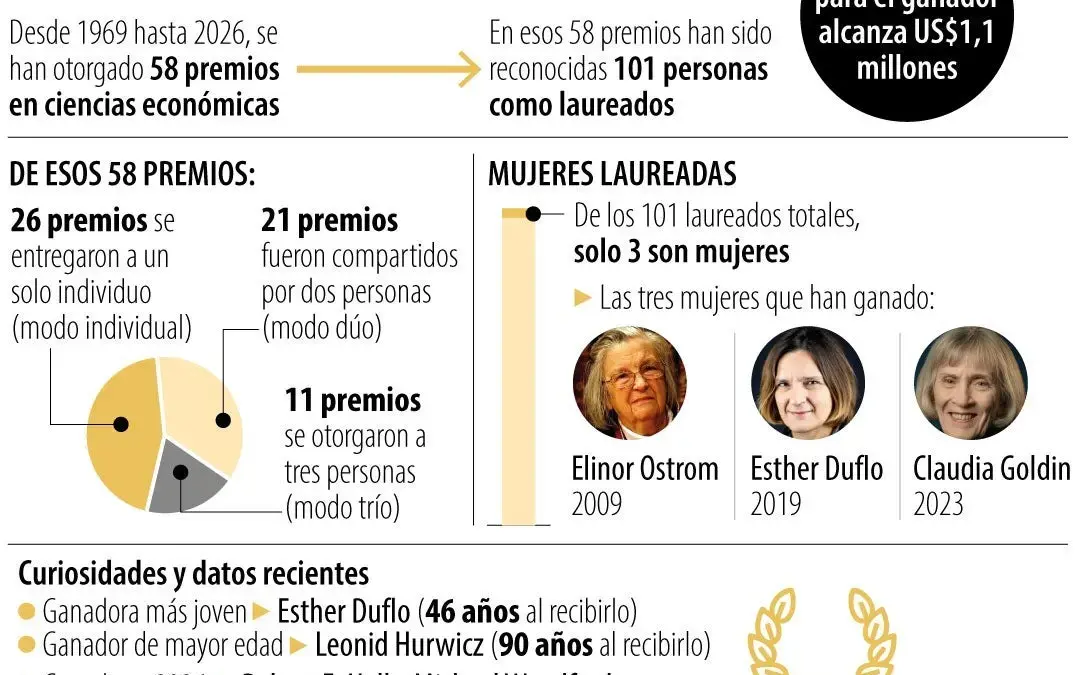
Over the course of 58 editions spanning from 1969 to 2026, the Royal Swedish Academy of Sciences has awarded 58 Economic Sciences prizes to 101 individual laureates.
Award Distribution Mechanics
Total Awards Granted (1969–2026): 58 Editions / 101 Laureates
 ├── Single Laureate Awards: 26 (44.8%)
 ├── Shared by Two Laureates: 21 (36.2%)
 └── Shared by Three Laureates: 11 (19.0%)
The distribution of awards highlights a shift over time: while single-recipient awards were common in early decades, recent awards increasingly recognize joint or collaborative contributions across institutions.
Historical Demographics
+-------------------------------------------------------------------------------+
|                         LAUREATE DEMOGRAPHIC BREAKDOWN                        |
+-----------------------------------+-------------------------------------------+
| Total Individuals Recognized      | 101                                       |
| Male Laureates                    | 98 (97.0%)                                |
| Female Laureates                  | 3 (3.0%)                                  |
| Youngest Laureate                 | Esther Duflo (Age 46, 2019)               |
| Oldest Laureate                   | Leonid Hurwicz (Age 90, 2007)             |
| Average Age at Award              | ~67 years                                 |
+-----------------------------------+-------------------------------------------+
To date, female scholars represent roughly 3% of all economic sciences laureates:
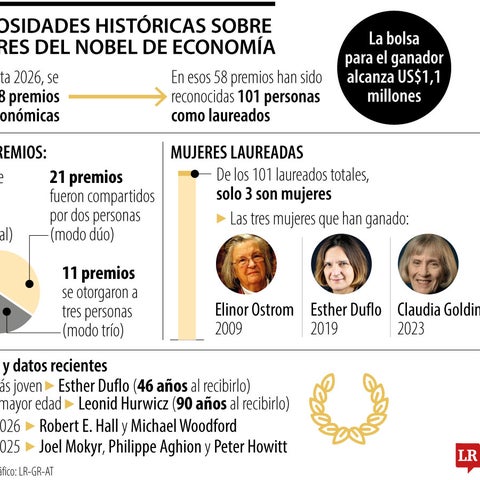
- Elinor Ostrom (2009): Institutional governance and common property.
- Esther Duflo (2019): Development economics and experimental poverty intervention.
- Claudia Goldin (2023): Gender-based wage gaps and labor market history.
Financial and Award Details
- Total Financial Purse (2026): 11.0 million Swedish Kronor (~US$1.1 million to US$1.2 million, subject to exchange rate fluctuations).
- Individual Share for 2026: Approximately US$600,000 per laureate.
- Physical Artifacts: Each recipient receives a custom-crafted 18-karat gold medal bearing the likeness of Alfred Nobel and an individualized hand-painted diploma produced by Swedish artists and calligraphers.
Official Responses and Selection Process
Statements from the Awarding Body
During the official press conference in Stockholm, the Economic Sciences Prize Committee emphasized the real-world relevance of the 2026 theoretical framework.
"Economic stability is not a passive outcome of free markets; nor is it easily managed through blunt policy tools," stated the Prize Committee. "The models developed by Robert Hall and Michael Woodford provided the mathematical and conceptual architecture that allows modern institutions to navigate unpredictable shocks, manage public expectations, and mitigate deep recessions."
Academic Community Reactions
Officials at Stanford University and Columbia University celebrated the announcements, highlighting the long-standing impact of both faculty members on public policy and academic mentorship.
- Stanford University Leadership: Praised Hall for his long career bridging rigorous empirical data with theoretical clarity, noting that his work on consumption dynamic behavior transformed how fiscal stimulus programs are measured today.
- Columbia University Leadership: Commended Woodford for producing the definitive manual on modern monetary policy, noting that his seminal text, Interest and Prices, remains essential reading for central bank researchers around the globe.
How the Laureates Are Selected
The process of choosing Economic Sciences laureates follows a rigorous procedure administered by the Royal Swedish Academy of Sciences:
SEPTEMBER/OCTOBER
Nominations requested from thousands of qualified academics and institutions worldwide.
       │
       ▼
JANUARY (31st)
Deadline for nominations. Self-nominations are strictly disqualified.
       │
       ▼
SPRING/SUMMER
The Economic Sciences Prize Committee evaluates candidates with specialized experts.
       │
       ▼
EARLY OCTOBER
The Academy votes by majority. The decision is final and announced publicly.
       │
       ▼
DECEMBER (10th)
Laureates receive medals and diplomas at the formal ceremony in Stockholm.
Under Nobel Foundation statutes, all documentation regarding nominations, expert assessments, and committee deliberations remains strictly confidential for 50 years.
Implications for Global Policy and Economic Theory
The recognition of Hall and Woodford’s work highlights the critical role micro-founded macroeconomic models play in addressing global policy challenges.
       [ UNEXPECTED ECONOMIC SHOCK ]
                     │
                     ▼
+-----------------------------------------+
|        HOUSEHOLDS & ENTERPRISES         |
|  Adjust expectations & consumption path |
|       (Hall's Random Walk Model)        |
+-----------------------------------------+
                     │
                     ▼
+-----------------------------------------+
|             CENTRAL BANKS               |
| Apply systematic interest-rate rules    |
| & clear forward guidance                |
|      (Woodford's New Keynesian Model)   |
+-----------------------------------------+
                     │
                     ▼
       [ STABILIZED ECONOMIC SYSTEM ]
Policy Applications in Modern Central Banking
- Managing Expectations (Forward Guidance): Woodford’s framework demonstrated that monetary policy operates as much through communication as through immediate interest rate movements. Central bank statements regarding future policy pathways directly influence long-term interest rates and market behavior today.
- Precision in Fiscal Stimulus: Hall’s research on how households evaluate permanent versus transitory income gains informed modern tax cut and direct transfer policies during economic crises, helping governments structure relief programs more effectively.
- Addressing the Zero Lower Bound: As global interest rates hovered near zero during recent economic downturns, Woodford’s models provided the theoretical framework for alternative monetary policy tools, such as quantitative easing and targeted asset purchases.
By linking microscopic decision-making with nation-wide monetary policy, the contributions of Robert E. Hall and Michael Woodford continue to provide central banks, treasury departments, and academic researchers with tools to navigate economic uncertainty.




Leave a Reply