


By Editorial Staff / Global Affairs Analysis
An independent investigation into the cost-efficiency of Colombia’s judicial system, transitional justice mechanisms, and the hidden crisis in rural governance.
Main Facts: A Trillion-Dollar Judicial Disconnect
Colombia stands at a profound historical crossroads, weighed down by a judicial paradox: while urban centers debate high-level political reforms and digital transformation, the foundational apparatus of the state remains structurally paralyzed. According to recent budgetary data and institutional performance reports, the Colombian state has funneled tens of trillions of pesos into specialized oversight and transitional justice mechanisms with disproportionately low output.
The core of the crisis lies in a stark fiscal asymmetry. Over recent budget cycles, the Special Jurisdiction for Peace (JEP) and the Office of the Attorney General (Procuraduría General de la Nación) have absorbed staggering sums of public money—over 4 trillion pesos allocated to the JEP and upwards of 2.1 trillion pesos annually for the Procuraduría. Yet, when measured against final, substantive rulings, the cost per effective decision reaches astronomical figures, sometimes scaling up to 15 billion pesos per macro-resolution.

In stark contrast, the ordinary municipal and circuit judges who form the backbone of Colombia’s territorial justice system operate under severe financial starvation. While a basic municipal court sentence costs the state an average of 9 to 11 million pesos, rural regions suffer from an acute absence of prosecutors, investigators, and judges. This systemic vacuum has created what legal analysts term "The Three Colombias": an urban center governed by tutelary litigations, a transitional justice framework operating with minimal territorial oversight, and a lawless rural hinterland where the state is virtually absent, leaving communities at the mercy of armed actors and institutional abandonment.
Chronology of Structural Decay: From Pastrana to Petro
To understand how Colombia reached this juncture, it is necessary to examine the evolution of the nation’s penal and investigative frameworks over the past three decades:
- 1991–1998 (Constitutional Re-engineering): The 1991 Political Constitution established sweeping structural reforms, including the creation of specialized control organs and the eventual recognition of special indigenous jurisdictions (Article 246). However, the foundational disconnect between urban-centric constitutional design and rural realities quickly became apparent.
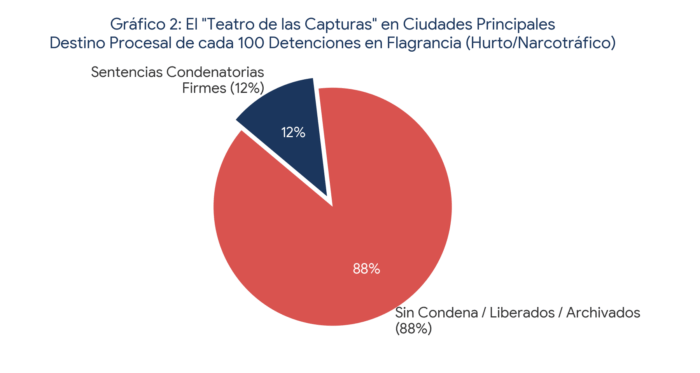
- 1998–2010 (The Era of "Capture Theater"): Under successive administrations from Pastrana onward, law enforcement agencies leaned heavily on the optics of mass arrests. While police statistics highlighted high volumes of detentions in cities like Bogotá, Cali, and Medellín, the investigative bottlenecks in the Prosecutor General’s Office (SPOA) ensured that urban impunity rates for high-impact crimes (homicides, extortion, and aggravated robbery) remained stubbornly high at 85% to 92%.
- 2016–2017 (The Birth of Transitional Justice): Following the Havana Peace Accords, the JEP was established to investigate, judge, and sentence serious violations committed during the internal armed conflict. Designed around macro-cases rather than individual criminal files, its complex architecture created immediate jurisdictional friction with ordinary courts and special indigenous authorities.
- 2019–2022 (The Jurisdictional Vacuum and Regional Crisis): High-profile cases, such as that of the dissident guerrilla leader known as "Mayimbú" (Léider Johany Noscué Bototo), exposed fatal flaws in institutional coordination. Operating within a gray zone between the JEP, indigenous jurisdictions, and military command structures, such figures exploited bureaucratic delays to rearm, control illicit coca corridors, and perpetrate regional massacres before finally being neutralized.
- 2024–2026 (The Current Fiscal Reckoning): As the National General Budget (PGN) faces tightening constraints, public debate has zeroed in on the massive operating costs of control bodies like the Procuraduría—where over 95% of disciplinary files are archived or prescribe without substantive rulings—while rural schools, health outposts, and local magistracies remain critically underfunded.
Supporting Data: The High Cost of Bureaucratic Inefficiency
A comparative analysis of Colombia’s judicial and oversight bodies reveals profound disparities between budgetary allocations and substantive output. According to data from the National General Budget (PGN) and judicial oversight bodies, the cost per effective ruling varies wildly across jurisdictions.

Comparative Table: Budgetary Allocation, Output, and Unit Costs
| Jurisdiction / Institution | Average Annual Budget (PGN) | Annual Output of Substantive Rulings | Estimated Cost per Substantive Ruling |
|---|---|---|---|
| Constitutional Court | ~$115,000 – $130,000 Million COP | ~600 – 700 rulings (C, SU, T) | $160 – $190 Million COP |
| Supreme Court of Justice | ~$280,000 Million COP | ~5,500 – 6,500 sentences/autos | $43 – $50 Million COP |
| Council of State | ~$210,000 – $230,000 Million COP | ~5,000 – 6,500 definitive rulings | $35 – $42 Million COP |
| Transitional Justice (JEP) | ~$744,000 – $777,000 Million COP | ~40 – 60 macro-resolutions | $12,000 – $18,000 Million COP (Macro-cases) |
| Ordinary Judges (Base Level) | ~$3.8 – $4.1 Trillion COP | ~350,000 – 400,000 sentences | $9 – $11 Million COP |
Methodological Note: Calculations isolate the direct operational budget assigned in the PGN against substantive, final rulings. They exclude interlocutory procedural motions and administrative filters (such as tutela admission screening).
Furthermore, the OECD highlights that Colombia maintains a severe deficit in judicial personnel, registering approximately 11 to 12 judicial officers per 100,000 inhabitants—far below the recommended OECD benchmark of 65 (which accounts for judges, magistrates, and direct support personnel).
In parallel, the Procuraduría General de la Nación absorbs over 2.1 trillion pesos annually, with nearly 68.5% dedicated strictly to administrative functioning. With over 95% of disciplinary investigations ultimately archived or expiring due to statute-of-limitations bottlenecks, the cost per effectively sanctioned public official ranges from 666 million to 5 billion pesos—the equivalent of funding up to 500 ordinary criminal convictions in rural Colombia.

Official Responses and Institutional Perspectives
The debate surrounding judicial restructuring has drawn sharp reactions from across the political and institutional spectrum:
- Proponents of Transitional Justice: Defenders of the JEP argue that evaluating transitional mechanisms through the lens of traditional, case-by-case cost metrics fundamentally misunderstands their nature. They maintain that macro-investigations addressing systemic patterns of violence, structural victim participation, and restorative justice cannot be equated with ordinary municipal crime adjudication.
- Legislative and Oversight Defenders: Representatives defending the current architecture of oversight bodies emphasize that institutions like the Procuraduría play a vital constitutional role in safeguarding public administration, checking executive overreach, and ensuring disciplinary compliance across thousands of municipal and regional entities.
- Critics and Reform Advocates: Civil society groups and legal scholars argue that the current model creates a "perverse incentive structure" where elite institutions consume vast fiscal resources while basic security and judicial services in the countryside starve. They contend that the method by which oversight heads are elected—often through congressional selection from presidential shortlists—insulates the bureaucracy from genuine public accountability.
Implications: Re-Engineering the State for Rural Modernity
The persistent failure to secure territorial justice carries severe socio-economic and security implications for Colombia:
- The Collapse of Rural Governance: In remote territories such as the Cauca department, local educators, healthcare workers, and community leaders face an impossible dilemma. When reporting severe infractions—such as child sexual abuse or forced recruitment—they are frequently left unprotected by the state. The absence of itinerant rural prosecutors forces local populations to navigate dangerous gray zones where the rule of law is supplanted by armed coercion or informal, uncoordinated local customs.
- Economic Stagnation: Modernity cannot take root in the Colombian countryside without legal certainty. Infrastructure projects, agricultural investments, and land formalization initiatives stall when property rights and civil contracts cannot be robustly enforced by local magistrates.
- The Necessity of Fiscal Realignment: Experts argue that achieving sustainable peace and rural development requires shifting public expenditure away from bloated administrative apparatuses and toward frontline state presence.
To overcome these structural bottlenecks, policy analysts have advanced four primary proposals for reform:
- Expansion of Prioritized Base Justice: Redirecting high-cost transitional margins toward the deployment of mobile rural prosecutors, professional judicial police units, and grassroots municipal courts.
- Establishment of a Public Penal Efficiency Indicator (IPEP): Mandating that the Prosecutor General’s Office and National Police publish a unified monthly index tracking the exact lifecycle of police detentions—from flagrante delicto capture to formal indictment, asset seizure, and final sentencing.
- Statutory Coordination and Diagnostic Inclusion: Implementing clear statutory regulations under Article 246 of the Constitution to harmonize indigenous and ordinary jurisdictions, while ensuring budgetary allocations for community-level diagnostic mapping of social and infrastructural problems.
- Pruning Administrative Over-Expenditure: Reallocating non-essential operational funds from oversight bodies like the Procuraduría directly into the ordinary judicial budget to multiply the country’s capacity to issue timely, low-cost criminal sentences.
Until Colombia confronts the fundamental mismatch between its lavishly funded urban oversight bodies and its destitute rural courts, impunity will remain the nation’s most enduring enterprise—keeping true modernity perpetually out of reach.




Leave a Reply