


BOGOTÁ & WASHINGTON — In a decisive move signaling a sharp tightening of U.S. foreign policy toward South America, the United States Department of State has officially revoked the entry visas of prominent Colombian figures Euclides Torres Romero and Senator Martha Peralta Epieyú. Both individuals are recognized as key political and financial allies of former Colombian President Gustavo Petro.
The punitive measures were spearheaded by U.S. Deputy Secretary of State Christopher Landau—widely referred to in diplomatic and political circles as "The Visa Revoker"—operating directly beneath Secretary of State Marco Rubio. This high-profile action stems directly from intelligence and target lists provided to Washington earlier this year by Abelardo de la Espriella, highlighting a robust convergence of anti-corruption enforcement and hemispheric security objectives under the current U.S. administration.
1. Main Facts: The Vetoes and the Target List
The recent diplomatic blow falls under the framework of the "Shield of the Americas" initiative, a coordinated U.S. foreign policy mechanism designed to penalize corrupt actors, narco-traffickers, and individuals undermining democratic governance across Latin America.

The individuals targeted in this latest wave of visa revocations carry significant political weight in Colombia:
- Euclides Torres Romero: A powerful businessman frequently cited as a major financial contributor and strategist behind leftist and progressive political campaigns in Colombia.
- Senator Martha Peralta Epieyú: A prominent indigenous leader from La Guajira, representing the MAIS (Movimiento Alternativo Indígena y Social) party, and one of the most vociferous defenders of the Petro administration within the Colombian Congress.
According to official communications released by the U.S. Embassy in Bogotá and the State Department’s Spokesperson Office, the visa restrictions extend beyond Torres and Peralta, explicitly including their immediate family members.
The actions validate a notorious 23-name blacklist—colloquially dubbed the "Tiger’s List" (Lista del Tigre)—compiled and publicly promoted by then-presidential candidate Abelardo de la Espriella during his 2026 campaign. De la Espriella had directly lobbied U.S. officials, including Deputy Secretary Landau, to place these individuals on Washington’s radar for alleged electoral crimes, corruption, and systemic abuse of power.

2. Chronology of Events: From Miami Meetings to Diplomatic Action
The pipeline leading to these high-level visa cancellations unfolded through a precise sequence of geopolitical alignment and backchannel diplomacy:
- March 6, 2026: In a clear display of early diplomatic alignment, then-candidate Abelardo de la Espriella met personally with U.S. Deputy Secretary of State Christopher Landau in Miami during a gala event celebrating the "Shield of the Americas" initiative. During this meeting, bilateral security, immigration control, and the containment of extra-hemispheric actors like China were prioritized.
- June 8, 2026: In the heat of the Colombian presidential campaign, De la Espriella hosted a widely viewed live broadcast explicitly naming 23 political figures allegedly involved in corruption and electoral manipulation. He publicly invoked the pressure of Washington—and Landau specifically—to isolate these individuals internationally.
- September 2026: The State Department operationalized the warnings issued months prior. In coordination with regional desks, the U.S. Embassy in Bogotá announced sweeping visa restrictions targeting corrupt actors across Bolivia, Colombia, and neighboring states, formally striking down the entry privileges of Torres and Peralta.
3. Supporting Data and Historical Context: The Landau Connection
To fully understand the gravity of these visa revocations, analysts must examine the profile and personal history of Deputy Secretary Christopher Landau. Operating as the second-in-command of U.S. diplomacy under Marco Rubio, Landau brings deep-seated, generational ties to Colombia.
Landau’s family history is intertwined with the Andean nation: his grandparents, Jacob and Jeanette, settled in Colombia, where they built their lives. His father spent formative years in the country before joining the U.S. Army and embarking on a distinguished diplomatic career. Today, Landau’s grandparents rest in the Southern Hebrew Cemetery in Bogotá. This personal familiarity with Colombia has granted Landau a granular understanding of its political landscape, contrasting sharply with the typical detachment of Washington bureaucrats.
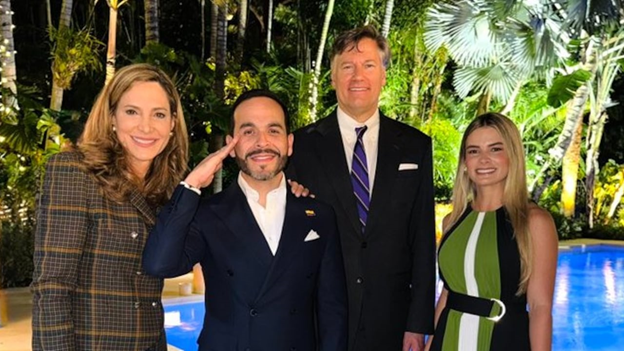
Landau’s aggressive posture regarding visa sanctions has earned him the moniker "The Visa Revoker." His portfolio expanded aggressively in early 2026 to encompass regional migration control, counter-narcotics, and the containment of authoritarian networks.
The Broader "Tiger’s List" Targets
Beyond Torres and Peralta, De la Espriella’s 23-name roster targeted several other high-profile figures from Colombia’s leftist and establishment political spheres, raising concerns across the political spectrum about who might be next on Washington’s chopping block:
- Carlos Caicedo: Former governor of Magdalena.
- Musa Besaile: Former two-tier senator from Córdoba, deeply entangled in historical corruption scandals such as Odebrecht and the "Cartel of the Toga."
- Agmeth Escaf: Prominent television actor, presenter, and former House Representative for the Atlantic department representing Colombia Humana.
- Mario Fernández: A political figure and cousin of former First Lady Verónica Alcocer.
- Viviana Marín: Secretary of the Communist Youth (JUCO) in Bogotá, who faced swift retribution—including a visa revocation—after publicly calling to make the country "unlivable" following the electoral victory of the conservative coalition.
4. Official Responses and Institutional Reactions
The unilateral nature of the U.S. action has triggered a wave of polarized reactions within Colombia’s fractured political ecosystem.

- The U.S. State Department Stance: Through official channels, Washington has maintained that the "Shield of the Americas" is not merely rhetorical, but an operational coalition. A spokesperson for the U.S. Embassy in Bogotá emphasized: "Today, the State Department is emprending measures to impose visa restrictions on corrupt actors in Bolivia, Colombia, and beyond… The Shield of the Americas is a coalition that acts."
- The Colombian Left and Petro Allies: Progressive sectors have condemned the visa revocations as an unprecedented, imperialist intervention in Colombian domestic politics. Allies of former President Petro argue that leveraging foreign judicial and administrative mechanisms—such as the arbitrary removal of travel privileges—amounts to political persecution designed to silence the opposition and criminalize progressive leadership.
- The Conservative Alignment: Conversely, the political right and supporters of the current administration have hailed the measures as long-overdue accountability. They argue that local judicial systems have historically stalled major corruption investigations, making international pressure from partners like the United States indispensable for cleaning up public administration.
5. Geopolitical Implications: A New Era in U.S.-Colombia Relations
The swift targeting of Euclides Torres and Senator Martha Peralta marks a profound structural shift in Washington’s diplomatic posture toward Bogotá. Under the combined leadership of Marco Rubio and Christopher Landau, the traditional boundaries separating diplomatic courtesy from aggressive law enforcement have dissolved.
- Direct Diplomatic Alignment: The direct operationalization of a domestic political candidate’s anti-corruption wishlist (De la Espriella’s list) demonstrates an extraordinary level of trust and alignment between Washington and the emerging conservative governance in Colombia.
- Deterrence Through Travel Restrictions: By utilizing visa revocations as a primary punitive instrument, the U.S. bypasses lengthy extradition treaties or complex international criminal proceedings, imposing immediate, highly visible personal and professional costs on accused elites.
- Chilling Effect on the Opposition: The targeting of high-ranking congressional figures like Peralta and elite financiers like Torres sends an unmistakable signal to the broader progressive movement in Colombia: international safe harbors are rapidly closing for those flagged by Washington for corruption or democratic subversion.
As the State Department continues to review the remaining names on the "Tiger’s List," the Colombian political class remains on high alert, acutely aware that the next wave of visa cancellations could strike at any moment from the offices of Washington’s most formidable diplomatic enforcers.




Leave a Reply