

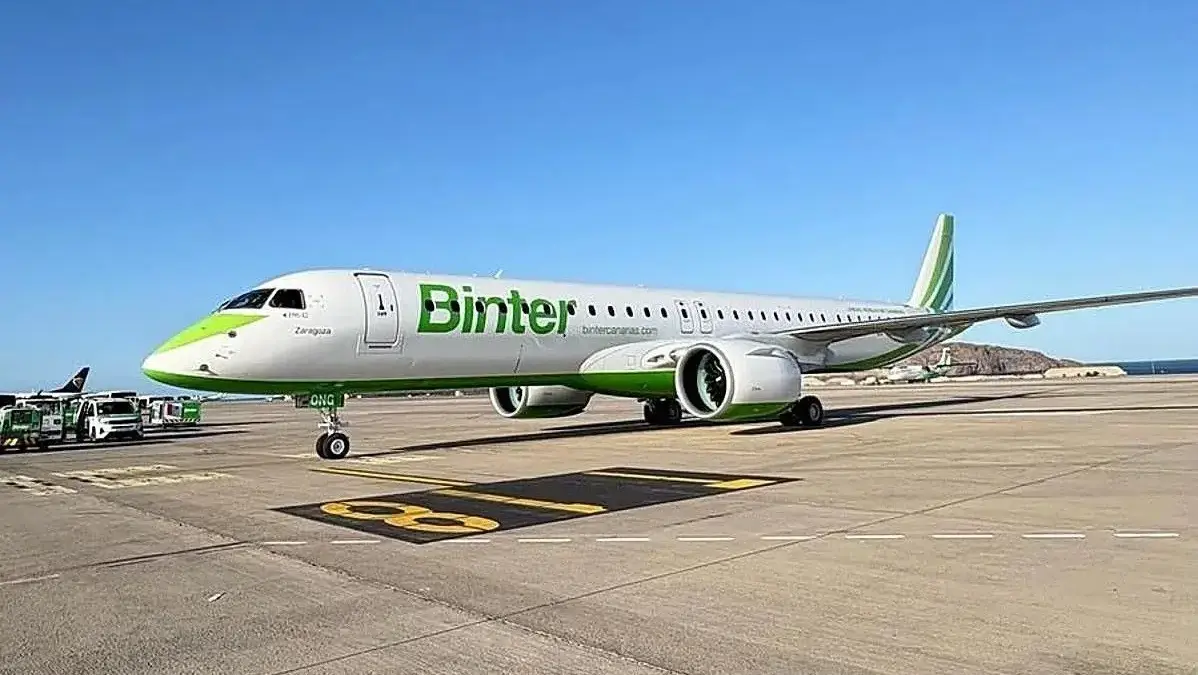
MADRID/LAS PALMAS DE GRAN CANARIA — In a landmark financial agreement that underscores the robust confidence of Spain’s premier financial institutions in the aviation sector, regional airline Binter has successfully closed a multi-million-euro financing deal. The capital injection, finalized in partnership with Banco Santander, CaixaBank, and BBVA, will fuel the carrier’s next ambitious chapter of fleet renewal and strategic network expansion.
The transaction—backed by legal advisory powerhouses Deloitte and KPMG—involves a total investment of $510 million USD (approximately €454.7 million). This substantial capital will be channeled directly into the acquisition of nine state-of-the-art Embraer E195-E2 aircraft. With these new additions, Binter’s total commitment to this specific aircraft family will reach an impressive 25 units, cementing its operational trajectory for the coming decade.
Main Facts
The agreement was officially signed by Binter’s President, Rodolfo Núñez, and Vice President, Alfredo Morales, alongside senior representatives from Santander, CaixaBank, and BBVA.
- The Investment: $510 million (€454.7 million) secured through a consortium of Spain’s top three banks.
- The Asset: Nine next-generation Embraer E195-E2 aircraft.
- Delivery Timeline: Deliveries are scheduled to begin progressively starting in 2027.
- Total Fleet Vision: Upon completion of this delivery cycle, Binter’s active fleet of Embraer E195-E2s will expand to 25 units.
- Advisory Team: Legal and financial structuring was supported by major consultancy firms Deloitte and KPMG.
- Aircraft Specifications: Each of the newly acquired jets will feature a 132-seat configuration arranged in a 2×2 layout, deliberately designed to eliminate middle seats and maximize passenger comfort.
The deal marks a critical milestone not only for Binter as a privately held regional carrier based in the Canary Islands, but also for the broader Spanish aviation market, demonstrating that regional operators with strong business models can secure prime financing terms even amid global macroeconomic uncertainties.
Chronology of the Acquisition and Fleet Strategy
Binter’s relationship with Embraer and its transition toward larger, more efficient jet aircraft has evolved methodically over recent years, transforming the carrier from a regional turboprop operator into a sophisticated, multi-hub international player.
Phase 1: The Turboprop Era and Inter-Island Dominance
For decades, Binter was synonymous with ATR turboprop aircraft, which were ideally suited for the short, hop-skip runways linking the islands of the Canarian archipelago. While these aircraft remain the backbone of the carrier’s intra-island hopping network, the airline recognized the necessity of upgrading its capabilities to service medium-haul routes connecting the islands to the Iberian Peninsula and West Africa.
Phase 2: Introduction of the E-Jets E2 Family
The turning point arrived when Binter selected the Embraer E195-E2, becoming a launch operator for the type in Europe. The airline praised the aircraft’s fuel efficiency, reduced noise footprint, and superior environmental credentials. The initial orders allowed Binter to launch direct services from the Canary Islands to various mainland Spanish destinations and international European markets previously unserved or underserved by direct point-to-point connections.
Phase 3: Scaling Up (2027 and Beyond)
The newly announced agreement for nine additional E195-E2s represents the next logical phase of this evolution. Slated to arrive from 2027 onward, these aircraft will bridge the gap between regional operations and international expansion. By standardizing its jet fleet around 25 units of the E195-E2, Binter achieves significant economies of scale in maintenance, crew training, and operational scheduling.
Supporting Data: The Embraer E195-E2 Advantage
The choice of the Embraer E195-E2 is central to Binter’s commercial and environmental strategy. As the largest member of Embraer’s advanced E-Jets E2 family, the aircraft incorporates cutting-edge technology designed to minimize ecological impact while maximizing passenger satisfaction.
Technical and Environmental Performance
- Fuel Efficiency: The E2 family features ultra-high bypass ratio engines and advanced aerodynamic design, resulting in double-digit improvements in fuel consumption compared to previous-generation aircraft.
- Emissions Reductions: Lower fuel burn directly translates to significantly reduced carbon dioxide ($CO_2$) emissions, aligning with the European Union’s stringent environmental targets and Binter’s own corporate sustainability commitments.
- Noise Footprint: The aircraft boasts a dramatically reduced noise contour, making it exceptionally well-suited for operations near populated urban centers and sensitive airport environments across the Canarian archipelago.
Passenger Experience and Cabin Ergonomics
Binter has opted for a customized layout for its 25-aircraft strong E195-E2 fleet:
- Capacity: 132 seats per aircraft.
- Seating Configuration: A spacious 2×2 layout. Crucially, there are no middle seats, ensuring that every passenger enjoys either a window or an aisle.
- Overhead Bin Storage: Generous overhead storage compartments accommodate roller bags easily, minimizing boarding and deplaning bottlenecks.
- Ambient Lighting and Quiet Cabin: The advanced sound-dampening materials used in the cabin construction, combined with modern LED mood lighting, significantly reduce travel fatigue for passengers on both short hops and longer regional sectors.
Official Responses and Stakeholder Perspectives
The significance of the €454.7 million financing package was underscored by statements from Binter’s executive leadership and financial partners, highlighting the socio-economic importance of the airline to the Canary Islands.
Rodolfo Núñez, President of Binter
Emphasizing the core philosophy driving the airline’s long-term strategy, President Rodolfo Núñez stated:
“These new acquisitions give a direct response to the airline’s mission of guaranteeing the best air connectivity for the Canary Islands, both inside and outside the archipelago, with a clear vocation for public service that allows us to continue contributing to the economic and social development of our islands.”
Núñez further elaborated that the continuous investment in modernized fleets is not merely a commercial luxury, but an operational necessity to maintain Binter’s unique market positioning. By investing in aircraft that offer a differentiated service and superior passenger value, the airline safeguards its competitive edge against low-cost carriers and legacy operators alike.
Alfredo Morales, Vice President of Binter
Vice President Alfredo Morales focused on the financial backing and the trust placed in the airline by Spain’s banking elite:
“We deeply appreciate the confidence, once again, shown by the main national banks in our fleet acquisition operations. This backing allows us to take our way of flying to more and more destinations while maintaining our core identity.”
Morales’ remarks reflect the strength of Binter’s balance sheet and its track record of financial discipline—factors that proved decisive in convincing Santander, CaixaBank, and BBVA to underwrite the massive capital expenditure required for the nine aircraft.
Strategic Implications: Connectivity, Hubs, and Market Growth
The incorporation of nine additional Embraer E195-E2 jets by 2027 will profoundly reshape Binter’s operational map and reinforce its strategic positioning across three distinct pillars:
1. Consolidating the Canary Islands–Africa Hub
For years, Binter has positioned the Canary Islands as a natural bridge between Europe, West Africa, and the Atlantic. The extended range and payload capacity of the E195-E2 enable the airline to open new routes to emerging markets in Northwest Africa with unprecedented frequency and reliability. The enhanced fleet will allow Binter to cement its role as the premier connecting carrier for passengers traveling between African destinations and the European mainland via its Canarian hubs.
2. Upgrading High-Density Domestic and Inter-Island Routes
While ATR turboprops will continue to handle lighter inter-island rotations, Binter plans to strategically deploy the E195-E2 on inter-island segments experiencing the highest surge in passenger demand. This deployment will relieve congestion, offer greater seating capacity during peak business and holiday travel windows, and maintain the high frequency required by local commuters.
3. Guaranteeing Operational Excellence
Binter has built its brand equity on pillars of regularity, reliability, and punctuality. Operating a uniform fleet of 25 modern Embraer jets minimizes technical dispatch delays and simplifies spare-parts inventory management. According to the airline’s commercial leadership, this standardization is the bedrock upon which its entire commercial program rests, ensuring that passengers experience seamless travel regardless of seasonal disruptions.
Conclusion
Binter’s closure of the €454.7 million financing agreement with Banco Santander, CaixaBank, and BBVA marks a defining moment in Spanish regional aviation. By committing to nine additional Embraer E195-E2 aircraft—bringing its total fleet of the type to 25 units by the time deliveries conclude post-2027—the airline has secured its technological future, reinforced its environmental commitments, and doubled down on its public service mandate to the Canary Islands. As these advanced jets take to the skies, they will carry not only 132 passengers per flight in middle-seat-free comfort, but also the economic aspirations of an entire archipelago looking confidently toward the horizon.



Leave a Reply