

By Hernán Guillermo Galindo M.
Adapted and expanded for international distribution
Main Facts: A Historic Milestone in Colorado
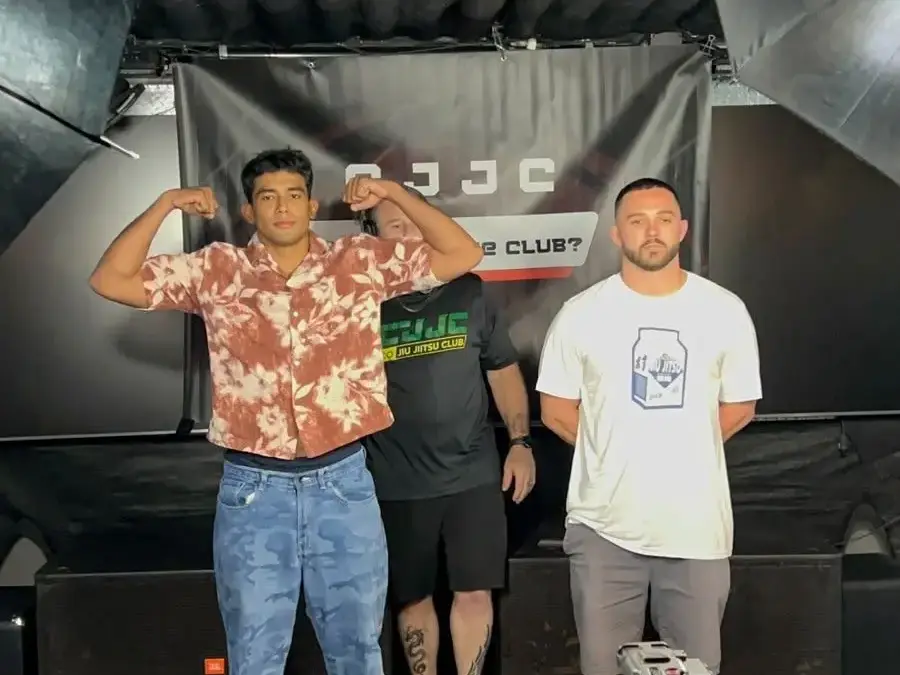
In the high-altitude city of Denver, Colorado, a young martial artist from the heart of Colombia has etched his name into the annals of combat sports history. Juan David Calderón Ibarra, a native of Neiva, Huila, delivered a statement performance inside the octagonal cage of the Colorado Jiu Jitsu Club (CJJC). Representing the world-renowned 10th Planet Denver academy—a global benchmark in no-gi grappling—Calderón faced off against American fighter Travis Rice, a formidable representative of the traditional Easton Jiu-Jitsu school, one of the largest and most respected institutions in the state.
The encounter took place during CJJC 31: Dominium. It required just 60 seconds for the Colombian prospect to dismantle his opponent. Utilizing a textbook mataleón (Rear-Naked Choke), Calderón forced a tap from Rice, an accomplished U.S. Marine and veteran fighter who had famously never been submitted in professional competition before that night.
With this victory, Calderón achieved a historic milestone: he became the very first athlete born in Neiva, Huila, to compete and emerge victorious inside the CJJC cage in Denver. More than just a win on a regional promotion’s card, the performance served as a testament to resilience, meticulous technical mastery, and the indomitable spirit of a Colombian athlete who refused to let geographical and economic barriers dictate his ceiling.
Chronology: From the Classrooms of Neiva to the American Mat
The Roots in Huila
Juan David Calderón Ibarra’s journey into combat sports began far from the bright lights of American promotions. As an 11th-grade student at the INEM Julián Mota Salas school in Neiva, a young Calderón spent hours consuming UFC events, captivated by the intricate chess match of grappling—a discipline blending wrestling, judo, and jiu-jitsu without the chaos of strikes.
His formal introduction to martial arts took place at Neiva’s Baekho martial arts academy, under the guidance of coach Edwin Cortés. Initially stepping through the doors to train in boxing, Calderón spent three months throwing punches before a fateful encounter with a South African practitioner shifted his trajectory permanently. Introduced to Brazilian Jiu-Jitsu (BJJ), he was instantly hooked. He realized that BJJ was a discipline dictated by leverage and technique rather than raw physical strength—a martial art where a smaller practitioner could neutralize and defeat someone 20 to 30 kilograms heavier through sheer mechanical efficiency.
Calderón dedicated the next three years to competing across Colombia. However, the path of a high-performance combat athlete in South America is notoriously fraught with hardship. Faced with chronic economic hurdles and a near-total absence of institutional sports funding, Calderón was forced to confront the harsh reality of his athletic ceiling at home.
The Leap to North America
Driven by an unrelenting ambition to test himself against the world’s best, Calderón set his sights on the United States. His first attempt came in 2023 via an international exchange program that placed him in a remote nature camp for four months—an isolating experience where training jiu-jitsu was entirely impossible. Undeterred, he returned to Colombia, scrimped, saved every available peso, and planned his next move.
By 2025, an opportunity materialized. While exploring wrestling camps in the U.S., he discovered the Au Pair program—a cultural exchange framework through which young adults live with American families while providing childcare. After completing the mandatory 1,000 hours of childcare experience, Calderón applied and was accepted by a host family in Denver, Colorado.
The arrangement proved to be a life-changing athletic catalyst. His host family granted him structured free time every morning and evening, allowing him to seamlessly integrate a rigorous training regimen alongside his child-rearing duties and his university studies in Foreign Languages.

Supporting Data: Inside the Mind and Statistics of a Rising Star
The Mechanics of No-Gi Grappling
Speaking to LA NACIÓN from his residence in Denver, Calderón broke down the nuances of his sport for fans back home. Unlike traditional Brazilian Jiu-Jitsu, which utilizes the heavy cotton gi (kimono) for grips and chokes, no-gi grappling relies entirely on body control, friction, and explosive wrestling transitions.
"It’s like a mixture of judo and wrestling," Calderón explained. "The objective is to control my rival and finish them via submission—which can be a choke, an arm lock, or something similar."
He detailed the grueling, high-stakes format typical of professional submission-only events:
- The Round: A single, unbroken 5-minute round.
- The Scoring: There are no judges’ scorecards, no points awarded for takedowns or positional dominance. The only path to victory is forcing a submission.
- Overtime (Sudden Death): If the clock expires without a tap, the match moves to an overtime period, forcing competitors to start from a severe defensive disadvantage and escape in the shortest possible time.
A Stellar Palmarès and High-Stakes Rivalries
Despite the challenges of his early career in Colombia—where financial constraints limited him to competing barely once a year due to the high costs of travel, lodging, and an exhausting 10-kilogram weight-cutting process—Calderón has built an impressive combat record.
- Professional Record: Approximately 25 matches, boasting 22 victories against just 3 defeats.
- Titles: Champion of NAGA (North American Grappling Association), one of the most prestigious grappling circuits in the United States.
- Circuit Experience: Regular competitor in high-level promotions like Grappling Industries.
When describing his latest opponent, Travis Rice, Calderón underscored the magnitude of the victory. Rice was not merely a local journeyman; he was a decorated U.S. Marine, a seasoned professional with multiple victories under his belt in the promotion, and an athlete who carried an unblemished submission-defense record. To finish a man of that caliber in just 60 seconds sent shockwaves through the Colorado martial arts community.
Official Responses and Acknowledgments
Behind every international triumph lies a network of mentors, family members, and foundational institutions that shaped the athlete’s character. As the dust settled on his victory at CJJC 31, Calderón made sure to turn his gaze backward, acknowledging the people who laid the groundwork for his success.
He expressed profound gratitude to his family members—specifically the Calderón and Ibarra families—for their unwavering emotional backing through years of financial uncertainty. He also extended public recognition to:
- Edwin Cortés and the Baekho Academy in Neiva, where his passion for ground fighting was first forged.
- Coach Miguel Ipúz and the Liga de Lucha de Neiva, where Calderón spent an intensive year sharpening his wrestling base. He credits this specific training block with giving him the physical resilience and mental fortitude required to survive and thrive on the competitive American circuit.
Implications: A Glimpse into the Future
At just 24 years of age, Juan David Calderón Ibarra’s career is accelerating rapidly. Far from resting on his laurels after his historic win in Denver, the Neiva native is maintaining a punishing training and educational schedule. Balancing his duties as an Au Pair, his university studies in foreign languages, and his athletic ambitions, his immediate calendar is packed with elite challenges:
- October: A targeted appearance at a NAGA championship tournament (pending confirmation against his university exam schedule).
- November 17: A high-profile tournament appearance under the UFC banner in Denver.
- December: A professional tournament structured as an elimination bracket, where the top four grapplers face off in a semifinals-to-finals format to crown an undisputed champion.
Looking past the immediate horizon, Calderón’s long-term aspirations are set firmly on the pinnacle of global combat sports. His ultimate targets include the UFC’s burgeoning grappling divisions, elite promotions like Number One, and the holy grail of submission grappling: the ADCC (Abu Dhabi Combat Club) World Championship, widely regarded as the most competitive grappling tournament on earth.
For the city of Neiva and the department of Huila, Calderón’s ascent represents a powerful narrative. It proves that raw talent, when matched with hyper-focused discipline and the courage to cross borders in search of opportunity, can break through any barrier. As he trains in the crisp mountain air of Colorado—often returning straight from the mats to care for the children in his charge—Juan David Calderón is not just building a career; he is blazing a trail for a new generation of Colombian martial artists.

Leave a Reply