

By Global Economic Desk
Published: October 2026
Main Facts: The Anticipation for the 2026 Sveriges Riksbank Prize in Economic Sciences
As the academic world and global financial markets turn their attention toward Stockholm and Oslo for the annual announcement of the Nobel Prizes, anticipation has reached its peak for the crowning event of the season: the Sveriges Riksbank Prize in Economic Sciences in Memory of Alfred Nobel. While the medicine, physics, chemistry, and literature laureates capture early October headlines, economists, policymakers, and market participants are intensely focused on the upcoming economic sciences announcement.
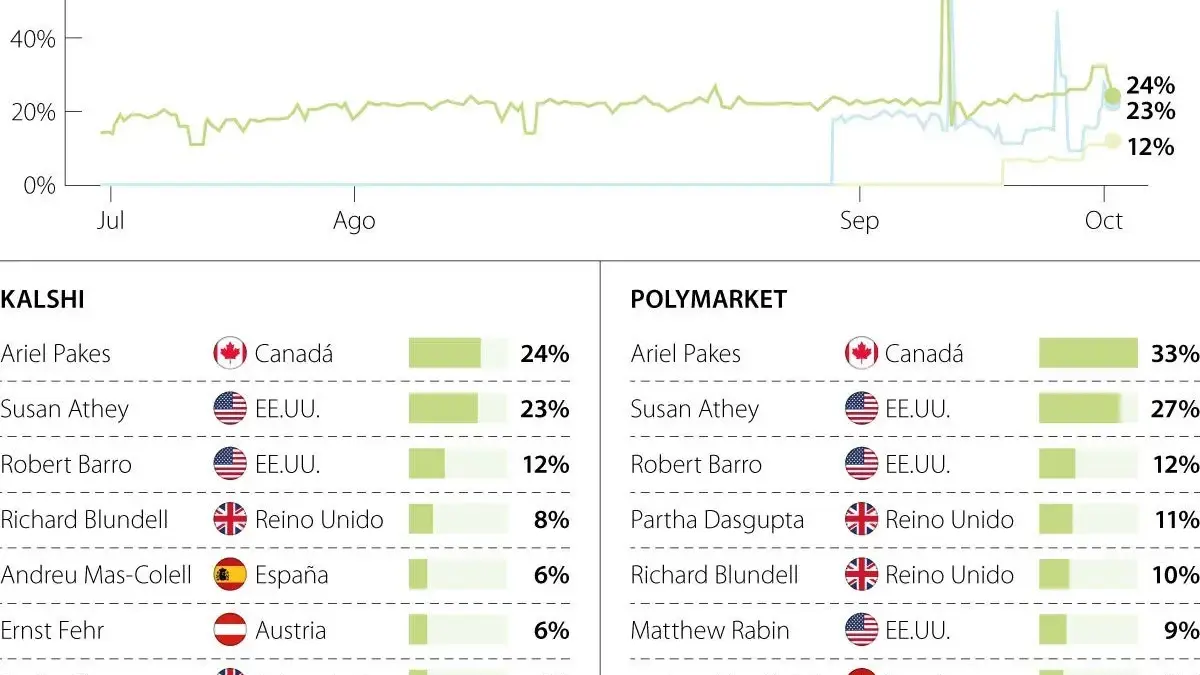
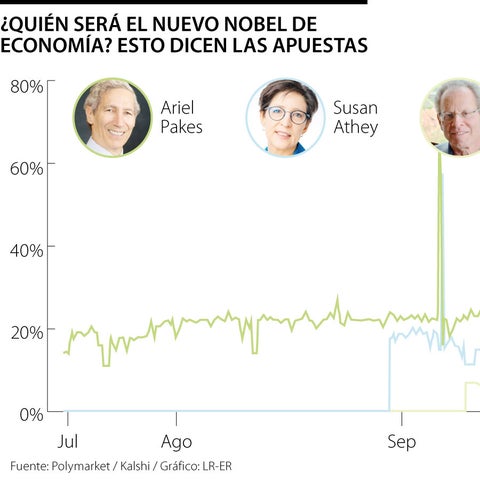
Prediction markets and academic consensus have narrowed down the field of potential laureates. Currently, platforms such as Polymarket and Kalshi position Canadian-born economist Ariel Pakes as the clear frontrunner to receive the prestigious distinction. Close behind him in the betting odds and academic discussions are two towering figures in modern economic thought: American econometrician and digital market pioneer Susan Athey, and legendary macroeconomist Robert Barro.
However, the impending announcement arrives during a turbulent era for the global economy. Prominent academics and institutional leaders emphasize that whoever claims the Nobel Prize this year will do so against a backdrop of sweeping structural uncertainties. From the fragmentation of international trade and geopolitical realignment to the disruptive rise of artificial intelligence and the complex realities of energy transitions, the economic sciences face unprecedented challenges.
This comprehensive report explores the leading contenders for the 2026 Nobel Prize in Economics, traces the chronology of the selection process, analyzes the underlying data and predictive trends, reviews official and academic responses from institutional leaders, and unpacks the deep structural implications of honoring economic research in today’s fractured world.
Chronology: The Road to the Nobel Announcement and the Economics Prize
To understand the weight of the Nobel Prize in Economic Sciences, it is essential to contextualize the timeline of the award season and the unique nature of this specific distinction.
- Early October: The Nobel Foundation commences its annual rollout of announcements. Physiology or Medicine opens the week, followed sequentially by Physics, Chemistry, and Literature.
- The Final Stretch: The economics prize—technically distinct from the original 1895 prizes established by Alfred Nobel, as it was founded in 1968 by Sweden’s central bank—traditionally serves as the grand finale of the announcement cycle.
- The Deliberation Process: Months prior to the public announcements, the Committee for the Prize in Economic Sciences at the Royal Swedish Academy of Sciences solicits confidential nominations from thousands of academics, university professors, previous laureates, and institutional members worldwide.
- Rigorous Filtering: Throughout the spring and summer, the committee evaluates these nominations, reviewing decades of empirical data, peer-reviewed citations, and the real-world policy impact of the proposed theories.
- The Final Decision: In early autumn, the academy votes on the laureate or laureates. The decision is kept under strict lock and key until the live broadcast from Stockholm, scheduled for Monday, October 12.
Supporting Data and Contender Profiles: Analyzing the Frontrunners
Prediction markets have evolved into sophisticated barometers of institutional expectation. Utilizing decentralized forecasting tools like Polymarket and regulated prediction exchanges like Kalshi, observers can track the shifting probabilities of academic recognition in real time. For the 2026 prize, three distinct intellectual titans dominate the discourse.
1. Ariel Pakes: The Empirical Pioneer of Market Dynamics
At the forefront of prediction market favorites is Ariel Pakes, a distinguished professor whose career has revolutionized industrial organization and empirical microeconomics.
- Core Contributions: Pakes has dedicated his career to developing sophisticated econometric frameworks that analyze how real-world markets react to shifts in public policy and macroeconomic conditions. His empirical models allow researchers and regulators to simulate how changes in regulations, taxes, or supply shocks ripple through consumer demand, pricing strategies, firm productivity, and long-term market evolution.
- Practical Application: Antitrust regulators, competition authorities, and corporate strategists globally utilize frameworks co-developed by Pakes to evaluate corporate mergers, telecommunications spectrum auctions, and industrial policies. By bridging theoretical models with massive empirical datasets, he transformed how economists observe the inner workings of imperfectly competitive markets.
2. Susan Athey: Architect of Digital Economics and Market Design
Occupying the second major tier in predictive forecasts is Susan Athey, a pioneering American economist whose work sits at the exhilarating intersection of digital platforms, algorithmic design, and econometrics.
- Core Contributions: Athey’s research investigates the economics of digitalization, marketplace architecture, and the integration of machine learning into econometric analysis. She has broken new ground in understanding how online advertising auctions operate, how digital media consumption transforms information distribution, and how tech platforms manage user engagement.
- Practical Application: Athey has served in advisory capacities for major technology institutions and has deeply influenced how governments approach antitrust enforcement in the digital age. Her integration of artificial intelligence and automated learning into causal inference models has provided modern econometricians with the tools necessary to analyze massive, unstructured digital datasets.
3. Robert Barro: The Macroeconomic Heavyweight
Rounding out the top three consensus picks is Robert Barro, a towering figure in modern macroeconomics whose theoretical models have shaped economic policy for decades.
- Core Contributions: Barro is internationally renowned for his work on macro-crisis management, economic growth determinants, business cycle theory, and the long-term impact of public debt and fiscal deficits. His modern reformulation of the Ricardian Equivalence theorem challenged conventional fiscal policy assumptions by suggesting that consumers anticipate future tax increases to pay off government debt, thereby altering their savings behavior.
- Practical Application: Barro’s recent research has expanded into diverse socioeconomic realms, including the empirical study of economic growth factors, corporate tax reforms, the macroeconomic consequences of pandemics, and even the complex intersection between religious practices and economic performance. Central bankers and fiscal authorities worldwide routinely consult Barro’s models when projecting the sustainability of public debt.
Official Responses and Academic Perspectives: Insights from Institutional Leaders
Beyond the speculative thrill of betting markets, academic leaders emphasize that the value of the Nobel Prize lies in its capacity to validate ideas that fundamentally reshape human progress. Institutional experts point out that the 2026 laureate must address a global economy grappling with unprecedented structural shifts.
Navigating "Altísimo Incertidumbre Estructural"
Juan Alejandro Cortés, Dean of the Schools of Economics, Administration, and Business at the Universidad Pontificia Bolivariana, argues that the contemporary economic landscape is defined by what he terms an "altísima incertidumbre estructural" (extremely high structural uncertainty).
According to Cortés, this uncertainty stems from several converging global phenomena:
- The progressive fragmentation of international trade networks.
- Heightened geopolitical tensions and the weaponization of supply chains.
- The transformative, yet disruptive, impact of artificial intelligence on labor markets and productivity metrics.
- The massive capital reallocation required for the global energy transition.
- Political transitions across Latin America that generate shifting economic expectations.
Focusing on regional challenges, particularly in nations like Colombia, Cortés highlights two pressing vulnerabilities: maintaining long-term fiscal sustainability and bridging persistent regional development gaps. Reflecting on the criteria for the ultimate award, Cortés stated:
"Whoever is deemed worthy of the Nobel Prize must have made a contribution that fundamentally changes the way economics formulates its core questions."
Transforming the Understanding of Markets and Prosperity
Echoing these sentiments, César Tamayo, Dean of the School of Economics at Universidad Eafit, underscores the profound role that academic institutions play in generating ideas capable of transforming human society.
Tamayo stresses that over the past century, one of the greatest triumphs of economic science has been helping society comprehend the delicate mechanisms of markets, the signaling power of the price system, and the foundational role of economic liberty in fostering social progress and broad-based prosperity.
In Tamayo’s view, a truly deserving Nobel laureate in Economic Sciences must be recognized for:
"Unique contributions that fundamentally changed the way society as a whole thinks about the world."
Implications: What a 2026 Nobel Prize Means for the Future of Economic Policy
The impending announcement of the 2026 Sveriges Riksbank Prize in Economic Sciences carries profound implications for the direction of global policy, academic funding, and public trust in market institutions.
1. Validating Empirical Rigor over Abstract Theory
If prediction market favorites like Ariel Pakes or Susan Athey secure the prize, it will mark a definitive continuation of the academy’s modern preference for empirical, data-driven, and computationally advanced economics. For decades, economic science was dominated by pure theoretical modeling. The elevation of scholars who design functioning market mechanisms, analyze digital ecosystems with machine learning, and deploy massive micro-datasets signals that the future of economics belongs to those who can rigorously measure reality and test policy interventions empirically.
2. Addressing Global Supply Chain and Fiscal Realities
Conversely, should a macroeconomist in the tradition of Robert Barro be selected, the prize will serve as a timely reminder of the enduring importance of fiscal discipline, debt sustainability, and macroeconomic stability. In an era where many sovereign nations are running unprecedented deficits to finance post-pandemic recovery, energy transitions, and defense modernization, Barro’s theoretical frameworks on public debt offer crucial cautionary tales for modern central bankers and finance ministers.
3. Restoring Public Confidence Through Intellectual Leadership
As institutions worldwide grapple with rising inflation, income inequality, and technological displacement, the Nobel Prize in Economics serves as a beacon of intellectual authority. By honoring research that tackles concrete societal challenges—whether through optimizing market competition, regulating digital platforms, or understanding long-term economic growth—the Royal Swedish Academy of Sciences reaffirms that economic science is not merely an abstract academic discipline, but an indispensable toolkit for human survival and prosperity.
As the countdown to Monday, October 12, continues, the global economic community waits to see which pioneer will etch their name into history alongside past giants like Milton Friedman, Paul Krugman, Joseph Stiglitz, and Esther Duflo. Whoever claims the 2026 Nobel Prize will take their place at the helm of a discipline tasked with guiding humanity through its most complex century yet.



Leave a Reply