

BOGOTÁ — As the final quarter of the year gets underway, the economic and social landscape of the country has officially shifted its focus toward one of the most contentious and economically sensitive rituals of the calendar: the negotiation of the legal minimum wage. Formally kicking off on October 1, 2026, the discussion regarding the minimum remuneration for 2027 has begun under the shadow of a deeply polarized economic backdrop.
The tripartite commission—comprising representatives from the national government, business syndicates, and labor unions—faces an exceptionally narrow path forward. They must balance the urgent need to protect the purchasing power of vulnerable households against severe labor market pressures, persistent inflation, and a broader macroeconomic environment defined by stringent fiscal tightness.
This year’s negotiations do not take place in a vacuum. They carry the heavy historical baggage of the 2026 wage cycle, a period defined by a landmark 23% increase decreed by the administration. That adjustment pushed the baseline monthly remuneration to COP $1,750,805, which, when combined with the statutory transportation allowance, cleared the milestone barrier of a COP $2 million integrated minimum wage. While celebrated by labor organizations as a historic victory for income redistribution, the ripple effects of that aggressive hike have fundamentally altered the macroeconomic equation, leaving scars on pricing structures, corporate balance sheets, and the central bank’s inflation-targeting mandate.
Main Facts: The Stakes for 2027
The formal installation of the Permanent Commission for the Concertation of Wage and Labor Policies on October 1, 2026, marks the opening salvo in what promises to be a grueling months-long dialogue. The core challenge facing the tripartite body is reconciling two fundamentally divergent visions of economic management:
- The Labor Perspective: Labor unions and worker confederations argue that persistent cost-of-living increases, structural inequality, and the erosion of real wages in prior years necessitate continued robust adjustments to guarantee a dignified standard of living.
- The Business Perspective: Employers, represented by major trade associations, counter that compounding high wage hikes atop elevated non-wage labor costs threatens business viability, stifles formal job creation, encourages informality, and fuels inflationary inertia.
Compounding these tensions is the current fiscal reality of the state. With limited fiscal space and growing pressures to maintain macroeconomic stability, the government’s traditional role as a mediator is complicated by the need to signal fiscal prudence to international markets and credit rating agencies. The decisions made in the coming weeks will reverberate through consumer price indexes, corporate hiring strategies, and collective bargaining agreements across every sector of the national economy.
Chronology of the Negotiation Process
The path from the initial exploratory meetings to a final binding figure is strictly regulated by legal frameworks, establishing a precise timeline that leaves little room for procrastination.
Phase 1: Installation and Initial Observations (October 2026)
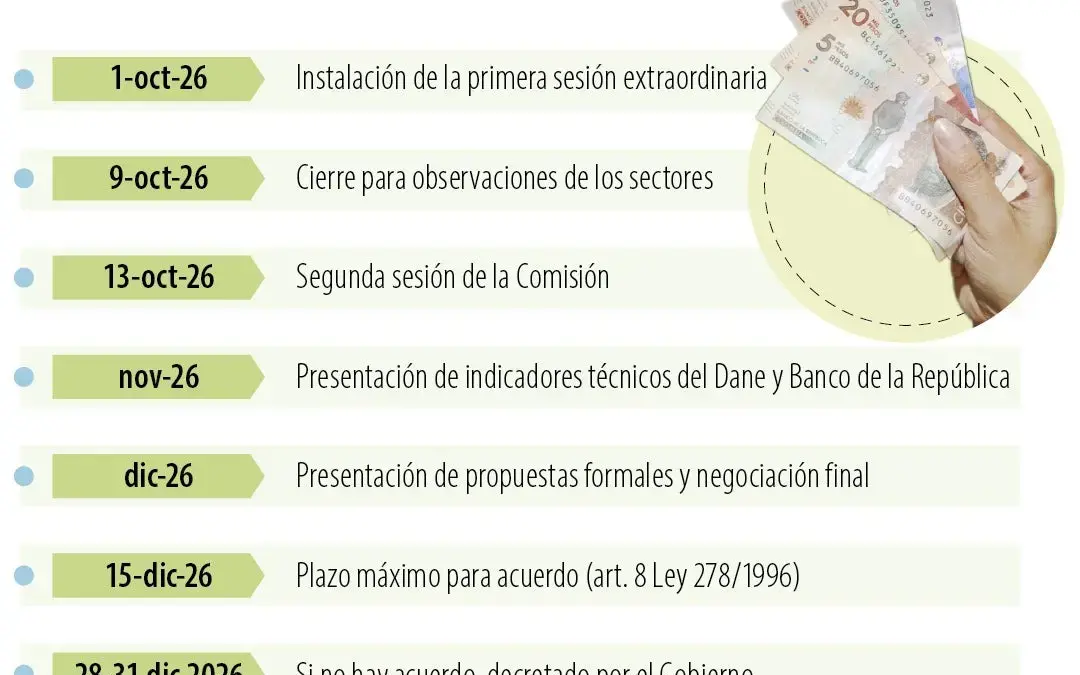
- October 1, 2026: Formal inauguration of the negotiation process with the first extraordinary session of the tripartite commission. Government officials, business leaders, and labor representatives convened to outline procedural rules and establish preliminary thematic priorities.
- October 9, 2026: Deadline for the various constituent sectors to submit their initial observations, preliminary positions, and foundational documents to the commission.
- October 13, 2026: The convening of the second formal session, designed to debate the initial positions and narrow down the scope of technical disagreements.
Phase 2: Technical Evaluations (November 2026)
Throughout November, the dialogue shifts from political posturing to empirical analysis. The National Administrative Department of Statistics (DANE) and the Central Bank (Banco de la República) take center stage. These institutions present crucial economic indicators, including:
- Year-to-date and projected inflation rates.
- Total factor productivity metrics.
- Gross Domestic Product (GDP) growth projections.
- Labor market indicators, including formal employment rates, unemployment figures, and informal labor statistics.
These technical inputs serve as the empirical foundation upon which subsequent wage proposals must, by law, be justified.
Phase 3: Formal Proposals and Deadlines (December 2026)
- Early December: Labor unions and employer associations present their formal, definitive percentage and nominal wage demands.
- December 15, 2026: According to Article 8 of Law 278 of 1996, this is the statutory deadline for the tripartite commission to reach a negotiated consensus. If an agreement is forged by this date, it is ratified and implemented by joint decree.
- Late December (December 28–31, 2026): In the historical event that employers and workers fail to reach a consensus by the December 15 deadline—an outcome that has occurred with high frequency in recent years—the window opens for the National Government to unilaterally decree the minimum wage adjustment. By law, this decree must be issued before the end of the calendar year to ensure implementation by January 1.
Supporting Data: The Long Shadow of the 23% Hike
To understand the contentious nature of the 2027 negotiations, one must examine the profound economic consequences unleashed by the 23% minimum wage increase that took effect on January 1, 2026.
While business federations such as the National Association of Entrepreneurs (ANDI) and the National Federation of Merchants (Fenalco) had aggressively defended a much more conservative adjustment—advocating for a rise between 7% and 11%—the government’s decree overrode their concerns. The fallout from that decision began materializing in consumer price indices as early as the first quarter of 2026.
Labor Costs and Sectoral Vulnerability
For labor-intensive sectors—such as hospitality, retail, agriculture, and light manufacturing—the sudden surge in payroll expenses left business owners with limited operational choices: absorb shrinking profit margins, adjust consumer prices upward, or downsize their workforces.
The impact was particularly visible in the consumer basket. The "food consumed away from home" division emerged as one of the most sensitive categories, contributing a full 1.05 percentage points to the headline inflation rate by August 2026. Restaurants and service providers, facing higher operational costs driven by minimum wage adjustments and associated non-wage labor obligations (such as mandatory health, pension, and severance contributions), had little choice but to pass these costs directly onto consumers.
Indexation and Central Bank Independence
Beyond direct labor costs, the knock-on effects of the 2026 wage hike severely complicated monetary policy. Numerous goods and services in the economy—most notably residential and commercial rents, school tuition fees, public utility rates, and various administrative contracts—are legally or customarily indexed to past inflation or the previous year’s minimum wage adjustments.
This systemic indexation created a stubborn feedback loop. As the high minimum wage worked its way through the pricing chain, it unmoored inflation expectations from the Central Bank’s target range of 2% to 4%.
Economic research divisions across major financial institutions highlighted this structural vulnerability. In a recent note, the economic research team at Grupo Cibest underscored the challenge: "The effect of indexation continues to be elevated relative to what would be desirable to achieve a more rapid normalization of inflation, driven directly by the significant upward adjustment of the minimum wage implemented for this current year."
Consequently, the Central Bank has been forced to maintain a cautious, restrictive monetary stance, keeping interest rates higher for longer to cool aggregate demand and combat generalized price pressures. This dynamic creates a delicate macroeconomic paradox: aggressive nominal wage gains intended to protect workers’ purchasing power risk being eroded by the very inflationary pressures and high borrowing costs they help perpetuate.
Official Responses and Stakeholder Postures
The initial ministerial-level acercamiento (approach) held ahead of the formal timeline offered a glimpse into the divergent priorities of the stakeholders, even as all parties committed to engaging within a structured institutional framework.
The Government’s Stance: Building Trust and Rules
Speaking on behalf of the executive branch, Labor Minister Natalia López emphasized the necessity of bridging deep ideological divides through rigorous technical analysis and mutual respect.
"Dialogue does not mean thinking alike; it means listening to one another, concerting, and building upon our differences," Minister López stated following the introductory session. "We want decisions rooted in solid technical and legal foundations, listening to all sectors. An economy that grows, generates opportunities, and reduces informality requires trust and clear rules. That is the dialogue we want to strengthen from the Ministry."
The Minister’s remarks underscored the administration’s awareness that heavy-handed interventions, while politically popular in the short term, risk alienating the private sector and destabilizing investment climates. To manage the complex legal and regulatory environment surrounding labor markets, the government agreed to establish a dedicated technical and legal working table to address lingering employer concerns regarding secondary labor regulations.
The government delegation featured high-level representation, including Vice Ministers Elianne Forero and Juliana Morad, alongside the Technical Secretary of the Commission, Carlos Adolfo Prieto.
The Private Sector: Cautious Pragmatism
Representing the employers, a broad coalition of major business groups—including the National Association of Entrepreneurs (ANDI), the Colombian Banking Association (Asobancaria), the Agricultural Society of Colombia (SAC), the Confederation of Small and Medium Enterprises (Acopi), Fenalco, and the National Guild Council (Consejo Gremial Nacional)—entered the negotiations demanding fiscal realism.
Business leaders have consistently argued that any prospective wage increase for 2027 must strictly reflect actual productivity gains and decelerating inflation rates, rather than political imperatives. They warn that further excessive hikes will accelerate automation, discourage formal enterprise creation, and push more of the economically active population into the informal sector—a structural Achilles’ heel of the national economy.
Labor Unions and Pensioners: The Demand for Dignity
On the other side of the negotiating table, major labor confederations—including the General Confederation of Labor (CGT), the Unitary Confederation of Workers (CUT), and the Confederation of Workers of Colombia (CTC), alongside pensioner organizations such as CPC and CDP—arrived with high expectations.
Labor leaders maintain that workers have borne the brunt of macroeconomic volatility, high utility tariffs, and structural inflation. They contend that any wage adjustment must not only preserve real purchasing power but also restore historical losses in workers’ disposable income, framing the minimum wage not merely as a cost of production, but as a fundamental human right necessary to sustain a basic standard of living.
Macroeconomic Implications for 2027 and Beyond
As the tripartite commission advances through its calendar of technical sessions and political negotiations, the stakes for the broader economy could hardly be higher.
The decision on the 2027 minimum wage will serve as a crucial litmus test for the country’s economic governance. A settlement that successfully balances labor dignity with corporate sustainability could help anchor inflation expectations, reassure international markets, and foster a more predictable business climate. Conversely, a failure to reach a negotiated consensus—resulting in another polarized, decree-imposed hike detached from productivity realities—risks entrenching inflationary inertia, straining corporate margins, and complicating the Central Bank’s ongoing efforts to steer inflation back toward its target band.
Ultimately, the negotiation table is where macroeconomics meets daily survival. As DANE and the Central Bank prepare to unveil their definitive technical reports in November, the eyes of workers, employers, and financial analysts alike will remain fixed on Brasília—and on the delicate art of economic concertation.


Leave a Reply