

MEDELLÍN, COLOMBIA — The department of Antioquia is solidifying its position as the primary engine of Colombia’s economic resilience. As the country navigates a complex macroeconomic landscape in 2026, Antioquia’s economy is projected to expand at a rate significantly higher than the national average.
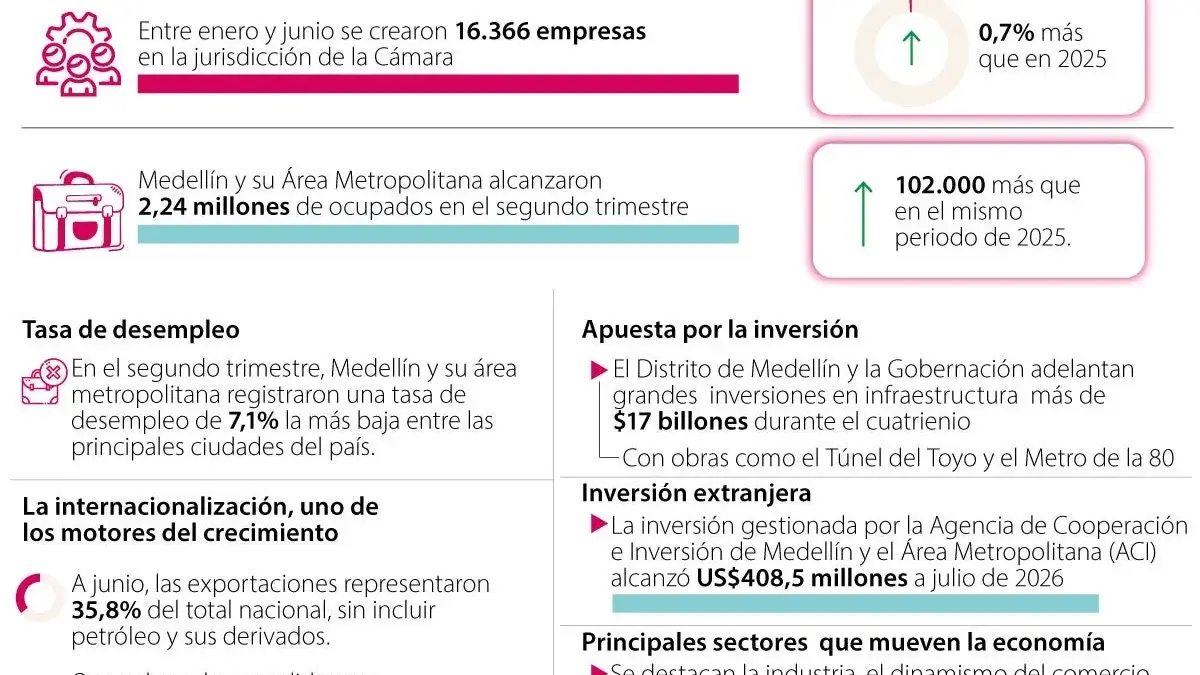
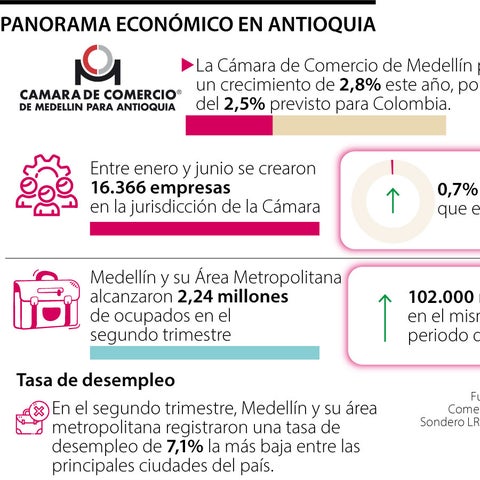
While the Colombian economy is expected to post a modest GDP growth of 2.5% in 2026, Antioquia is on track to achieve an expansion between 2.8% and 3.0%, according to the latest projections from the Medellín Chamber of Commerce for Antioquia.
Though a 0.3 to 0.5 percentage point growth premium may appear marginal on paper, economists point out that this divergence represents a profound structural shift. It underscores the region’s historic capacity to withstand national volatility by rapidly diversifying its productive apparatus away from traditional commodities and toward high-value-added services, tech exports, and creative industries.
Main Facts: The Structural Shift in Numbers
The macroeconomic narrative of Antioquia in 2026 is defined by several key performance indicators that highlight both its regional dominance and its structural evolution:
- Growth Divergence: Antioquia’s projected GDP growth of 2.8% to 3.0% outpaces the national forecast of 2.5%, proving the region’s economic policies and business environment are successfully buffering against broader national headwinds.
- Entrepreneurial Dynamism: During the first half of 2026, the region registered 16,366 new companies, representing a 0.7% year-on-year increase compared to the same period in 2025.
- Export Dominance: Excluding petroleum and its derivatives, Antioquia accounted for 35.8% of Colombia’s total exports in the first half of the year, driven by a mixture of traditional commodities (gold, copper, bananas) and a massive surge in high-tech goods.
- Foreign Direct Investment (FDI): By July 2026, the Agency for Cooperation and Investment of Medellín and the Metropolitan Area (ACI Medellín) managed USD $408.5 million in inbound foreign investment, reflecting strong international confidence in local talent and regional stability.
- The Rise of High-Value Sectors: While traditional pillars like civil construction, commerce, and textile manufacturing remain vital, the region’s growth is increasingly powered by a "new economy" comprising creative industries (audiovisual, music, software, video games), specialized tourism, and advanced business services.
Chronology of an Economic Transformation
To understand Antioquia’s performance in 2026, it is essential to trace the chronological milestones of its economic transition over recent years and through the first semesters of 2026.
[Pre-2020]                [2021–2025]               [H1 2026]                [July 2026]
Traditional Industrial -> Service & Tech Pivot -> 16,366 New Firms -> USD 408.5M FDI
Base (Textiles, Gold)     (Creative, Tourism)     (+0.7% YoY Growth)       (Targeted Tech/Services)
Phase 1: The Traditional Foundation (Pre-2020)
For decades, Antioquia’s economy was built on robust industrial manufacturing, textile production, agriculture (primarily coffee and bananas), and gold mining. While highly successful, this model left the region vulnerable to global commodity price shocks, domestic currency fluctuations, and low-cost international manufacturing competition.
Phase 2: The Service and Tech Pivot (2021–2025)
Recognizing the limitations of a purely industrial economy, local authorities, academia, and the private sector aligned under a unified regional strategy. Medellín transformed itself into a hub for the Fourth Industrial Revolution (4IR), incentivizing software development, digital services, and the creative arts (the "Orange Economy"). Concurrently, the city became a premier global destination for leisure and business tourism.
Phase 3: Consolidation and Divergence (First Semester of 2026)
- January – March 2026: The year opened with lingering concerns over national inflation, high interest rates, and regulatory uncertainty surrounding federal reforms. However, Antioquia’s corporate registrations began showing early signs of recovery, driven by tech startups and tourism-related services.
- June 2026: Mid-year audits revealed that 16,366 new companies had been established in the first six months. Non-traditional exports, specifically medium- and high-technology goods, recorded explosive growth rates.
- July 2026: Inbound FDI figures compiled by ACI Medellín officially reached USD $408.5 million. Concurrently, international gold prices reached historic highs, providing a massive financial cushion for the department’s rural subregions.
Supporting Data: Analyzing the Regional Engines
The resilience of Antioquia’s economy in 2026 is supported by deep-seated changes across several key sectors.
1. Corporate Registrations and the Entrepreneurial Ecosystem
The creation of 16,366 new companies in the first half of 2026 is not merely a quantitative victory; it is a qualitative indicator of economic diversification. Unlike previous decades, where new registrations were heavily concentrated in retail commerce and low-margin services, the 2026 cohort shows a high concentration in knowledge-intensive sectors.
According to Chamber of Commerce data, the fastest-growing subsectors for new business creation include:
- Digital transformation and IT consulting.
- Creative and cultural services (music production, digital marketing, audiovisual editing, and gaming).
- Bilingual corporate services (outsourced human resources, software engineering, and customer success hubs).
2. Export Sophistication and High-Tech Domination
Antioquia’s export basket is undergoing a quiet revolution. While traditional commodities continue to secure the department’s balance of trade, advanced manufacturing is taking center stage.
| Export Category | National Export Share (Non-Oil) | Key Drivers (2026) | Annual Growth Rate |
|---|---|---|---|
| Traditional Commodities | 35.8% (Combined total) | Gold, Copper, Bananas, Coffee | Stable (Supported by high gold prices) |
| Medium & High-Tech Goods | Part of regional basket | Medical devices, electrical machinery, chemical inputs | > 50.0% |
The greater than 50% growth rate in medium- and high-technology exports is particularly notable because it has proven highly resilient to exchange rate volatility. Unlike raw agricultural products, high-tech manufactured goods command premium pricing, allowing regional exporters to maintain strong margins even when the Colombian Peso (COP) experiences sharp fluctuations.
3. Tourism and the Creative Economy
Medellín and the wider Antioquia department have transitioned from a regional tourism destination to a global hotspot. The influx of international visitors has triggered a powerful multiplier effect across the local service economy, directly boosting:
- Gastronomy and Hospitality: High-end restaurants, boutique hotels, and specialized tour operators.
- The Entertainment Industry: Concerts, cultural festivals, and creative conventions.
- The Gig Economy and Transport: Local logistics, ride-sharing platforms, and translation services.
Official and Expert Perspectives
The economic narrative of Antioquia is shaped by a highly collaborative relationship between regional business leaders, academic institutions, and public agencies. Key figures have weighed in on what these metrics mean for the region’s future.
The Chamber of Commerce View: Fredy Pulgarín
Fredy Pulgarín, Vice President of Competitiveness and Business Development at the Medellín Chamber of Commerce for Antioquia, emphasizes that the region’s success lies in its proactive diversification strategy.
"Antioquia has been developing a series of alternative growth engines closely associated with high-value-added services," Pulgarín explains. "Among them, we clearly identify creative industries, tourism, business services, and activities linked to technology and innovation."
Pulgarín highlights the extraordinary performance of the region’s tech exports as a structural turning point:
"When you analyze Antioquia’s exports, products of medium and high technology are growing at rates of around 50% and more. This opens up a major opportunity: to transition from an export economy sustained by traditional commodities to one with an increasingly larger participation of high-value-added goods and services."
He also notes that this trend is reflected in the local startup ecosystem:
"There is a new generation of companies that is finding opportunities in activities intensive in knowledge, creativity, and services. The region’s growth no longer depends exclusively on how traditional sectors perform."
The Academic View: César Eduardo Tamayo
From an academic and analytical perspective, César Eduardo Tamayo, Dean of the School of Economics and Finance at EAFIT University, points out that Antioquia is currently operating as a highly synchronized, dual-speed economy.
"In recent years, Antioquia’s economic dynamics have been explained, on one hand, by the excellent performance of the urban economy in Medellín—where tourism, entertainment, and, more recently, retail commerce have thrived," Tamayo notes. "On the other hand, the rest of the department has been sustained by robust agro-industrial performance and metallic mining. The price of gold, in particular, has risen significantly over the past few years, providing a vital economic buffer for our subregions."
Implications and Future Outlook
While Antioquia’s economic performance in 2026 is highly encouraging, the region does not operate in a vacuum. To sustain this momentum, regional stakeholders must successfully navigate several macroeconomic headwinds and structural challenges.
                   [MACROECONOMIC RISK FACTORS]
                                |
       +------------------------+------------------------+
       |                        |                        |
[National Reforms]      [Monetary Policy]       [Structural Gaps]
- Labor Reform costs    - High interest rates   - Talent shortages
- Tariff adjustments    - Exchange rate swings  - Infrastructure limits
1. Macroeconomic Threats and Regulatory Uncertainty
The primary risks to Antioquia’s continued expansion stem from national-level policies and global economic conditions:
- The Labor Reform: Business leaders across the department have expressed concern over proposed national labor reforms, which could significantly increase formal employment costs, potentially impacting the margins of service-oriented startups and traditional manufacturers alike.
- Monetary Policy and Interest Rates: Although inflation has begun to cool, historically high interest rates continue to restrict access to corporate credit, dampening domestic consumption and private capital expenditure.
- Exchange Rate Volatility: While high-tech exporters are partially insulated, traditional agricultural exporters (such as flower and banana growers) remain highly sensitive to fluctuations in the COP/USD exchange rate.
2. The Productivity Imperative
Despite positive growth numbers, experts warn against complacency. To avoid falling into a middle-income trap, Antioquia must actively work to close internal productivity gaps.
While Medellín’s urban core thrives on technology and services, rural subregions remain heavily reliant on primary agriculture and mining. Bridging this divide requires targeted investments in regional infrastructure, rural connectivity, and technical education.
3. Talent Retention and the Innovation Ecosystem
The influx of USD $408.5 million in FDI managed by ACI Medellín is testament to the region’s attractive business ecosystem. However, sustaining this level of investment requires a continuous pipeline of highly skilled, bilingual talent, particularly in STEM (Science, Technology, Engineering, and Mathematics) fields.
If Antioquia can successfully expand its educational capacity to meet the demands of its fast-growing tech and creative sectors, the region will not only maintain its lead over the national economy but will also cement its status as one of Latin America’s premier knowledge-based economies for the next decade.



Leave a Reply