

LONDON — In the realm of automotive television and viral marketing, few stunts are as universally etched into the collective memory as the legendary abuse inflicted upon a Toyota Hilux by the BBC’s Top Gear in 2003. For decades, that diesel-powered workhorse set the global benchmark for vehicular indestructibility—surviving immersion in the sea, engulfed in flames, battered by a demolition ball, and even sitting atop a high-rise apartment block as it was imploded.
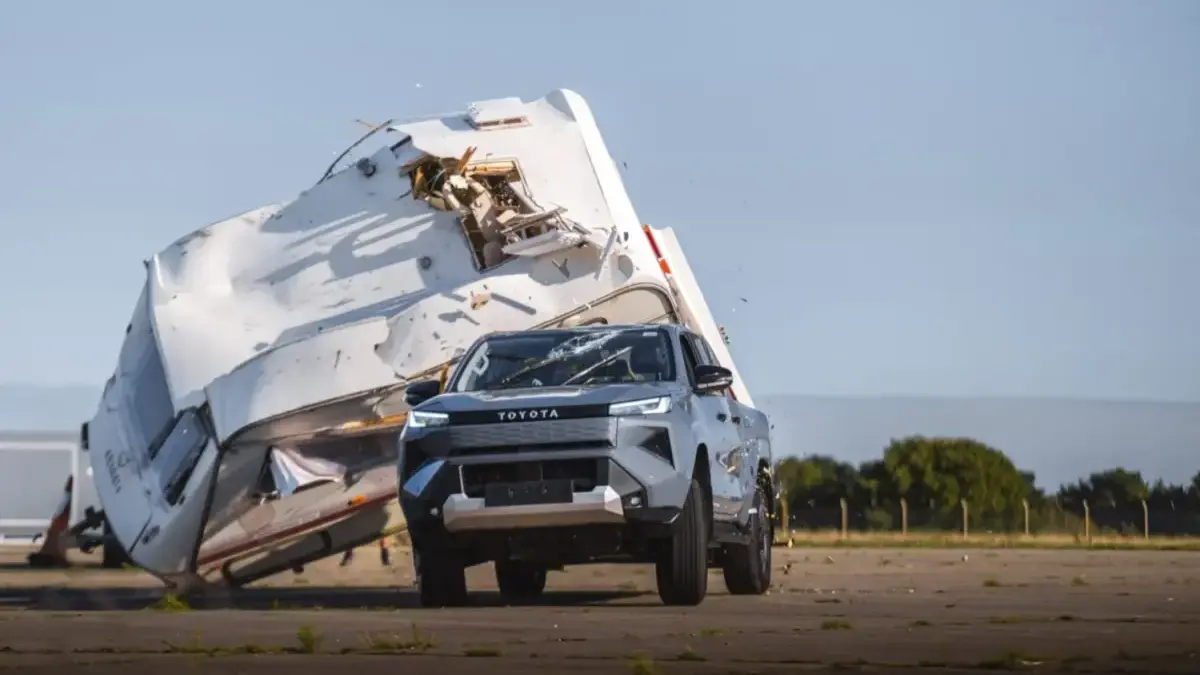
Now, more than twenty years later, Toyota is revisiting that golden era of motoring television with a high-stakes modern twist. The Japanese manufacturer has taken its brand-new, battery-electric Toyota Hilux BEV and subjected it to the ultimate nostalgic trial: dropping a 760-kilogram caravan directly onto its roof from a height of nine meters.
The objective was straightforward yet audacious: to prove to skeptics and loyalists alike that the Hilux’s legendary, almost mythical durability remains completely intact, even when you strip away the diesel engine and replace it with a complex high-voltage electrical architecture.
Main Facts: The Stunt, the Vehicle, and the Legacy
The staging ground for this high-impact experiment was the historic Bentwaters airfield in Suffolk, England—a sprawling, industrial expanse well-suited for heavy-duty vehicular testing. Suspended by a heavy-duty industrial crane, a standard 760-kilogram caravan was hoisted into the grey English sky before being abruptly released, plummeting downward to deal a devastating blow to the cabin of the pioneering electric pick-up truck.
This was not merely an arbitrary marketing whim; it was a democratized act of digital destruction. Prior to the drop, Toyota UK engaged with the automotive community through a targeted poll on Reddit, giving British users a binary choice on how they wanted to torture the new zero-emissions pick-up: take hits from a one-ton demolition ball or endure a free-falling caravan. The caravan option won by an overwhelming margin, cementing the callback to the 2003 television broadcast that turned the Hilux into a pop-culture icon.
Underneath the battered sheet metal lies the Toyota Hilux BEV, the brand’s first-ever fully electric pick-up truck. Unlike its combustion-engined predecessors, which relied on cast-iron blocks and mechanical simplicity to survive catastrophic damage, the BEV variant relies on:
- A 59.2 kWh lithium-ion battery pack strategically integrated into the ladder-frame chassis.
- A dual-motor setup delivering a combined output of 196 horsepower.
- An advanced electronic four-wheel-drive (AWD) system distributing torque dynamically.
- An estimated homologated driving range of approximately 250 kilometers (155 miles), varying by market and specific operational configuration.
Despite the profound technological leap from old-school diesel injection to sophisticated power electronics and sensitive battery cells, Toyota engineers walked away with what they came for: after the dust settled, the windows shattered, and the roof caved in, the Hilux BEV powered on and drove away under its own electrical power.
Chronology of the Event: From Reddit Poll to the Suffolk Drop
To understand how this high-voltage resurrection came to pass, it is essential to trace the sequence of events that brought the electric pick-up to the Bentwaters airfield.
Phase 1: The Community Vote
In early October 2026, Toyota UK launched an interactive campaign targeting automotive enthusiasts on Reddit. The prompt was simple: challenge the new Hilux BEV in a manner reminiscent of the classic Top Gear trials. The internet voted swiftly and decisively for the caravan drop, setting the machinery in motion for a recreation of the famous episode featuring presenters Jeremy Clarkson and the indestructible 1988 diesel Hilux.
Phase 2: Preparation at Bentwaters Airfield
Engineers transported a pre-production-spec Hilux BEV to the Suffolk airfield. Safety protocols for electric vehicles were rigorously observed; although the high-voltage systems were armed, emergency disconnects were on standby in the event of an uncontrolled thermal runaway triggered by the heavy structural blow. A crane was calibrated to lift a fully furnished 760-kilogram caravan precisely nine meters above the ground, centered above the pick-up’s cabin.
Phase 3: The Impact
With cameras rolling from multiple angles, the release mechanism was triggered. The caravan plummeted, striking the roof of the Hilux cabin with a devastating, kinetic impact that instantly obliterated the trailer into a chaotic heap of fiberglass, wood, and aluminum shards. The kinetic energy transferred directly downward, causing severe structural buckling of the A-pillars, roof rails, and windscreen frame.
Phase 4: The Post-Impact Assessment and Drive-Away
Immediately following the collision, safety technicians inspected the high-voltage isolation status of the vehicle to ensure no live terminals were exposed. Once cleared, the ignition sequence was initiated. To the astonishment of onlookers and production crews, the dashboard illuminated without fault codes indicating critical drivetrain failure, and the electric motors responded. The scarred, roof-crushed Hilux BEV engaged its gear selector and rolled forward under its own electric power, successfully recreating the legendary climax of the 2003 broadcast.
Supporting Data: Evolution of a Workhorse
To fully grasp the significance of this test, one must analyze the technological chasm that separates the original 2003 diesel Hilux from the modern 2026 BEV iteration.
| Metric / Feature | 2003 Toyota Hilux (Top Gear Classic) | 2026 Toyota Hilux BEV |
|---|---|---|
| Powertrain | 2.4L Naturally Aspirated Diesel (2L/3L engine series) | Dual Electric Motors + 59.2 kWh Battery Pack |
| Power Output | Approx. 85 – 95 HP | 196 HP |
| Drivetrain | Manual 4×4 with mechanical transfer case | Electronic AWD with torque vectoring |
| Vulnerability Factors | Heavy steel blocks; minimal electronics; mechanical fuel injection | High-voltage cabling, inverter modules, lithium-ion pouch/prismatic cells |
| Global Sales Milestone | Cumulative global sales surpassing 15 million units at the time | Cumulative global sales exceeding 27 million units |
While a traditional diesel engine can tolerate physical deformation because its combustion relies purely on compression and fuel delivery (requiring little more than a functioning starter motor and fuel line to run), an electric vehicle presents a radically different engineering challenge. A heavy impact directly over the cabin risks compromising the high-voltage bus bars, short-circuiting the inverter, or damaging the structural integrity of the battery pack mounted directly beneath the floorpan.
The fact that the Hilux BEV absorbed a 760-kilogram overhead blow and remained functional highlights extraordinary advancements in structural reinforcement, crash-energy dissipation, and electronic compartmentalization in modern electric commercial vehicles.
Official Responses and Corporate Strategy
Toyota’s leadership has been vocal about the strategic importance of this stunt. While the imagery is undeniably entertaining and leans heavily into nostalgic viral marketing, the underlying corporate message is razor-sharp: electrification does not mean a compromise in utility, durability, or toughness.
In an official statement following the test, a Toyota spokesperson emphasized the weight of the Hilux nameplate:
"The Hilux has built its reputation over decades across the most hostile environments on Earth—from the frozen wastes of the Arctic to the blistering heat of the Sahara. With over 27 million units sold globally, our customers depend on its indestructible nature to make a living. As we transition toward zero-emission mobility, our absolute priority is ensuring that the transition to electric powertrains does not dilute the core DNA of the vehicle. Surviving the caravan drop proves that our engineering team has successfully bridged the gap between cutting-edge green technology and legendary industrial-grade resilience."
Industry analysts have noted that pick-up truck buyers—traditionally among the most conservative and change-resistant segments in the automotive market—often harbor deep skepticism regarding the durability of electric utility vehicles. Concerns over battery longevity on rough job sites, water-fording capabilities, and structural resilience under heavy loads have slowed EV adoption in the commercial sector. Toyota’s theatrical demonstration serves as a direct, high-impact counter-narrative designed to assuage these exact fears.
Market Implications and the Road Ahead
The timing of this stunt coincides precisely with the commercial rollout of the Hilux BEV across international markets, including its official introduction in Spain and broader European territories. Here, the electric pick-up enters a growing, competitive segment where it must coexist alongside traditional internal combustion engine (ICE) variants and plug-in hybrid options.
What Lies Next for the Battered EV?
True to the spirit of the original Top Gear challenges, the story of this specific test vehicle does not end in the scrapyard. Toyota has formally handed over the battered, roof-caved Hilux BEV unit to the production team at Top Gear to undergo further evaluation.
Industry insiders anticipate a series of follow-up challenges designed to test the limits of the electric drivetrain in ways the original 2003 truck never faced:
- Deep Water Fording: Testing the waterproof rating (IP67/IP69K) of the battery housing and electric motors after severe structural trauma.
- Towing and Payload Strain: Evaluating how the damaged chassis handles maximum towing capacity under regenerative braking stress.
- Thermal Stress Testing: Pushing the battery management system to its limits in extreme heat and cold environments following structural compromise.
Conclusion: Nostalgia Meets Modern Engineering
Toyota’s modern recreation of the caravan drop is a masterclass in automotive PR. By fusing the powerful nostalgia of early-2000s television culture with the stark reality of modern electrification, the brand has successfully captured public attention while delivering a serious engineering statement.
The Hilux BEV has proven that beneath its sleek lines, digital displays, and chemical battery cells, the beating heart of an unyielding workhorse still lives on. As the automotive world navigates the turbulent waters of the green transition, Toyota has sent an unmistakable signal to the market: the tools may change, but the toughness is eternal.


Leave a Reply