

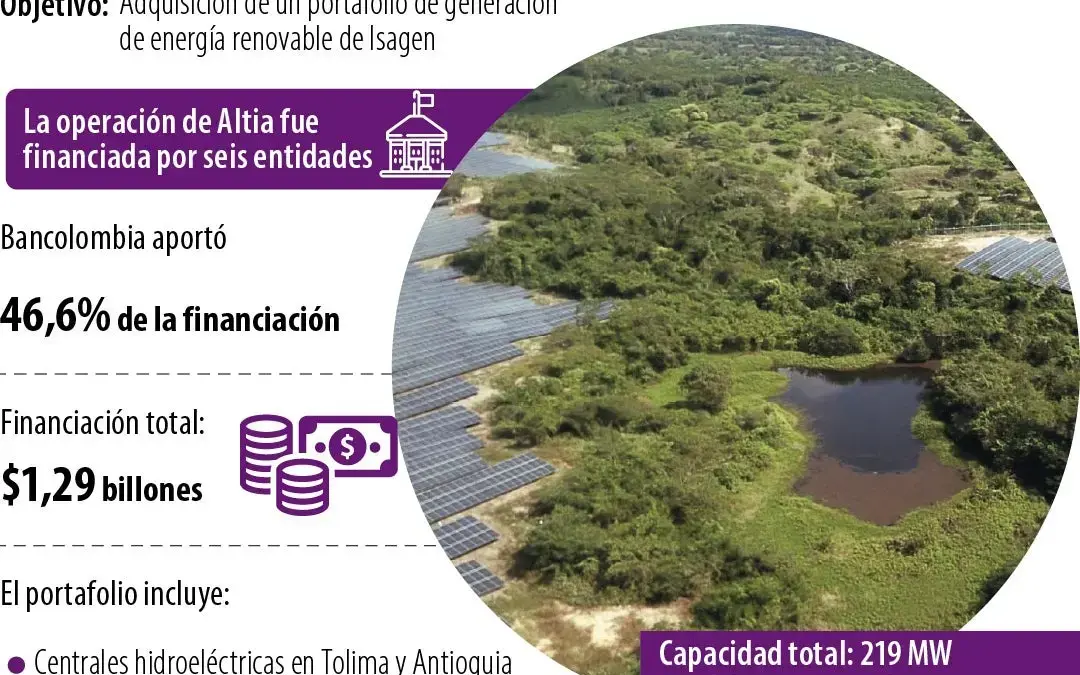
BOGOTÁ, COLOMBIA — In a milestone transaction that underscores the accelerating momentum of Latin America’s green transition, energy company Altia has successfully finalized the acquisition of a major renewable generation portfolio from Isagen. The strategic expansion, valued at an impressive COP 1.29 trillion, was made possible through a robust syndicated financing package led by Bancolombia in collaboration with five other prominent financial institutions.
This multi-billion-peso operation not only marks a defining moment for Altia’s corporate evolution and geographical diversification but also injects 219 megawatts (MW) of clean, reliable energy capacity into the national grid. By seamlessly combining state-of-the-art run-of-the-river hydroelectric plants with a sprawling utility-scale solar complex, the transaction exemplifies the viability and attractiveness of sophisticated project finance structures in driving sustainable infrastructure development across Colombia.
Main Facts
At the core of this landmark transaction is Altia’s strategic acquisition of a diverse, high-yielding portfolio of renewable energy assets previously owned by Isagen, one of Colombia’s premier energy generators. The total capitalization required to close the deal reached COP 1.29 trillion, mobilized through a sophisticated project finance scheme designed to mitigate risk while optimizing long-term capital deployment.
The newly acquired portfolio encompasses a balanced mix of hydro and solar assets totaling 219 MW of installed capacity:
- Hydroelectric Generation (119 MW): Comprising three efficient run-of-the-river hydroelectric plants strategically distributed across the departments of Tolima and Antioquia.
- Solar Generation (100 MW): Anchored by a massive, multi-phase photovoltaic complex situated in the Caribbean department of Atlántico.
Bancolombia, acting as the lead financial orchestrator and primary lender, provided a dominant 46.6% of the total COP 1.29 trillion financing package. The remaining balance was distributed among a syndicate of five other reputable financial institutions, reflecting broad institutional confidence in Altia’s operational capabilities, the quality of the underlying assets, and the long-term fundamentals of Colombia’s power sector.
This structural infusion of capital allows Altia to dramatically broaden its technological footprint. Previously reliant on specific generation niches, the company now commands a resilient, dual-source renewable portfolio that hedges against hydrological volatility—such as the cyclical impacts of the El Niño phenomenon—by balancing water-dependent assets with high-yield solar generation.
Chronology of the Transaction
The realization of this multi-trillion-peso agreement was the culmination of a rigorous, multi-month process involving complex due diligence, regulatory clearances, financial structuring, and multi-party negotiations.
Phase 1: Strategic Alignment and Asset Identification (Early to Mid-2023)
The genesis of the transaction lay in Isagen’s ongoing portfolio optimization strategy, which sought to divest certain non-core renewable assets to reallocate capital toward large-scale strategic initiatives. Concurrently, Altia identified a prime opportunity to scale its operations rapidly. Rather than enduring the lengthy greenfield development cycle—which entails complex environmental licensing, community consultations, and construction risks—Altia targeted brownfield operational assets capable of immediately contributing to its top-line revenue and generation metrics.
Phase 2: Financial Structuring and Syndicate Formation (Late 2023)
Recognizing the capital intensity of acquiring 219 MW of operational renewable capacity, Altia engaged Bancolombia to structure a bespoke project finance vehicle. Given the sheer scale of the COP 1.29 trillion requirement, Bancolombia initiated the formation of a financial syndicate. Over several months, legal, technical, and financial advisors conducted exhaustive audits of the target assets, evaluating everything from hydrological data and power purchase agreements (PPAs) to environmental compliance and transmission grid connections.
Phase 3: Syndication Closure and Regulatory Approvals (Early 2024)
By assembling five additional financial institutions to share the debt syndication, Bancolombia successfully mitigated individual credit exposure while tailoring debt-service schedules to match the predictable cash flows of the hydro and solar assets. Concurrently, filings were submitted to relevant regulatory bodies, including the Superintendencia de Industria y Comercio (SIC) and the Ministerio de Minas y Energía, to ensure compliance with free-competition laws and sector-specific regulations.
Phase 4: Financial Closing and Asset Handover (Recent)
With all regulatory clearances secured and the syndicated loan fully executed, the financial closing was formally consummated. Ownership of the hydro plants in Tolima and Antioquia, alongside the solar complex in Atlántico, officially transferred to Altia. The integration process immediately commenced, supported by transition services agreements with Isagen to ensure uninterrupted generation and dispatch into the National Interconnected System (SIN).
Supporting Data and Asset Breakdown
To fully appreciate the scope of this transaction, one must examine the granular composition of the 219 MW portfolio acquired by Altia. The assets represent a harmonious blend of geographical dispersion and technological diversification, shielding the company from localized climate shocks.
The Hydroelectric Fleet (119 MW Total Capacity)
Run-of-the-river hydroelectric plants are prized in modern energy portfolios for their lower environmental impact compared to massive reservoir dams, as they do not require large-scale flooding of valleys. The three hydro assets integrated into Altia’s portfolio are:
-
Amoyá Hydroelectric Plant (Chaparral, Tolima):
- Capacity: A vital asset located in the southern region of Tolima. Amoyá harnesses the waters of the Amoyá River along the eastern slope of the Central Cordillera.
- Significance: Known for its engineering ingenuity in traversing rugged Andean terrain, Amoyá provides consistent, baseload renewable energy to the central grid, reinforcing supply reliability for Andean and Tolimense demand centers.
-
Barroso Hydroelectric Plant (Salgar, Antioquia):
- Capacity: Situated in the southwestern subregion of Antioquia, a historic hub for Colombian coffee and commerce.
- Significance: Barroso leverages the robust hydrological profile of the region, capitalizing on consistent rainfall patterns and steep elevation drops to generate clean energy with high operational efficiency.
-
Guanaquitas Hydroelectric Plant (Santa Rosa de Osos and Gómez Plata, Antioquia):
- Capacity: Straddling two municipalities in the northern highlands of Antioquia.
- Significance: Operating in close proximity to major consumption nodes in the Aburrá Valley (including Medellín), Guanaquitas minimizes transmission losses and provides strategic flexibility in regional energy dispatch.
The Solar Complex (100 MW Total Capacity)
To complement its hydro assets and introduce a diurnal generation profile, Altia integrated a massive photovoltaic footprint in Colombia’s sun-drenched Caribbean region.
- Bosques Solares de Bolívar 1-5 (Sabanalarga, Atlántico):
- Capacity: 100 MW of utility-scale solar generation.
- Significance: Located in the municipality of Sabanalarga, this complex represents one of the premier solar installations in the northern Colombian department. By harnessing the high solar irradiance of the Caribbean coast, Bosques Solares de Bolívar generates peak power during daylight hours—precisely when industrial and residential air-conditioning loads peak. This generation profile inversely correlates with hydro availability during drier months, creating a perfectly balanced corporate energy matrix.
Financial Engineering: The Mechanics of Project Finance
The COP 1.29 trillion transaction was executed utilizing a project finance framework, a cornerstone of modern infrastructure funding. Under this arrangement, the debt incurred by Altia is secured primarily by the projected cash flows generated by the Amoyá, Barroso, Guanaquitas, and Bosques Solares de Bolívar assets, rather than relying exclusively on the balance sheet of the parent company.
Bancolombia’s role as the anchor lender—contributing 46.6% of the total financing—underscores the bank’s sophisticated risk-appetite assessment capabilities and its long-standing commitment to environmental, social, and governance (ESG) lending frameworks. The participation of five secondary financial institutions further validates the maturity of Colombia’s sustainable debt markets, proving that local institutional capital is increasingly willing to back high-value, green transition assets.
Official Responses and Stakeholder Perspectives
The successful closing of the Altia-Isagen transaction drew widespread acclaim from corporate leaders, financial executives, and energy sector experts, who viewed the deal as a testament to the resilience and attractiveness of Colombia’s green economy.
Bancolombia’s Strategic Vision
Speaking on behalf of the lead financial institution, Mauricio Rosillo, Corporate Business Vice President at Bancolombia, emphasized the profound systemic implications of the deal. In an official statement, Rosillo articulated the bank’s philosophy regarding sustainable investments:
"This operation allows renewable assets to continue contributing to the country’s growth and demonstrates that, when we connect investment with opportunities, we advance toward a more resilient economy prepared for the future."
Rosillo’s remarks highlight Bancolombia’s strategic alignment with global decarbonization goals. By steering nearly 47% of a COP 1.29 trillion syndicate toward green assets, the bank is actively fulfilling its commitments to portfolio greening and climate risk mitigation. Furthermore, Rosillo noted that transactions of this magnitude send a powerful signal to international investors that Colombia possesses the legal security, financial sophistication, and institutional depth required to execute complex infrastructure deals.
Altia’s Corporate Transformation
Executives from Altia echoed these sentiments, framing the acquisition not merely as a portfolio expansion, but as a fundamental pivot in the company’s corporate identity. By absorbing 219 MW of operational capacity in a single stroke, Altia instantly elevates its standing among Colombia’s independent power producers (IPPs).
Internal company communications stress that the integration of diverse technologies—combining the predictable baseload capabilities of Andean run-of-the-river hydro with the high-yield diurnal peaks of Caribbean solar—positions Altia to offer bespoke, highly competitive energy supply contracts to large industrial and commercial off-takers. In an electricity market increasingly influenced by climate variability and evolving regulatory mandates, possessing a hybridized renewable portfolio is viewed as the ultimate competitive advantage.
Isagen’s Portfolio Optimization
From the perspective of Isagen, the divestment of these specific assets represents a classic case of capital recycling. By successfully monetizing mature, operating hydro and solar assets at an attractive valuation, Isagen frees up substantial balance-sheet capacity. This capital can now be redeployed into pioneering greenfield renewable projects, grid-scale battery storage initiatives, or the modernization of its remaining flagship generation fleet, thereby maintaining its leadership position in Colombia’s energy transition.
Implications for Colombia’s Energy Sector and Economy
The ripples of this COP 1.29 trillion transaction extend far beyond the corporate balance sheets of Altia, Bancolombia, and Isagen. The deal carries profound macroeconomic, regulatory, and environmental implications for Colombia as a whole.
1. Strengthening Macroeconomic Resilience Through Diversification
Colombia’s historical reliance on large-scale hydroelectric generation has traditionally exposed its power grid to severe vulnerabilities during prolonged dry spells induced by climate phenomena such as El Niño. By injecting 100 MW of solar capacity in the Caribbean alongside 119 MW of run-of-the-river hydro in the Andes, this transaction actively combats hydrological concentration risk. A diversified energy matrix ensures stable electricity pricing, reduces the probability of energy rationing during droughts, and stabilizes industrial overhead costs across the nation.
2. Deepening the Domestic Sustainable Debt Market
The successful syndication of COP 1.29 trillion involving Bancolombia and five other financial institutions demonstrates the growing depth and liquidity of Colombia’s financial sector when it comes to funding green infrastructure. Historically, major infrastructure projects in Latin America relied heavily on multilateral development banks (such as the IFC or IDB) or international bond issuances exposed to foreign exchange volatility. The fact that local financial institutions successfully syndicated a transaction of this scale in Colombian Pesos (COP) highlights the maturity of the domestic capital market and shields local borrowers from currency mismatch risks.
3. Accelerating the National Decarbonization Agenda
Colombia has established ambitious Nationally Determined Contributions (NDCs) under the Paris Agreement, pledging to reduce greenhouse gas emissions by 51% by 2030 and achieve carbon neutrality by 2050. Achieving these targets requires the mobilization of billions of dollars in private capital toward clean energy infrastructure. Transactions like Altia’s acquisition prove that the energy transition in Colombia is not driven solely by government mandates or foreign aid, but by robust, market-driven commercial logic where sustainability and profitability intersect.
4. Regional Economic Development in Tolima, Antioquia, and Atlántico
Beyond megawatts and financial ratios, the assets central to this transaction generate tangible socio-economic benefits at the local level. The operation and maintenance of the Amoyá, Barroso, and Guanaquitas hydroelectric plants, alongside the Bosques Solares de Bolívar complex, sustain hundreds of direct and indirect high-skilled engineering and operational jobs in rural municipalities. Furthermore, municipal governments benefit from continuous tax contributions and environmental transfer payments (transferencias eléctricas), which fund local infrastructure, education, and community development programs.
Conclusion
The acquisition of Isagen’s 219 MW renewable portfolio by Altia, backed by a COP 1.29 trillion syndicated financing package spearheaded by Bancolombia, stands as a watershed moment for the Colombian energy landscape. By uniting hydro and solar assets under a single, highly resilient corporate umbrella, the transaction redefines the parameters of operational diversification in the national power market.
As Mauricio Rosillo aptly noted, this operation is living proof that connecting strategic investment with clear market opportunities paves the way for a robust, future-proof economy. As Colombia continues to navigate the complexities of climate change and energy security, visionary transactions of this scale ensure that the nation’s transition toward a cleaner, greener tomorrow remains firmly on track—powered by local ingenuity, financial rigor, and an unwavering commitment to sustainable growth.


Leave a Reply