

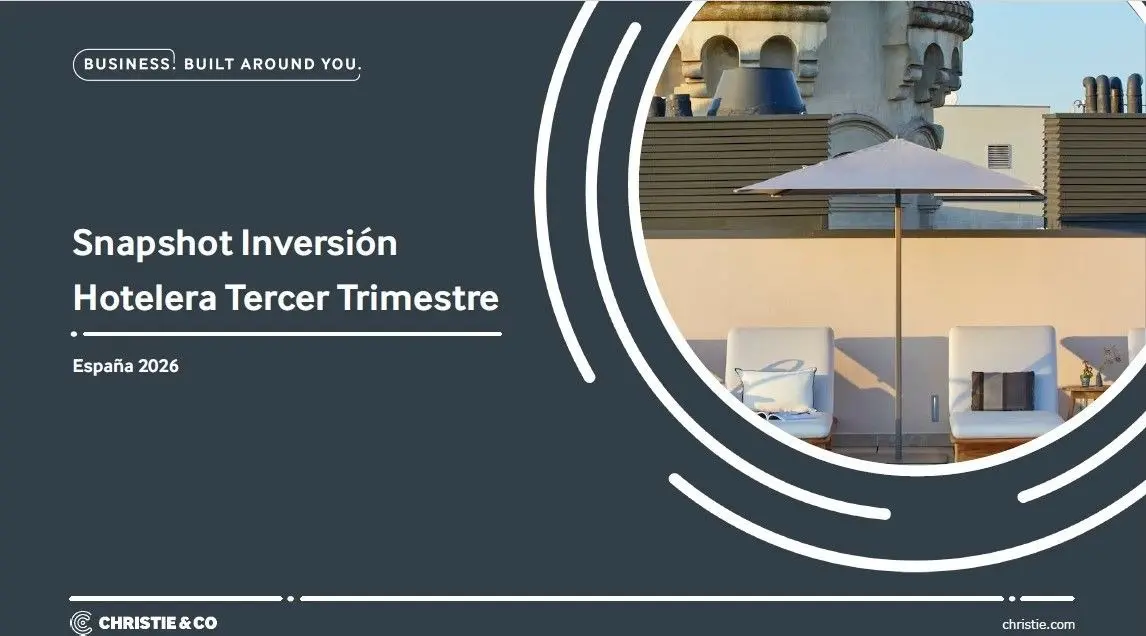
SPAIN — The Spanish hotel investment market continues to exhibit remarkable resilience and robust momentum as it moves through the final quarter of 2026. According to the latest comprehensive market report released by international real estate consultancy Christie & Co, transaction volumes in Spain’s hospitality sector surpassed 3 billion euros during the first nine months of the year.
This sustained appetite from both domestic and international capital underscores Spain’s position as Europe’s premier hospitality investment hub. Propelled by stellar operational performance across traditional tourist strongholds and high-growth urban centers, the market has successfully absorbed more than 100 hotel assets and 13,000 rooms between January and September 2026.
Main Facts
The third-quarter report from Christie & Co highlights several defining characteristics of Spain’s thriving hotel real estate landscape:
- Total Transaction Volume: More than €3 billion invested up to September 2026.
- Asset Liquidity: Over 100 hotel assets and approximately 13,000 rooms changed hands.
- Segment Balance: The resort/vacation segment holds a slight edge over urban properties, capturing 51% of total transaction volume, with urban assets taking the remaining 49%.
- High-End Dominance: Upscale properties remain the primary target for investors, with 4-star and 5-star hotels commanding an overwhelming 82% of the total capital deployed.
- Geographic Concentration: Madrid and Barcelona dominate the urban landscape, jointly accounting for 69% of the national total (Madrid at 40%, Barcelona at 29%). Among resort destinations, the Costa del Sol captured 12% and the Balearic Islands secured 9%.
- Surging Valuations: The average price per room climbed to €233,000, representing a significant 12.5% increase compared to the same period in 2025. Prime trophy assets substantially exceeded this average.
- Capital Origins: Domestic Spanish capital accounted for the majority share at 60%, while international investors drove 40% of the activity, spearheaded by notable inflows from France (29%) and Turkey (14%).
Chronology of Major Transactions (Q1–Q3 2026)
The year 2026 has been marked by high-profile corporate buyouts, single-asset acquisitions, and strategic repositioning of landmark properties across Spain’s key tourism corridors.
First Half: Setting a Fast Pace
The groundwork for the €3 billion milestone was laid during the first and second quarters, characterized by institutional funds repositioning portfolios and private equity firms targeting coastal conversions. Prime resort areas such as the Balearic Islands and the Costa del Sol saw early competitive bidding wars for established four-star coastal complexes, driving yields down and valuations upward.
Mid-Year Surge: High-Profile Deals
As the market transitioned into the summer months, three monumental transactions defined the upper echelon of the market, setting new valuation benchmarks and drawing global attention:
- The Acquisition of ME Barcelona: Demonstrating the immense appeal of Barcelona’s luxury segment, the prestigious 5-star, 164-room ME Barcelona was acquired by the prominent Turkish conglomerate Kaya Group. Significantly, the deal was structured to retain Meliá Hotels International as the ongoing hotel operator, ensuring continuity in service and branding.
- The Room Mate Macarena Sale in Madrid: Highlighting the fierce competition for prime urban real estate, the building housing the 3-star, 120-room Room Mate Macarena—ideally situated directly on Madrid’s iconic Gran Vía—changed hands in a high-stakes transaction valued at over 80 million euros.
- La Zambra Resort Joins Grupo Hesperia: In the luxury resort sphere, the Costa del Sol witnessed a landmark deal as Grupo Hesperia finalized the acquisition of La Zambra Resort, an ultra-luxury 197-room complex located in Mijas, further solidifying the buyer’s footprint in high-end leisure hospitality.
These headline-grabbing sales not only contributed heavily to the aggregate volume but also propelled individual room valuations past the €610,000 mark in select prime deals.
Supporting Data and Market Metrics
A deeper dive into the numbers provided by Christie & Co reveals structural shifts in how investors are evaluating risk, location, and asset class within the Spanish hospitality market.
Geographical Breakdown of Investment
[Madrid] ------------------- 40%
[Barcelona] ---------------- 29%
[Costa del Sol] ------------ 12%
[Balearic Islands] --------- 9%
[Other Destinations] ------- 10%
Madrid’s 40% share reflects its ongoing transformation into a premier luxury lifestyle and corporate hub in Europe. The Spanish capital continues to attract high-net-worth individuals and institutional funds looking for stable, year-round occupancy rates and robust ADR (Average Daily Rate) growth. Meanwhile, Barcelona’s 29% share proves that regulatory tightening in previous years has been successfully navigated by institutional investors who remain confident in the city’s unyielding appeal to international travelers.
Room Pricing Dynamics
The 12.5% year-on-year increase in the average price per room—reaching €233,000—signals strong inflationary hedging within real estate, as well as a qualitative shift toward superior assets. While standard upper-midscale hotels remain attractive, the scarcity of prime beachfront plots and central historic buildings in cities like Madrid and Barcelona has triggered aggressive bidding. For top-tier assets like the ME Barcelona and Room Mate Macarena, valuations skyrocketed beyond €610,000 per room, rivaling figures seen in traditional financial capitals like London and Paris.
Source of Capital: Domestic Resilience Meets International Appetite
While foreign capital historically dominated Spanish hotel transactions, 2026 has witnessed a powerful resurgence of domestic investment, which accounts for 60% of total deployment. Spanish family offices, institutional funds, and hotel chains are aggressively expanding their portfolios at home.
On the international front—which accounts for the remaining 40%—geopolitical realignments and strategic regional expansions are evident. French investors led foreign deployment with 29% of international capital, followed closely by Turkish investors at 14%, catalyzed by high-profile cross-border expansions such as Kaya Group’s entry into the Spanish market.
Official Responses and Expert Analysis
Industry leaders and market analysts have pointed to these figures as proof of structural maturity rather than a temporary post-pandemic bubble.
Alberto Martín, Director of Investment for Spain and Portugal at Christie & Co, emphasized the enduring fundamentals of the Spanish market during the release of the third-quarter report:
"Hotel investment in Spain maintains a solid dynamic throughout 2026, reaffirming its leadership as a benchmark market in Europe. This is driven by the robust operational performance of the sector, the perennial attractiveness of our destinations, and the growing, diversified interest from both domestic and international capital."
Martín noted that the shift toward luxury and upper-upscale categories (4 and 5 stars) is not merely a passing trend, but a calculated strategy by investors seeking assets capable of passing inflationary pressures onto consumers through high ADRs.
Real estate economists also credit Spain’s modernized hotel infrastructure—largely the result of continuous capital expenditure (CapEx) by hoteliers over the last decade—as a critical factor shielding the market against broader macroeconomic uncertainties in the Eurozone.
Implications for the Future of Spanish Hospitality
The strong performance recorded through the first three quarters of 2026 carries several profound implications for investors, operators, communities, and policymakers:
1. Sustained Consolidation and Brand Management Separation
The trend seen in deals like the ME Barcelona—where asset ownership is transferred to foreign conglomerates while established Spanish operators retain day-to-day management—is expected to accelerate. This separation of real estate ownership from hotel operations allows institutional funds to secure stable rental yields while leveraging local operational expertise.
2. Gentrification and Pricing Pressures in Prime Urban Centers
With Madrid and Barcelona capturing nearly 70% of total capital, local municipal authorities face ongoing pressure to balance tourist infrastructure investments with housing affordability and sustainable urban management. As property values push past €610,000 per room, developers will increasingly look to peripheral neighborhoods or secondary cities (such as Valencia, Seville, and Málaga) to find yield arbitrage opportunities.
3. Sustainability as a Non-Negotiable Asset Driver
With 82% of capital flowing into 4- and 5-star properties, environmental, social, and governance (ESG) compliance has become a critical valuation metric. Institutional buyers are increasingly factoring energy efficiency, water conservation technologies, and carbon-neutral building certifications into their underwriting models, forcing older legacy hotels to undergo mandatory green retrofitting.
4. Outlook for the Close of 2026 and Beyond
With over €3 billion already secured by the end of Q3, market consensus points toward a strong final quarter. Barring unforeseen macroeconomic shocks, analysts project that total annual hotel investment in Spain for 2026 will comfortably clear historical averages, cementing the country’s status as the most liquid and desirable hospitality investment destination in Mediterranean Europe.



Leave a Reply