

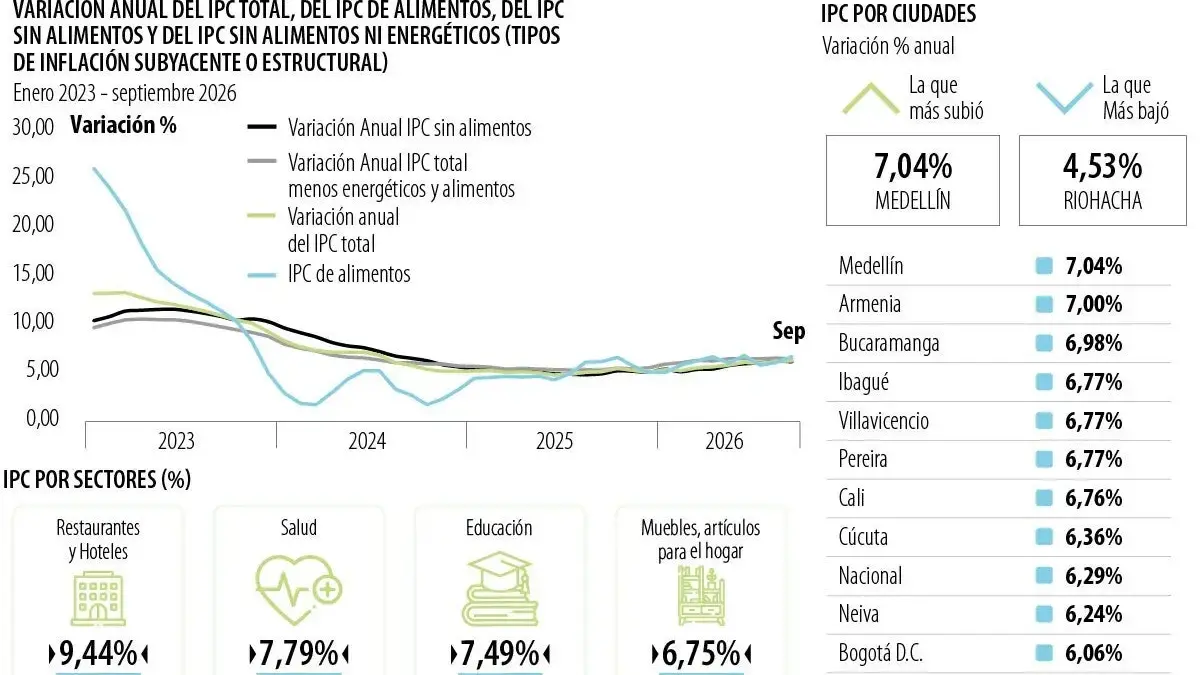
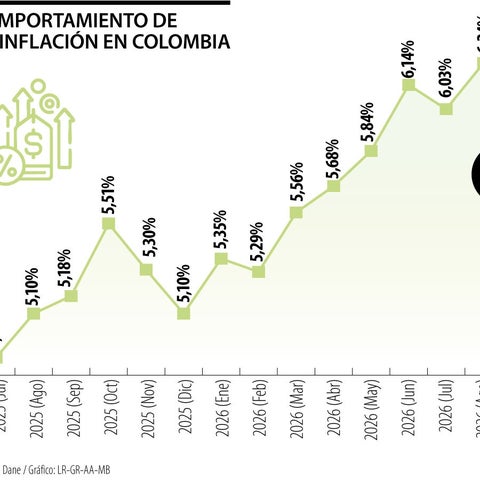
ECONOMY — In a development that caught financial analysts and market forecasters by surprise, the Consumer Price Index (CPI) for September 2026 registered an annual variation of 6.29%. While a broad consensus among economists had predicted an acceleration closer to 6.33% for the ninth month of the year, the actual print demonstrated a slight resilience against the anticipated upward trajectory.
Despite coming in below market expectations, the figures released by the National Administrative Department of Statistics (DANE) illustrate a complex macroeconomic landscape. On an annual basis, inflation accelerated by 1.11 percentage points compared to September 2025, and ticked up by five basis points relative to the previous month of August 2026. Meanwhile, the monthly variation for September stood at 0.37%, marking a five-basis-point increase compared to the monthly figure recorded in September 2025.
The latest reading highlights that while the pace of price increases is not surging as aggressively as feared by some forecasters, structural stickiness—particularly within the services and food sectors—continues to exert a heavy toll on household budgets and complicate the central bank’s path toward normalization.
Main Facts and Core Figures
The DANE report provides a granular breakdown of the forces shaping the country’s inflationary environment as the final quarter of 2026 begins. The primary drivers behind the annual inflation rate of 6.29% were anchored in three major expenditure divisions:
- Alojamiento (Housing, Water, Electricity, and Gas): Contributed 1.78 percentage points to the annual total.
- Alimentos y Bebidas No Alcohólicas (Food and Non-Alcoholic Beverages): Contributed 1.28 percentage points.
- Restaurantes y Hoteles (Restaurants and Hotels): Contributed 1.06 percentage points.
When examining the monthly variation of 0.37% for September alone, the expenditure divisions exerting the most upward pressure shifted slightly in magnitude, though the key culprits remained consistent. Food and non-alcoholic beverages led the monthly increase with a contribution of 0.15 percentage points, followed closely by housing, water, electricity, and gas at 0.09 percentage points, and education adding 0.06 percentage points.
Regionally, the cost of living exhibited notable disparities across the country. Medellín emerged as the city with the highest annual inflation rate in September, registering 7.04%. It was closely followed by Armenia at 7.00% and Bucaramanga at 6.98%. On the other end of the spectrum, cities experiencing the most moderate price variations included Riohacha at 4.53%, Pasto at 5.05%, and Montería at 5.26%.
Chronology of Economic Indicators in 2026
To understand the trajectory of September’s inflation print, it is essential to contextualize the timeline of macroeconomic performance throughout the year:
- Early 2026: The macroeconomic landscape opened with significant carryover effects from the substantial minimum wage increase implemented for the year. This upward adjustment acted as a key indexation mechanism, embedding cost pressures into service contracts, rents, and labor-intensive sectors.
- Mid-2026 (Q2): Inflationary pressures began to show signs of stubborn persistence. While goods inflation stabilized somewhat, services inflation remained stubbornly high, defying early hopes for a rapid return to the central bank’s target range.
- August 2026: The previous month’s data set the stage for September, showing baseline acceleration that led analysts to project a consensus annual inflation rate of 6.33% for the subsequent month.
- September 2026: DANE released the monthly CPI figures. Contrary to projections of an acceleration to 6.33%, the actual figure printed at 6.29%, showing a slight cooling relative to expectations, though up 5 basis points from August and 1.11 percentage points higher than September 2025.
- Outlook for Late 2026 and 2027: Financial institutions and economic research desks began revising their year-end closing estimates, centering around a projected 6.6% inflation rate for the full year of 2026, with an anticipated descent toward 5.3% through 2027.
Supporting Data and Sectoral Breakdown
A deeper dive into the specific divisions and subclasses reveals where price pressures are most acute. The annual variations across specific sectors demonstrate that inflation is no longer driven by a generalized shock, but rather by entrenched structural components and indexation.
The divisions of expenditure with the most pronounced annual variations in September were:
- Restaurantes y Hoteles (Restaurants and Hotels): 9.44% annual increase. Within this category, the sub-item for contracted meal supply services (servicio de suministro de comidas por contrato) registered the highest jump at 9.51%.
- Salud (Health): 7.79% annual increase, driven largely by outpatient services (servicios para pacientes externos), which surged by 9.36%.
- Educación (Education): 7.49% annual increase, with secondary education leading the category at an 8.74% rise.
The persistence in these specific categories underscores the role of services in keeping inflation elevated. Unlike traded goods, which are more exposed to international supply chains and exchange rate fluctuations, services are heavily dependent on domestic labor costs, rent adjustments, and formal indexation formulas that tie price changes to past inflation or the minimum wage.
Official Responses and Expert Analysis
The nuance of the September inflation print has drawn varied interpretations from leading economic analysts and financial institutions, who are weighing current data against future monetary policy decisions.
The Challenge of Indexation and Services
Laura Clavijo, Director of Economic Research at Grupo Cibest, pointed out that while the headline figure missed expectations on the downside, the underlying composition of inflation remains a concern.
"We anticipated a monthly inflation of 0.26% in services, in line with the spread this group presents relative to seasonal inflation, driven primarily by rental rates and meals prepared outside the home for immediate consumption," Clavijo noted.
She further emphasized that structural indexation continues to block a faster macroeconomic adjustment:
"The effect of indexation remains high compared to what would be desirable to achieve a more rapid normalization of inflation, driven primarily by the significant increase in the minimum wage for this year."
Year-End Projections and Medium-Term Risks
David Cubides, Chief Economist at Banco de Occidente, offered an assessment of how educational and food pressures have shaped the year, while outlining the trajectory for the months ahead.
"In education, we knew that pressures would come on account of tuition fees alongside food items, which have maintained upward pressure. We expect this year’s inflation to close at 6.6%, and we imagine 2027 retreating to seek levels close to 5.3%," Cubides explained.
Looking toward the medium term, Cubides warned that external and domestic shocks could complicate the downward path of inflation. On the horizon, the potential resurgence of weather phenomena such as El Niño poses a direct threat to food supply chains and utility service tariffs. Furthermore, looking ahead to 2027, the initial discussions surrounding the next minimum wage adjustment are expected to reintroduce labor cost pressures, particularly in sectors with high labor intensity.
Implications for Monetary Policy and Households
The September 2026 inflation print of 6.29% carries significant implications for both macroeconomic policy and everyday consumers.
For Monetary Policy
The central bank faces a delicate balancing act. While the fact that inflation came in slightly below market expectations provides a psychological relief, the stubbornness of services inflation—bolstered by indexation and wage dynamics—means that monetary policy cannot prematurely pivot toward aggressive easing. Real interest rates must remain sufficiently restrictive to anchor long-term inflation expectations, even as economic growth signals warrant a cautious approach to borrowing costs.
The persistent variance between goods and services inflation suggests that monetary transmission mechanisms are working unevenly across the economy. While tradable goods prices have largely normalized, the non-tradable service sector continues to recycle past inflation into current pricing structures.
For Households and Purchasing Power
For the average citizen, the data confirms that the cost-of-living crisis is evolving rather than disappearing. Even though the monthly variation was contained at 0.37%, the cumulative effect of a 6.29% annual inflation rate means that everyday essentials—such as housing, food, dining out, and education—continue to erode purchasing power.
Families living in urban centers like Medellín, Armenia, and Bucaramanga are feeling the pinch most acutely, as local price indices outpace the national average. Meanwhile, parents navigating educational costs and workers facing rising rents find themselves constrained by adjustments that outpace baseline wage gains.
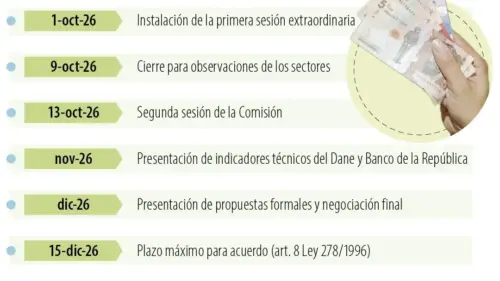
As the economy transitions into the final stretch of 2026, all eyes will remain on DANE’s upcoming monthly prints, the behavior of the labor market, and the critical negotiations surrounding the upcoming year’s minimum wage—a variable that economists agree will dictate whether inflation successfully converges toward desired targets by late 2027.



Leave a Reply