


Fitness routines that target the upper body often fail not from a lack of effort, but from a lack of clarity. When individuals understand how to properly utilize dumbbells and structure their movements, incorporating a reliable arm workout into a weekly schedule becomes significantly more manageable.
Recent insights shared by fitness trainer Yaneth Ponce have brought renewed attention to home-based upper-body training. Utilizing a pair of five-kilogram (approximately 11-pound) dumbbells, Ponce’s routine outlines five core movements divided evenly between biceps and triceps, supplemented by a seated shoulder press. However, while such routines offer an excellent framework, fitness professionals stress that both the weight load and the volume of sets must be tailored meticulously to the individual, especially for beginners.
Main Facts
The foundational mechanics of home-based arm conditioning rely on a careful selection of compound and isolated movements designed to stimulate both the anterior and posterior compartments of the upper arms, alongside shoulder stability.
- The Core Routine: The workout highlights five essential movements: the hammer curl and traditional curl for the biceps; the triceps kickback and overhead dumbbell extension (cup) for the triceps; and a seated shoulder press for overall upper-body engagement.
- The Load Variable: While trainer Yaneth Ponce utilizes five-kilogram weights in her demonstrations, experts emphasize that this specific load is merely an example of equipment used, not a universal prescription.
- Frequency and Recovery: Professional guidelines universally recommend performing upper-body strengthening sessions two to three times weekly, ensuring at least one day of muscular recovery between sessions while engaging other muscle groups on alternate days.
- The Fat-Loss Distinction: Scientific consensus confirms that targeted resistance training builds muscle tissue and strength, but it does not dictate localized fat reduction in the exercised limbs.
Chronology of Effective Arm Training
The evolution of home fitness has shifted from chaotic, high-repetition endurance sets to structured, progressive resistance training. Understanding how these routines are built requires looking at the sequence of movements and the progressive adaptation of the body over time.
Phase 1: The Biceps Sequence
The routine initiates with the hammer curl, a movement designed to target both the biceps brachii and the brachialis. Practitioners hold the dumbbells with palms facing inward (neutral grip) and elevate the weight by flexing the elbows. A popular variation involves performing one repetition with the right arm, one with the left, and concluding with a simultaneous double-arm curl, counting ten repetitions of the combined sequence.
Following the hammer curl, the routine transitions into the traditional curl. Here, the palms face upward (supinated grip). The practitioner must keep the elbows locked tightly against the torso, avoiding any swinging or momentum from the hips or back. Standard programming for this movement often features four sets of 15 repetitions.
Phase 2: The Triceps Sequence
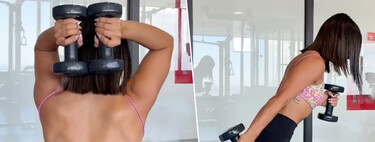
Addressing the posterior upper arm, the routine introduces the triceps kickback. With the torso hinged forward, the elbow is extended backward until the arm is straight, keeping the upper arm strictly parallel to the floor. The routine typically calls for ten controlled repetitions.

Next comes the overhead dumbbell extension (often referred to as the cup press). The practitioner holds a single dumbbell vertically behind the head and presses it upward until the arms are fully extended. Crucially, the elbows must be kept pointing forward and close to the head. This exercise is frequently programmed for four sets of 15 repetitions.
Phase 3: Shoulder Stabilization and Progression
The fifth movement—the seated shoulder press—completes the upper-body focus. Performed while sitting upright in a chair to protect the lower back, the dumbbells are pressed overhead from shoulder height.
As practitioners adapt to these movements over weeks and months, progression does not merely mean adding more weight. It involves monitoring execution speed, optimizing the range of motion, and eventually increasing resistance only when the current workload can be completed with pristine form.
Supporting Data and Expert Guidelines
To transform a social media fitness routine into a safe, long-term training habit, guidelines from reputable health institutions provide essential boundaries.
Mayo Clinic Recommendations on Technique and Load
According to physical health guidelines published by Mayo Clinic, selecting the correct resistance is critical. An appropriate weight should feel comfortable for the first several repetitions but cause significant muscle fatigue by the final repetitions (typically targeting a range of 12 to 15 repetitions).
- Form over Weight: If the practitioner begins to sacrifice good form—such as using body momentum or arching the back—the weight is too heavy or the set has gone on too long. In such cases, reducing the load or cutting the repetitions short is advised.
- Warm-Up Protocols: A proper preparation phase lasting between five and ten minutes of light dynamic movement should always precede lifting.
- Volume Flexibility: Beginners do not need to start with four sets per exercise. Current evidence suggests that a single, well-executed set of 12 to 15 repetitions to near-fatigue can yield substantial muscular adaptations for individuals starting out.
Quantifying Effort: Repetitions in Reserve (RIR)
To measure workout intensity more accurately than simply looking at the number on the dumbbell, modern training philosophies utilize the concept of Repetitions in Reserve (RIR). Popularized by conditioning analyses, RIR asks the simple question: "How many more clean repetitions could I have completed once this set ended?"
Using RIR allows practitioners to gauge true effort. If a set of 15 bicep curls finishes and the lifter feels they could have effortlessly completed ten more, the stimulus was likely too low, regardless of whether the weight was five kilograms or ten. Conversely, an RIR of 1 to 2 indicates an optimal challenge level for hypertrophy and strength development.
Official Responses and Scientific Consensus
Fitness trends often make sweeping promises about transforming specific body parts in record time. Science, however, provides a more sober evaluation of what isolated resistance training can and cannot achieve.
The Myth of Spot Reduction
A persistent myth in physical conditioning is that working out a specific muscle group will burn the fat sitting directly above it—the phenomenon colloquially known as "spot reduction."
To test this hypothesis, a comprehensive meta-analysis published in the journal Human Movement (2022) pooled data from 13 independent studies involving a total of 1,158 participants. The researchers systematically compared changes in fat mass in trained limbs versus untrained limbs. The findings were definitive: targeted resistance training did not produce localized fat reduction in the exercised extremities.
While exercises like bicep curls and triceps extensions successfully hypertrophy (enlarge and strengthen) the underlying muscle tissue, the loss of subcutaneous fat is a systemic process governed by overall energy balance, nutrition, and genetics. Therefore, treating an arm routine as a shortcut to eliminating upper arm fat is scientifically unfounded.
Implications for Practitioners
Understanding the nuances of home workouts, load selection, and physiological realities leads to several key takeaways for anyone looking to tone and strengthen their arms:
- Ditch Universal Load Standards: Just because a fitness professional or online influencer uses five-kilogram dumbbells does not mean those weights are appropriate for a beginner. The correct weight is entirely subjective and must be dictated by individual muscular capacity and form preservation.
- Prioritize Consistency and Recovery: Overtraining the arms daily will yield diminishing returns. Allowing 48 hours of recovery between upper-body sessions ensures that muscle fibers can repair and rebuild effectively.
- Align Expectations with Reality: Integrating resistance training improves metabolic health, boosts functional strength, and shapes the upper body. However, achieving a leaner aesthetic requires a holistic approach that includes overall body fat reduction through nutrition, patience, and lifestyle management.
By approaching arm routines with proper biomechanics, realistic loading, and an understanding of physiological limits, home fitness enthusiasts can build sustainable, injury-free habits that deliver long-term strength and vitality.




Leave a Reply