


Main Facts: The Anatomy of a Home Arm Routine
Incorporating an arm-strengthening routine into a weekly schedule becomes significantly more manageable when individuals understand how to properly utilize free weights. Recent fitness trends highlight methodologies popularized by professional trainers such as Yaneth Ponce, who routinely demonstrates home-based upper-body circuits using accessible equipment—specifically, a pair of five-kilogram dumbbells.
While social media fitness routines offer excellent templates, health and wellness authorities emphasize that exercise selection, load management, and volume must be tailored to an individual’s current fitness level. A standard routine designed for home practice typically targets the primary muscle groups of the arms through specific compound and isolation movements: two exercises dedicated to the biceps, two targeting the triceps, and a foundational overhead movement for the shoulders.
However, fitness experts warn against the common pitfall of mistaking a trainer’s specific weight load or high-volume sets for a universal prescription. Effective strength training relies on personalized load selection, proper biomechanical execution, adequate recovery periods, and a balanced diet rather than the pursuit of unrealistic, rapid cosmetic transformations.
Chronology: Evolution of Modern Strength Training Guidelines for Beginners
The approach to home-based resistance training has undergone a significant transformation over the past decade, shifting away from rigid, one-size-fits-all bodybuilding splits toward more flexible, evidence-based methodologies designed for general longevity and functional strength.
- The Rise of Digital Fitness Mentorship (2020–2023): As home workouts surged in popularity, fitness professionals increasingly utilized platforms like Instagram and specialized wellness blogs to share micro-routines. Trainers like Yaneth Ponce demonstrated that traditional gym exercises—such as curls, kickbacks, and presses—could be effectively replicated in living rooms using moderate weights.
- The Shift Toward Evidence-Based Simplicity (2024–2025): Publications and health portals, including Vitónica, began emphasizing targeted training parameters for specific demographics, such as strength routines tailored for women over 50. Concepts like "repetitions in reserve" (RIR) replaced subjective exhaustion metrics, allowing practitioners to gauge workout intensity more scientifically.
- Current Standards in Load and Volume Management (2026): Updated guidelines from clinical authorities such as Mayo Clinic continue to refine how beginners approach resistance training. Modern consensus emphasizes that high volume (such as four sets per exercise) is not a mandatory starting point. Instead, a single, highly focused set executed with proper form can yield substantial hypertrophic and strength benefits for novices, shifting the focus from grueling endurance tests to sustainable, injury-free progress.
Supporting Data: Breaking Down the Five Core Movements
To better understand how a structured home arm routine operates, fitness analysts frequently break down standard routines into their constituent movements. Utilizing a moderate weight load—such as five-kilogram dumbbells, as demonstrated in popular trainer circuits—requires precise execution to maximize muscle fiber recruitment while protecting the joints.
1. The Hammer Curl
The routine typically opens with the hammer curl, which places emphasis on the brachialis and brachioradialis, adding overall thickness to the arm.

- Execution: Dumbbells are held with a neutral grip (palms facing each other) and elevated by flexing the elbows.
- Structure: Advanced variations may involve alternating single-arm raises followed by a simultaneous double-arm raise, culminating in a designated rep count (e.g., ten repetitions of the combined movement).
2. The Traditional Bicep Curl
Following the hammer curl, the traditional curl targets the biceps brachii directly.
- Execution: Palms face upward throughout the upward phase of the lift. Practitioners must keep their elbows locked tightly against the torso to prevent the body from swaying or using momentum.
- Structure: Standard programming often prescribes higher repetitions, such as four sets of 15 reps, focusing on a controlled eccentric (lowering) phase.
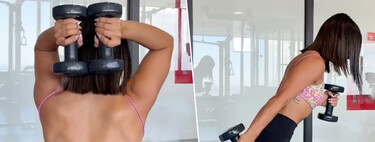
3. The Tricep Kickback
Shifting focus to the posterior compartment of the arm, the tricep kickback isolates the triceps brachii.
- Execution: With the torso hinged forward at the hips and the upper arm held parallel to the floor, the practitioner extends the elbow backward, ensuring the shoulder remains completely stable.
- Structure: Typically performed for moderate to high repetitions (e.g., ten to 12 controlled reps per arm).
4. The Overhead Tricep Extension (Dumbbell "Cup")
To complement the kickback, the overhead extension engages a different angle of the tricep, particularly the long head.
- Execution: Holding a single dumbbell vertically with both hands behind the head, the weight is lowered via controlled elbow flexion and then pressed back upward toward the ceiling.
- Structure: Recommendations often suggest four sets of 15 repetitions, accompanied by a strict cue to keep the elbows pointed forward and close to the head rather than flaring outward.
5. The Seated Shoulder Press
While primarily a shoulder (deltoid) exercise, the overhead press heavily integrates the triceps as secondary movers.
- Execution: Performed while seated on a chair with a straight, supported back, the weights are pressed upward from shoulder height until the arms are fully extended overhead.
- Frequency: Fitness professionals generally advise integrating this movement into a balanced routine performed two to three days per week, ensuring at least 48 hours of recovery between upper-body sessions.
Official Responses and Expert Recommendations: Mayo Clinic and Clinical Guidelines
Translating professional routines into safe, effective personal workouts requires adhering to established physiological principles. Major medical and wellness institutions provide clear guardrails for individuals embarking on a strength training journey.
Selecting the Right Weight Load
A fundamental error made by beginners is attempting to replicate the exact poundage used by experienced fitness influencers. Organizations like the Mayo Clinic stress that weight selection must be entirely subjective.
- The 12-to-15 Repetition Rule: Practitioners should select a weight that can be lifted comfortably for 12 to 15 repetitions while inducing a moderate level of muscular fatigue by the final repetition.
- Form Over Load: If the lifter’s form begins to break down—such as arching the back, swinging the torso, or using momentum—the weight is too heavy and must be reduced immediately.
Volume and Frequency Adjustments
Traditional bodybuilding routines often prescribe three to four sets per exercise, but clinical guidelines clarify that this is not mandatory for beginners.
- The Single-Set Efficacy: Research and clinical reviews indicate that a single, high-effort set of 12 to 15 repetitions can successfully stimulate muscle adaptation and strength gains in untrained individuals.
- Gradual Progression: As physical conditioning improves and the target rep range becomes easy to complete, resistance can be progressively increased in small increments. Furthermore, a proper warm-up consisting of five to ten minutes of light aerobic movement and dynamic stretching is essential to prepare the connective tissues for load bearing.
Implications: Muscle Building Versus Fat Reduction
One of the most pervasive misconceptions in fitness culture is the belief that targeted resistance training can melt away localized body fat in specific areas—a myth often colloquially referred to as spot reduction.
The Myth of Spot Reduction
Many individuals begin arm-sculpting routines hoping to eliminate stubborn upper-arm adipose tissue (often referred to colloquially as "bat wings"). However, extensive scientific literature refutes the possibility of localized fat loss through targeted exercise alone.
- The 2022 Human Movement Meta-Analysis: A comprehensive meta-analysis published in the journal Human Movement examined 13 independent studies involving a total of 1,158 participants. The researchers directly compared fat reduction in trained limbs versus untrained limbs.
- The Findings: The data conclusively demonstrated that localized resistance training does not produce a statistically significant reduction in fat tissue in the exercised region. While arm exercises successfully hypertrophy, strengthen, and tone the underlying musculature, they do not dictate where the body metabolizes stored fat.
The Realistic Path to Aesthetic and Functional Goals
Understanding the physiological distinction between muscle hypertrophy and fat loss has profound implications for how individuals design their fitness expectations:
- Dual Approach: Achieving a lean, toned physical appearance requires combining resistance training (to build and shape the underlying muscle matrix) with systemic fat loss strategies, which are primarily driven by caloric balance, cardiovascular health, and nutritional adherence.
- Tracking Progress via Effort, Not Aesthetics: Utilizing tools like "repetitions in reserve" (RIR)—evaluating how many clean repetitions a practitioner could theoretically perform before absolute failure—provides a reliable metric for workout intensity.
- Long-Term Sustainability: By decoupling physical workouts from the false promise of spot reduction, individuals can approach home arm routines with patience, prioritizing joint health, functional upper-body strength, metabolic health, and sustainable lifestyle habits over quick fixes.




Leave a Reply