

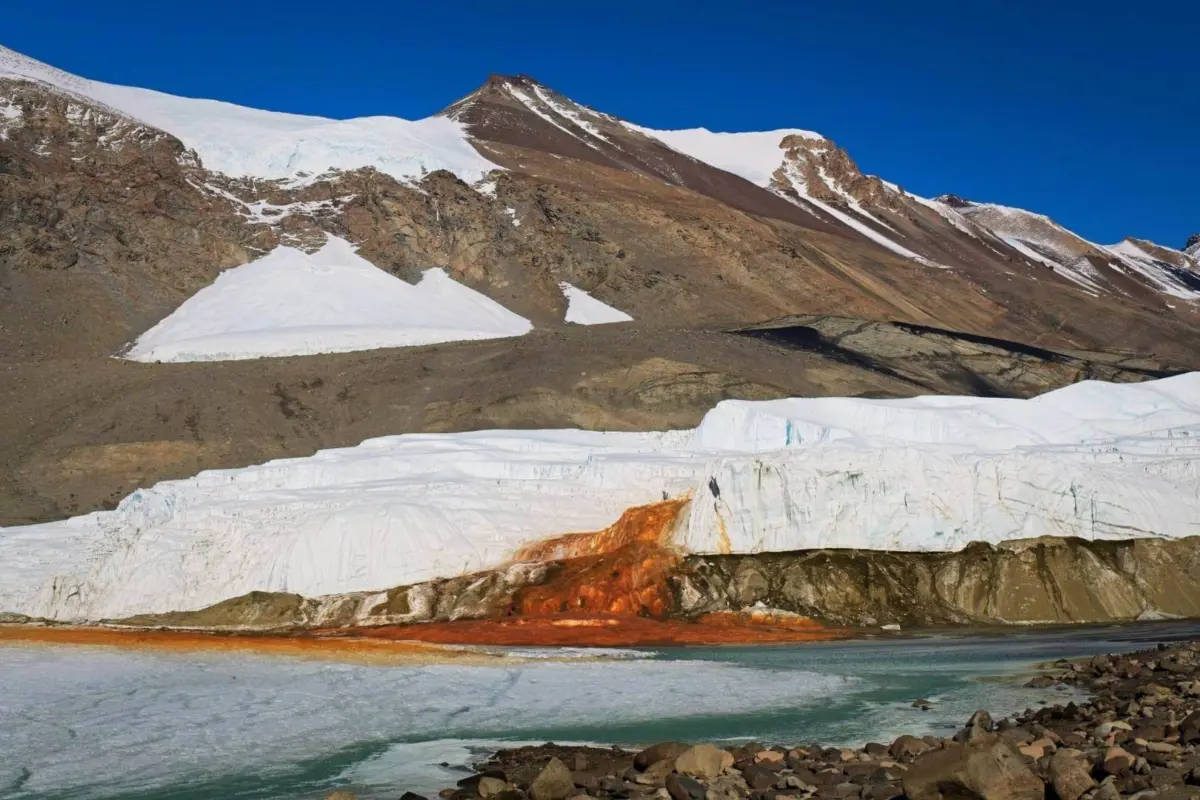
ANTARCTICA — For over a century, Blood Falls has stood as one of the most mesmerizing and chilling enigmas of the polar south. From a distance, this striking geological feature resembles a massive, open wound slashed across the stark white expanse of the Taylor Glacier. A vivid, blood-red fluid seeps out from beneath the ice, staining the glacial tongue before draining toward the frozen basin of Lake Bonney.
For decades, this eerie phenomenon has fueled intense scientific speculation and imaginative theories. Now, a groundbreaking study published in Nature Geoscience adds a revolutionary chapter to the narrative, concluding that this frozen enclave preserves a living memory of an ancient, pre-glacial Antarctica.
An international team of researchers has uncovered robust molecular evidence that the subglacial brine network hidden beneath the glacier harbors a thriving microbial community of undeniable marine origin. These are not merely ancient DNA fragments trapped in ice, nor are they modern spores swept in by coastal winds. Scientists have detected organisms that continue to exhibit active biological function, transforming this remote wasteland into a bona fide biological time capsule.
The implications of this discovery stretch far beyond explaining the vivid crimson waterfall. It provides critical clues about historical sea levels, the evolutionary history of Antarctic ice sheets, and the extraordinary resilience of ecosystems persisting through deep planetary transitions.
Main Facts: The Enigma of the Crimson Glacier
Discovered in 1911 by geologist Thomas Griffith Taylor during the ill-fated Terra Nova Expedition, Blood Falls initially confounded researchers. Early polar explorers hypothesized that the shocking red color was caused by red algae staining the snow and ice—a plausible assumption given that various cryophilic algae can bloom in polar regions.

Over time, that hypothesis was decisively dismantled. Modern science proved that the coloration stems from high concentrations of dissolved iron within a hypersaline brine. Trapped beneath hundreds of meters of ice, this water remains liquid exclusively due to its immense salt content and pressure. When the brine finally breaches the surface and interacts with atmospheric oxygen, the dissolved iron oxidizes instantaneously, generating the signature rust-red hue.
While the chemical source of the color was understood, a more profound mystery lingered: Where did this ancient brine originate?
Geochemical models long suggested a marine pedigree. The leading hypothesis posited that millions of years ago, during a significantly warmer climatic epoch, the ocean flooded the Taylor Valley. Subsequent advances of the Taylor Glacier sealed off this marine basin, trapping a vast pocket of saltwater beneath a colossal blanket of ice.
The new Nature Geoscience study moves past geochemical inference, diving directly into the genetics of the system to confirm that the ocean’s past inhabitants are still present—and still alive.
Chronology of Discovery: From Polar Exploration to Metatranscriptomics
To test the marine-origin hypothesis at a biological level, the research team embarked on a massive sampling campaign across the McMurdo Dry Valleys.

- 1911: Geologist Thomas Griffith Taylor discovers the crimson falls during a British Antarctic Expedition.
- Mid-to-Late 20th Century: Researchers identify the brine as an iron-rich, hypersaline liquid driven by subglacial hydrology rather than surface melting.
- Early 2000s: Initial genetic sequencing hints at microbial life thriving within the anaerobic, pitch-black subglacial brine, sparking debates over their origin.
- The Recent Study (Published August 2026): An international team analyzes 167 distinct samples from ice, red-stained mud, wind-blown debris, and marine control sites in the McMurdo Sound using advanced genetic sequencing and metatranscriptomics.
By analyzing 167 samples collected from diverse niches across the Dry Valleys, the scientists mapped microbial communities in unprecedented detail. They compared genetic material from Blood Falls’ red sediments directly against modern marine samples from the McMurdo Sound.
The results were astonishing. Zones directly associated with Blood Falls—particularly the crimson mud and sediment matrices—harbored an extraordinarily high concentration of taxa typically found in marine environments. Conversely, adjacent regions of the Dry Valleys were dominated by terrestrial and freshwater species.
Among the identified organisms were diatoms, dinoflagellates, haptophytes, and ciliates—groups of eukaryotic microorganisms that form the bedrock of modern marine ecosystems and serve as stellar environmental indicators. Approximately 9.3% of the eukaryotic microorganisms in Blood Falls shared direct genetic affinities with marine reference communities, contrasted with a mere 1.15% affinity across other Dry Valley terrestrial sites.
Supporting Data: Not Just Fossils, But Active Life
One of the most astonishing breakthroughs of the 2026 study lies in its methodology. The researchers did not stop at DNA extraction; they employed metatranscriptomic analysis to study RNA. While DNA reveals what genetic blueprints are present, RNA exposes which genes are actively being transcribed into proteins at any given moment.
The metatranscriptomic data revealed that many of these marine-origin microorganisms are actively carrying out essential biological functions. The team detected active gene expression related to:

- Photosynthetic machinery remnants and energy regulation,
- Specialized mechanisms for tolerating extreme salinity,
- DNA repair pathways to combat environmental stress,
- Active metabolic responses to low-oxygen, high-pressure subglacial conditions.
This confirms that the microbes are not merely "molecular fossils" frozen in time. They are living, functioning entities adapting in real-time to an intensely hostile subterranean ecosystem.
Furthermore, genetic divergence between Blood Falls’ microbes and their modern marine counterparts points toward prolonged, independent evolution. These populations have spent millennia diverging in isolation beneath the ice sheet, developing unique genetic variants suited exclusively to subglacial brines. Because wind-blown microbes would be distributed uniformly across the Dry Valleys—a pattern absent from the data—the researchers ruled out recent atmospheric contamination.
"These results point to the persistence of an ancient ecosystem, not simply the occasional, transient transport of microorganisms," the study’s authors emphasize.
Official Responses and Expert Perspectives
The academic community has received the findings with immense enthusiasm, viewing Blood Falls as a premier natural laboratory for astrobiology and paleoclimatology.
Dr. Christian Pérez, a science communication specialist closely following polar research, notes that the discovery fundamentally shifts how scientists view subglacial refugia. "For a long time, we treated the base of thick ice sheets as sterile, crushing environments where life could only occasionally survive in stasis. Blood Falls proves that complex microbial networks can not only endure isolation for evolutionary timescales, but they can actively maintain metabolic processes in the dark, cold depths of the Earth."

Astrobiologists are particularly electrified. The conditions beneath the Taylor Glacier—extreme cold, high salinity, absolute darkness, and heavy metal concentrations—serve as a terrestrial analogue for icy moons in our outer solar system, such as Jupiter’s Europa or Saturn’s Enceladus. If complex eukaryotic life can persist in active subglacial brines on Earth for millions of years, similar extraterrestrial habitats may harbor active microbial ecosystems.
Implications: A Window into Antarctica’s Green and Blue Past
The implications of the Blood Falls study resonate across multiple scientific disciplines:
1. Paleoclimatic Reconstruction
Biological communities act as biological archives. The verified presence of marine eukaryotic lineages trapped beneath the Taylor Glacier provides definitive biological backing for geological models showing that the Taylor Valley was once an open marine embayment. This helps scientists map past sea-level fluctuations and ice-sheet collapses during past warm periods in Earth’s history.
2. Glacial Dynamics and Stability
Understanding how water moves beneath ancient ice sheets—and how biological systems interact with subglacial hydrology—improves modern computer models tracking contemporary ice-sheet melting and sea-level rise. Subglacial water acts as a lubricant for glacier movement; understanding the chemistry and biology of these hidden networks is crucial for predicting how modern glaciers will react to global climate change.
3. Astrobiological Exploration
As space agencies look toward icy ocean worlds in the outer solar system, terrestrial analogues like Blood Falls offer testing grounds for life-detection technologies. If robotic probes are ever to drill through the ice crust of Europa, the methodologies used to sample and sequence active subglacial ecosystems in Antarctica will serve as the mission blueprints.

Conclusion
Blood Falls remains a haunting sight: a stark, bleeding scar upon an endless expanse of white ice. Yet, beneath its terrifying exterior lies one of the most triumphant testaments to life’s tenacity on Earth.
As researchers continue to analyze the genetic secrets locked within the Taylor Glacier’s subterranean brines, every drop of red water retrieved from the ice brings humanity closer to understanding a forgotten Antarctica—a world where the ocean once lapped against shores now buried beneath miles of ice, and where life refused to surrender to the cold.


Leave a Reply