

By Christian Pérez
Specialized Science and History Contributor
Main Facts
October 2, 1959, began like any other morning across the Canary Islands, yet it quickly devolved into a spectacle that blurred the lines between rigorous international science and folkloric panic. Across Tenerife, Gran Canaria, and Fuerteventura, newspapers had spent days publishing precise timetables forecasting the exact moment the Sun would surrender to the Moon. Foreign scientists, military dignitaries, and specialized research teams flooded the archipelago, hauling massive telescopes, spectrographs, and polarimeters. At Los Rodeos Airport, U.S. Air Force logistical and strategic aircraft—including the Lockheed C-130A Hercules and the colossal Douglas C-124 Globemaster—stood ready to support an unprecedented high-altitude research mission.
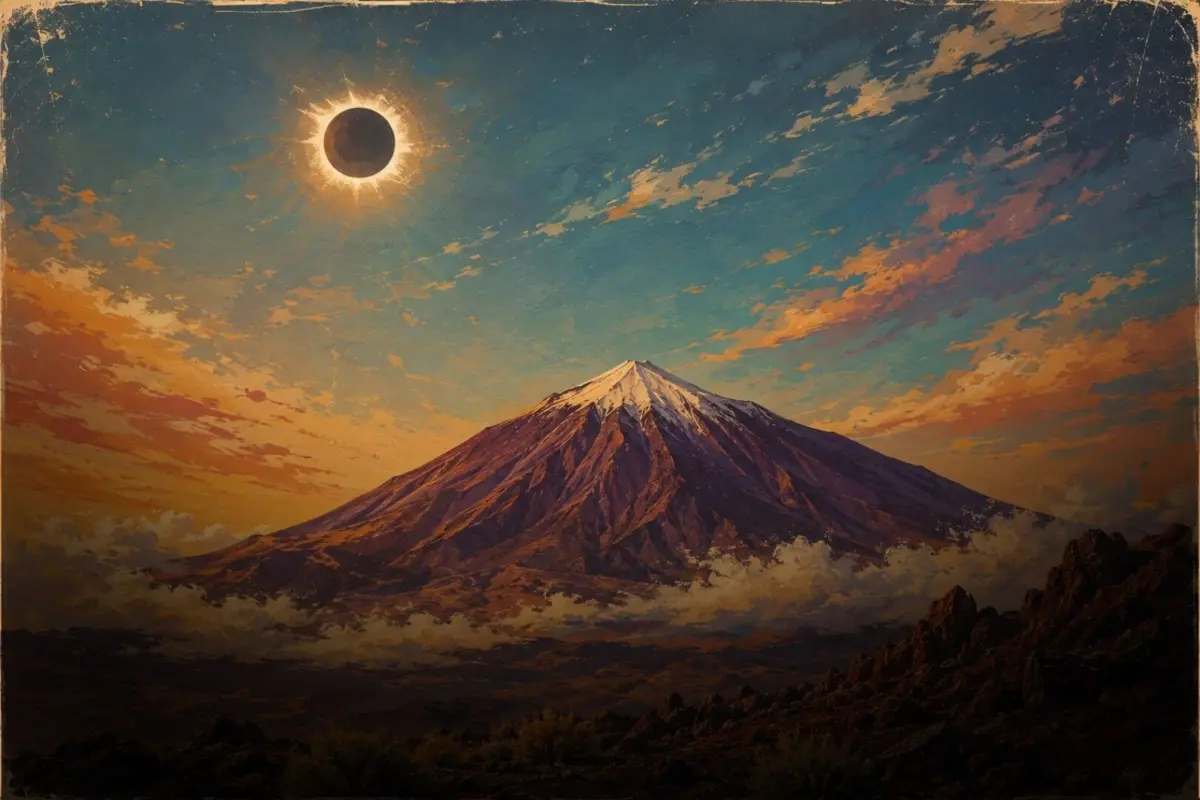
At precisely 10:17 a.m. in Santa Cruz de Tenerife, the visual spectacle began. By 11:41 a.m., the Moon entirely blocked the solar disk within the band of totality, plunging a portion of the archipelago into a sudden, eerie twilight that lasted for roughly two minutes and twenty seconds.
While researchers gathered atmospheric data and mapped the sun’s corona, everyday citizens experienced nature turning completely upside down. Animals panicked, barometric pressure fluctuated wildly, winds whipped across mountain summits, and pockets of the population seriously wondered if they were witnessing the end of the world. Decades later, historical retrospectives—most notably from the Instituto de Astrofísica de Canarias (IAC)—have revealed that this brief cosmic alignment was far more than an atmospheric curiosity; it served as a vital catalyst in transforming the Canary Islands into one of the premier astrophysical hubs on planet Earth.
Chronology of an Eclipse: From Dawn to Totality
To fully understand the weight of the October 1959 event, historians must turn to the yellowed pages of regional archives, such as the Canarian newspaper El Día. The chronicle of that historic morning unfolds through a strict, nearly minute-by-minute timeline of tension and awe:

- Early Morning Hours: Local communities buzzed with a mixture of scientific anticipation and rustic superstition. While university-backed research committees set up stations across the islands, rumors of impending doom circulated through rural towns. In some households, pragmatic citizens decided to eat large meals immediately—reasoning that if the world was genuinely ending, they preferred to face the apocalypse with full stomachs.
- 10:17 a.m. (First Contact): In Santa Cruz de Tenerife, the partial phase of the eclipse officially commenced. The Moon took its first visible "bite" out of the solar disc, prompting crowds to gather in plazas, on rooftops, and along coastal promenades using makeshift viewing filters, smoked glass, and pinhole projections.
- 11:41 a.m. (Totality): Within a roughly 100-kilometer-wide band crossing the northeast of Tenerife, Gran Canaria, and the southwest of Fuerteventura, day instantaneously turned into night. Streetlights flickered on automatically or manually as daytime temperatures plummeted. The solar corona blazed like a silvery halo around the jet-black silhouette of the Moon.
- Post-Totality & Recovery: Barely two and a half minutes later, the diamond ring effect signaled the return of direct sunlight. The sudden shift caught domestic and wild fauna entirely off guard, sparking bizarre behavioral cycles that local reporters documented with meticulous fascination.
Supporting Data and Scientific Operations
The scientific deployment in the Canaries during the fall of 1959 mirrored the high-stakes technological competition of the early Cold War era. Space-based observatories did not exist, meaning that ground-based and high-altitude observations during total solar eclipses represented humanity’s only window into the innermost regions of the solar corona.
International and Military Scale
The strategic geographical positioning, high altitude, and exceptionally clear skies of the Canary Islands attracted researchers from numerous European and American institutions. A British experimental commission of ten scientists set up base camps in Tenerife, while multi-national teams established outposts on the island of Fuerteventura (Jandía).
Simultaneously, the United States military launched unprecedented aerial operations. Operating out of Los Rodeos Airport, massive transport planes facilitated heavy equipment logistics. Most astonishingly for Spanish citizens living under the economic constraints of the Franco-era postwar period, a U.S. Air Force F-101B Voodoo supersonic interceptor was tasked with climbing to an altitude of roughly 20,000 meters. From this dizzying height, far above the thickest layers of the Earth’s atmosphere, the jet captured pristine, uninterrupted data regarding the solar corona and upper atmospheric reactions.
Atmospheric Disturbances at Izaña
While amateur observers stared upward at the visual poetry of the corona, meteorological instrumentation at the Izaña Observatory recorded quantifiable shifts in the local physics of the air. Headlines in regional newspapers highlighted unexpected "atmospheric perturbations."
At Izaña, instruments noted a sharp drop in barometric pressure paired with a sudden spike in wind velocity. When solar radiation is abruptly cut off by a total eclipse, the ground and lower atmospheric layers suddenly stop absorbing heat. This rapid cooling creates localized thermal and pressure gradients, manifesting as sharp wind gusts and micro-meteorological shifts.

These instrument readings were mirrored by human experiences. Pilots navigating open-cockpit aircraft during the eclipse—such as aviator Francisco Abreu Plaza—reported battling severe, unexpected wind shears while airborne. Furthermore, residents along the coast in Puerto de la Cruz reported witnessing "flying shadows"—undulating, faint bands of light and dark flickering across white walls immediately before and after totality, caused by atmospheric turbulence refracting the remaining sliver of direct solar rays.
Official Responses and Ecological Anomalies
Beyond hard physics, the psychological and ecological impact of the 1959 eclipse provided some of the day’s most enduring anecdotes.
The Animal Kingdom Reacts
With no evolutionary mechanism to comprehend a midday solar eclipse, local wildlife relied purely on biological circadian rhythms. As the sky darkened prematurely, livestock and domestic animals displayed immediate confusion.
According to reports archived by El Día and later expanded upon by the Museum of Science and Cosmos in Tenerife, rural chickens abandoned their daytime foraging and frantically rushed back to their coops. Some birds stared skyward in postures typically reserved for defending against predatory hawks, while others settled down to roost as if night had genuinely fallen.
More surreal was the aftermath: when the diamond ring effect flooded the islands back with light barely 150 seconds later, roosters across rural rooftops became utterly disoriented, breaking into loud, triumphant crows to announce what they believed was a second, premature dawn.

Public Reception: Science Meets Superstition
The stark contrast between modern scientific understanding and mid-century rural superstition defined how the general populace processed the event. While urban centers treated the eclipse as a modern technological festival, rural communities wrestled with lingering anxieties. The phrase “el fin del mundo” (the end of the world) was muttered across several towns.
These reactions highlighted the profound cultural gap of the era. The very same daily newspapers dedicating front-page spreads to international astrophysics, polarimeters operated by visiting American researchers, and high-altitude military jets also carried sober notices regarding local economic hardship, postwar poverty, and rural emigration.
Implications for the Future of Spanish Astronomy
The true legacy of the October 2, 1959, eclipse extended far beyond the two minutes of darkness it brought to the archipelago. It acted as an unintentional dress rehearsal for the international validation of Canarian skies.
The Spark of the IAC
Decades prior, in 1910, French astronomer Jean Mascart had suggested the peaks of Guajara were ideal for astronomical tracking. Later, visionaries like José María Torroja and Father Antonio Romañá championed the systematic study of Izaña’s meteorological and optical excellence.
To execute these foundational site-testing surveys, the scientific establishment enlisted a young, freshly graduated physicist named Francisco Sánchez. Tasked with monitoring and quantifying the atmospheric stability and transparency of Tenerife’s highest elevations, Sánchez’s empirical data proved what visionaries had long suspected: the Canary Islands possessed some of the most pristine, stable astronomical viewing conditions on the face of the Earth.

Sánchez would go on to found and direct the Instituto de Astrofísica de Canarias (IAC). While the 1959 eclipse did not single-handedly create the institution, it served as a powerful historical catalyst. It forced Spanish authorities and international partners alike to recognize that the islands were a strategic frontier for space science.
Looking Forward
As modern Spain prepares for the upcoming total solar eclipse on August 12, 2026—arriving 67 years after that fateful morning in the Canaries—the events of 1959 stand as a fascinating time capsule. They capture a society navigating a major scientific marvel without the aid of smartphones, internet feeds, or satellite telemetry.
The people of the Canary Islands watched the Sun vanish into shadow in 1959, but in doing so, the international scientific community caught its first brilliant, unclouded glimpse of the future of astrophysics in Spain.




Leave a Reply