

By César Noragueda
Specialized Journalist in Cinema, Science, and Critical Thought
Published: August 6, 2026
Main Facts: The Breakthrough in Remote Atmospheric Detection
A row of trees lining an urban avenue typically reads as standard municipal landscaping rather than a sophisticated analytical laboratory. Yet, moving silently between their trunks is a complex cocktail of gases, microscopic droplets, and invisible aerosols. Traditionally, tracking the composition of this atmospheric soup required deploying dense grids of expensive electronic sensors or meticulously calibrated optical instruments at every street corner.
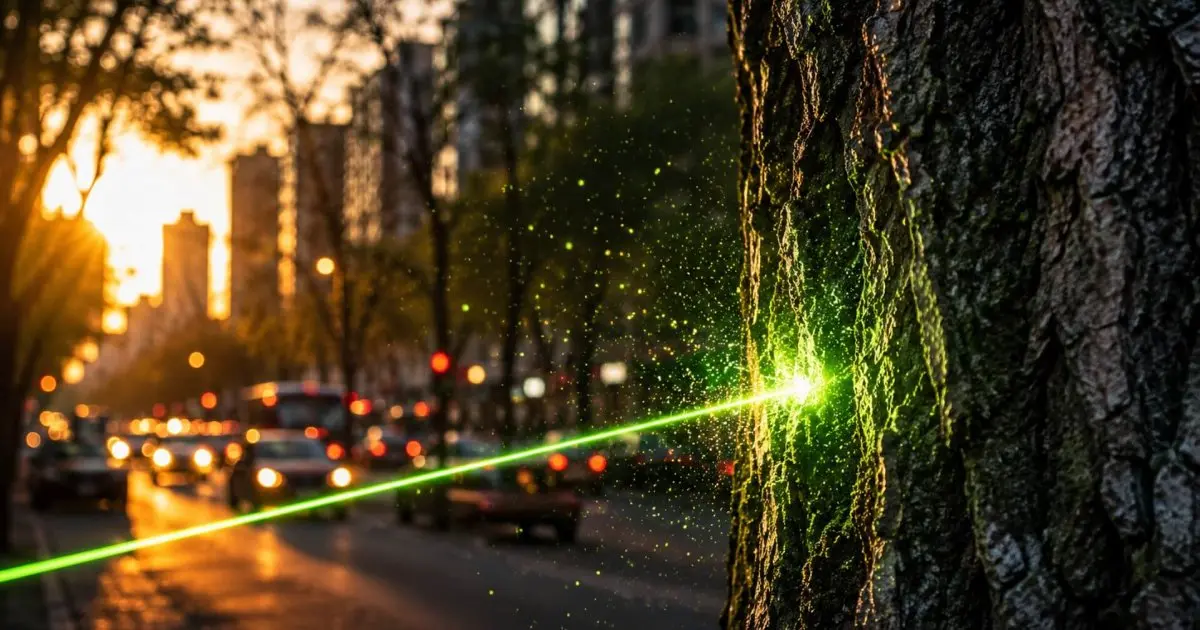
However, a groundbreaking study recently published in the scientific journal Applied Optics proposes a paradigm shift. Researchers at the Pacific Northwest National Laboratory (PNNL) have successfully demonstrated an infrared spectroscopy technique that dispenses with dedicated artificial reflectors. Instead, the system utilizes ordinary, everyday surfaces—ranging from the rough bark of trees to metal street signs, painted cartons, and building façades—as natural retroreflectors.
By analyzing how an infrared laser beam is modified as it traverses the air and bounces back off these mundane objects, scientists can identify airborne chemical compounds and hazardous aerosols from a distance. Rather than forcing technicians to install specialized, high-maintenance optical mirrors at precise coordinates, this new methodology turns the pre-existing physical environment into an active component of the scientific apparatus.
Chronology: Overcoming the Obstacles of Remote Sensing
To understand the significance of this development, it is helpful to trace the technical evolution of optical remote sensing over recent decades:

- The Era of Active Optical Detection: For years, atmospheric physicists and environmental agencies relied on active standoff detection systems. These devices projected laser beams across open spaces to analyze pollution plumes, industrial leaks, or chemical releases.
- The Bottleneck of Artificial Reflectors: A major constraint quickly emerged. To obtain a return signal strong enough for accurate spectral analysis, these systems required the placement of specialized optical retroreflectors at the far end of the measurement path. This requirement introduced severe logistical bottlenecks. Installing, aligning, and maintaining these targets meant that true "remote" monitoring was frequently hindered by the need for hands-on preparation. Furthermore, environmental elements—such as dust, grime, heavy rain, physical scratches, and structural shifts—degraded the optical return, requiring frequent human intervention.
- The Conceptual Shift at PNNL: Seeking an alternative, researchers at the Pacific Northwest National Laboratory questioned the necessity of specialized optical targets. They asked a fundamental question: What if the laser beam could rely on naturally occurring background surfaces—such as architectural walls, traffic infrastructure, and tree bark—to return the light?
- Material Testing Phase: The research team conducted comprehensive reflectivity tests on nearly fifty common urban and industrial materials. They mapped the optical return efficiency of surfaces including tree bark, painted cardboard, automotive body panels, drywall, exterior building coatings, and road signs. While specialized optics still provided the strongest signal, many everyday materials returned sufficient infrared radiation to make spectral analysis viable.
- Controlled Laboratory Validation: To prove the concept, the team built a specialized tubular aerosol chamber. Inside this controlled environment, they generated suspended particles of known sizes and chemical compositions—such as diethyl sebacate (a safe simulant for hazardous compounds) and calcium carbonate. Using an integrated system comprising an infrared laser, a receiving telescope, and custom noise-filtering software, the equipment successfully detected and identified the target substances across a testing distance of up to eleven meters.
Supporting Data and Scientific Methodology: The Fingerprint of Light
At the core of this innovation is infrared spectroscopy, a technique that examines how matter interacts with specific regions of the light spectrum. Every chemical compound possesses a unique molecular structure that absorbs specific wavelengths of light while allowing others to pass through unimpeded.
When an infrared laser beam traverses a volume of air containing suspended liquid droplets or solid particles—collectively known as aerosols—certain frequencies within the beam are selectively absorbed or scattered. The resulting spectrum functions precisely like a chemical fingerprint.
As explained in the study, the measurement sequence operates through several distinct steps:
- Emission: A targeted infrared laser is directed through a designated zone of the atmosphere toward a background surface.
- Interaction: As the light passes through the air, it interacts with any particulate matter, smoke, chemical fog, or combustion residues present, resulting in the weakening of specific light frequencies.
- Reflection: The beam strikes a natural background object—such as the rough bark of a tree or a painted metal sign—which scatters and returns a fraction of the radiation back toward the source.
- Reception and Analysis: A specialized telescope coupled with a sensitive spectrometer captures the returning light. Advanced software algorithms filter out environmental noise and compare the depleted frequencies against a library of known chemical signatures.
During testing, the research team implemented dynamic beam-shaping mechanisms and advanced computing filters to compensate for the lower reflectivity of natural surfaces compared to optical mirrors. By automatically adjusting the laser’s focus and concentration based on distance, the system maximized the optical return, effectively turning a rough, irregular patch of tree bark into an efficient analytical screen.
Official Responses and Expert Perspectives
While popular headlines frequently frame the discovery around "trees ratting out traffic pollution," the researchers and independent atmospheric scientists emphasize that the scope of the technology is significantly broader and more versatile.

Dr. Timothy Johnson and his colleagues at the Pacific Northwest National Laboratory note that the tree itself does not absorb, store, or metabolize traffic emissions in a way that creates a permanent chemical archive. Instead, the tree’s sole function within this specific setup is mechanical: it acts as a passive, conveniently placed reflector.
"The tree does not detect the pollution or store a chemical log of traffic," the researchers clarify in the technical documentation of the experiment. "Its trunk plays a much simpler role: it returns a fraction of the light it receives back to the telescope. The chemical clue is picked up earlier, while the laser cuts through the air situated between the instrument and the bark."
External experts in environmental optics have praised the conceptual elegance of the approach. By shifting the burden of reflection from engineered equipment to the ambient landscape, the technology eliminates one of the most stubborn logistical hurdles in field chemistry. Rather than viewing the urban or natural environment as a collection of obstacles that scatters light and ruins data, this methodology embraces background irregularity, integrating the surrounding geography into the analytical tool itself.
Implications: Industrial Safety, Security, and Future Horizons
The practical implications of using natural background surfaces for standoff spectroscopy extend far beyond academic curiosity. If scaled successfully from controlled laboratory environments to complex real-world scenarios, this technique could transform multiple sectors:
1. Industrial Leak Detection and Plant Safety
Chemical processing plants, refineries, and manufacturing facilities often struggle to monitor sprawling perimeters for accidental gas leaks or volatile organic compound releases. With this technology, fixed or mobile laser systems could target existing structural walls, storage tanks, or perimeter fencing downrange from critical junctions. This allows safety operators to identify toxic plumes instantly from a safe distance before dispatching emergency response personnel into hazardous zones.

2. Public Event and Perimeter Security
Large public gatherings, stadiums, and transport hubs require stringent chemical safety protocols. The ability to scan open spaces using existing architectural backdrops—such as stadium walls, light poles, or concrete pillars—provides a non-intrusive method to detect the deliberate or accidental release of harmful agents well before they reach crowds.
3. Atmospheric Research and Environmental Monitoring
Environmental agencies frequently need to track atmospheric drift, urban smog layers, or agricultural chemical dispersion. The flexibility to dynamically alter the targeting angle of the laser and bounce it off varying natural backgrounds—such as rock faces, forest canopies, or urban infrastructure—allows researchers to map air quality dynamically without permanently altering or cluttering public spaces.
Current Challenges and the Road Ahead
Despite its immense promise, significant hurdles remain before this methodology sees widespread commercial deployment in cities and industrial corridors:
- Complex Atmospheric Conditions: Real-world outdoor air contains fluctuating humidity, shifting wind currents, variable temperatures, dust, and multi-layered chemical mixtures that produce overlapping spectral signatures.
- Artificial Intelligence Integration: Researchers acknowledge that parsing heavily overlapped spectral signatures in messy, dynamic environments will require the implementation of machine learning and advanced artificial intelligence models to rapidly isolate target compounds from environmental background noise.
- Distance and Weather Resilience: While the initial laboratory experiments achieved successful readings at distances of eleven meters, scaling the technology to cover hundreds of meters while withstanding rain, fog, and intense sunlight will require powerful lasers and highly sensitive photon-detection arrays.
Conclusion: A New Way of Seeing the Invisible
The breakthrough achieved at the Pacific Northwest National Laboratory does not endow trees with mystical diagnostic powers, nor does it provide an instant, turnkey solution for municipal traffic monitoring. However, it accomplishes something arguably more profound: it alters how science interacts with the physical world.
By demonstrating that ordinary materials—tree bark, road signs, and building walls—can serve as reliable partners in sophisticated optical measurements, this research removes the need to pre-prepare the environment for scientific observation. The next time we walk past a row of trees along a city avenue, they will continue to provide shade, sequester carbon, and support local ecosystems. But thanks to this advancement, their rugged surfaces can also be understood as silent screens, capable of reflecting the hidden truths of the air that surrounds us before those invisible hazards reach our lungs.



Leave a Reply