

By Editorial Science Desk
Published: August 4, 2026
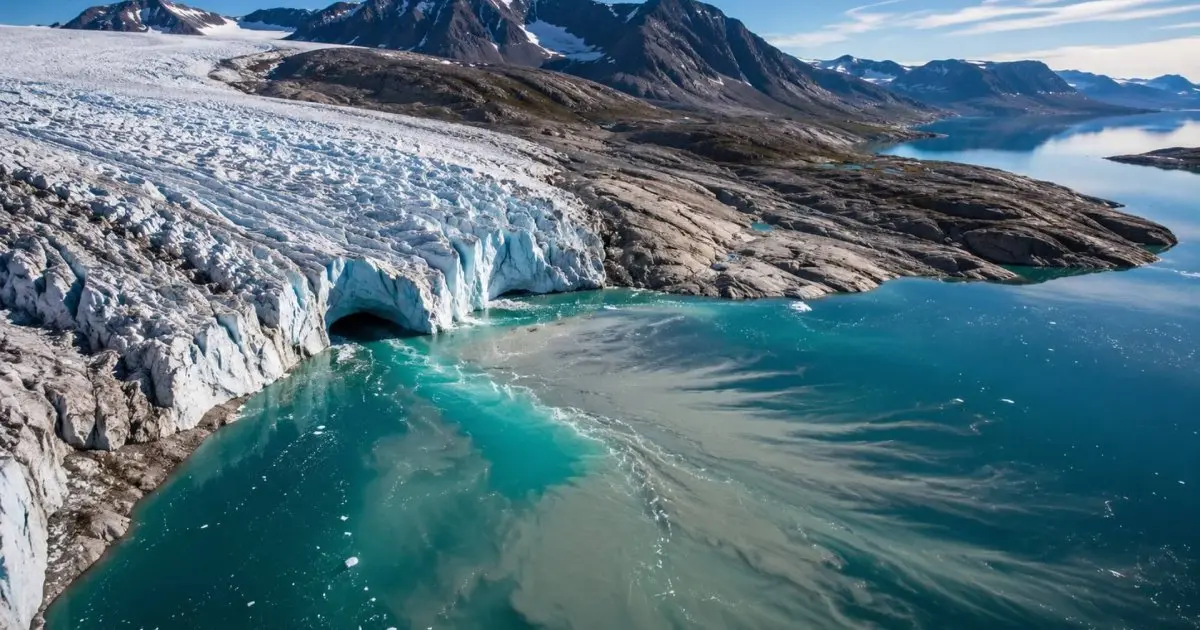
Viewed from a distance, a glacier appears as a monument of pure, frozen stillness. Yet beneath its gleaming, brittle crust lies a dynamic, subterranean engine. Rivers of pressurized water carve through ice, rock is relentlessly ground into fine mineral flour, and isolated liquid pockets remain trapped for months in total darkness.
As summer arrives, this hidden machinery awakens, forging a direct hydraulic link between the frozen heart of the ice sheet and the open ocean.
For decades, scientific inquiry into Greenland’s relentless melt has focused primarily on a single, daunting metric: how much water the island will lose and how high it will push global sea levels. However, glacial runoff carries far more than just fresh water. It sweeps along a dense cargo of sediments, vital nutrients, and hazardous trace metals. Understanding this invisible baggage is becoming increasingly critical for anticipating how Arctic ecosystems will respond to a rapidly warming climate.
According to a landmark study published in Communications Earth and Environment, an international team of researchers tracked this chemical journey throughout the 2023 ablation season—the peak period of snow and ice loss—tracing water from the high ice sheet all the way down to the Kangerlussuaq Fjord. Their objective was clear: to determine where Arctic mercury comes from, what paths it travels, and what happens to the ecosystem once it leaves the continent.
Main Facts: The Hidden Transport of a Global Pollutant
Mercury is a notoriously persistent global pollutant, but its narrative does not begin solely inside industrial smokestacks. It is also a natural component of Earth’s crust, bound within ancient minerals and rocks. Human emissions over the centuries have significantly elevated its atmospheric background concentration, allowing gaseous mercury to drift across the globe on air currents before finally settling back to the surface via rain, snow, or particulate fallout.
The Arctic acts as a massive atmospheric sink, receiving vast quantities of this airborne cargo. Once deposited, the mercury is trapped within snowpacks, deep permafrost soils, and coastal sediments. These expansive reservoirs function as chemical archives, accumulating natural and anthropogenic inputs over centuries. As long as these layers remain frozen solid, the mercury stays largely immobilized. However, modern climate change is aggressively reorganizing the Arctic’s hydrological connections, putting long-locked contaminants back into circulation.

Not all forms of mercury carry the same ecological hazard. Inorganic mercury can be transformed by microbial activity into monomethylmercury—a potent neurotoxin that is easily absorbed by living organisms and biomagnifies as it ascends the marine food web. Consequently, quantifying the total volume of mercury released by the melting ice sheet is only half the battle; scientists must also determine its exact chemical speciation as it enters rivers and coastal waters.
Chronology of a Melt Season: Tracking a Drop from Ice to Ocean
To reconstruct the precise transit of mercury from the ice sheet to the sea, researchers conducted intensive daily sampling between June and July 2023 along the Qinnguata Kuussua River. This major waterway drains approximately 2,800 square kilometers of western Greenland before discharging into the Kangerlussuaq Fjord.
The scientific team cast a wide net, collecting samples not only from the main river stem but also from proglacial streams, subglacial discharge points, surface meltwater channels, thawing permafrost zones, and multiple locations throughout the marine fjord.
Rather than relying on isolated snapshots, the "ice-to-ocean" tracking approach captured the extreme variability of the Greenlandic summer. Glaciers evolve rapidly during the ablation season; a single day’s sample can coincide with extreme rainstorms, low flows, or peak surface melting. Monitoring the entire season allowed researchers to map how the sources of runoff shifted in real-time.
A Summer of Extreme Rain and Sudden Connections
The 2023 field campaign unexpectedly coincided with an unusually warm, humid July. Several atmospheric rivers—narrow bands of intense moisture transport—reached western Greenland, unleashing heavy, sustained rainfall across the ice sheet. During one of these extreme weather events, the river’s discharge nearly doubled, accompanied by sharp spikes in filtered mercury, particulate-bound contaminants, and toxic monomethylmercury.
Initially, this pulse of meltwater and rain washed through saturated soils and the active layer of the permafrost—the upper fringe of earth that thaws each summer. This initial flush was rich in dissolved organic carbon, which readily binds to mercury and facilitates its transport. An upstream stream fed by degrading permafrost recorded the highest filtered-mercury concentration of the entire campaign, proving that heavy rains actively bridge terrestrial mineral deposits with river channels.
The proportion of monomethylmercury also peaked during this phase, indicating either active microbial production within newly saturated soils or the mobilization of organic-rich hotspots. Thus, the early-season pulses of contamination did not originate primarily from the high-altitude ice sheet, but rather from the proglacial terrain—the land immediately fronting the ice margin—and deep terrestrial reservoirs unlocked by unprecedented rainfall.

Supporting Data: The Subglacial Engine and Isotopic Fingerprints
As the summer progressed and peak melt set in, the river’s chemical signature evolved. It transitioned from terrestrial dominance—characterized by high organic matter—to being heavily dominated by pristine glacial meltwater. Logic might suggest that such massive volumes of clean water would dilute the pollutant concentrations, but the mercury signal stubbornly persisted. In fact, the amount of mercury bound to suspended particles actually increased in tandem with rising discharge and sediment loads.
Sampling at the outlets of the Russell and Leverett glaciers revealed contaminant concentrations comparable to those of the main river channel, whereas water collected directly atop the ice sheet contained vastly lower levels. This striking contrast pointed directly to a subglacial origin.
[Atmospheric Deposition] --> [Snow & Permafrost Archives]
                                    |
     +------------------------------+------------------------------+
     |                                                             |
     v (Surface Runoff)                                            v (Subglacial Erosion)
[Supraglacial Waters]                                    [Subglacial Bedrock & Fluids]
 (20% - 48% of filtered mercury)                          (~50%+ of seasonal export)
     |                                                             |
     +------------------------------+------------------------------+
                                    |
                                    v
                       [Qinnguata Kuussua River]
                                    |
                                    v
                       [Kangerlussuaq Fjord Reactor] --> [Marine Food Web]
The intense mechanical friction of the glacier grinding against its bedrock base—known as basal abrasion—generates massive quantities of reactive mineral flour capable of carrying metal loads. Furthermore, liquid water trapped in dark, oxygen-poor subglacial pockets for extended periods accumulates high concentrations of dissolved and methylated fractions.
To verify these sources, researchers analyzed stable isotopes—variants of the same chemical element with differing atomic masses that act as distinct chemical fingerprints. The isotope balance confirmed that supraglacial sources (on top of the ice) contributed between 20% and 48% of the filtered mercury exported, depending on the timing of the season. Even at the height of the summer melt, roughly half of the mercury continued to emerge from the dark, hidden world beneath the ice sheet.
When these waters finally discharged into the marine environment, the sudden shift in chemistry—particularly the introduction of salt—caused a portion of the mercury bound to sediment particles to desorb and enter the dissolved phase. The fjord acted less like a passive pipe and more like a chemical reactor, where glacial runoff, terrestrial drainage, atmospheric inputs, and marine waters actively mixed.
Filtered mercury concentrations near the surface of the fjord averaged roughly three times higher than those measured in the inflowing river, while monomethylmercury levels doubled. While these increases could not be attributed solely to the glacier, the mineral particles brought down from the ice undoubtedly supplied the inorganic raw materials necessary for local microbial methylation.
Official Responses and Scientific Context
The study’s findings have prompted a significant re-evaluation of how scientists model polar chemical fluxes. The research team calculated a total mercury yield of approximately 23 millimoles per square kilometer per year for the studied basin.

While a millimole represents just a thousandth of a mole (the fundamental unit used by chemists to count atoms and molecules), this yield is more than an order of magnitude lower than previous, generalized Arctic estimates. However, it remains entirely comparable to the discharge rates of major free-flowing Arctic rivers.
When these localized figures are extrapolated across the entire southwestern margin of the Greenland Ice Sheet, scientists estimate an annual flux of roughly 1,525 moles of mercury. This accounts for approximately 1% of the total contemporary riverine mercury input to the entire Arctic Ocean.
Consequently, researchers emphasize that Greenland is a minor contributor on a pan-Arctic scale, though its local impact on specific coastal fjords and near-shore ecosystems is profound. Regional environmental importance must not be confused with global geochemical dominance.
Implications: Rewriting the Planet’s Chemical Ledger
The broader lesson extending from the Greenlandic ice sheet reaches far beyond mercury pollution. Humanity has historically viewed climate change through a narrow lens: rising temperatures, shrinking ice sheets, and swelling seas. However, by accelerating the global hydrological cycle, climate change is actively reactivating ancient chemical storehouses, altering transport pathways, and coupling previously isolated environments.
Climate projections indicate that continued mass loss from the Greenland Ice Sheet will likely increase the overall export of trace metals in the coming decades. Yet this does not mean every additional cubic kilometer of meltwater will carry a uniform concentration of contaminants. The ultimate trajectory will depend on complex variables:
- How much deep permafrost thaws.
- Which geological bedrock formations are exposed to subglacial hydrology.
- How long meltwater remains sequestered beneath the ice before discharge.
- How efficiently coastal fjords process incoming metal loads.
Ultimately, this research transforms our fundamental perception of Greenland. It is no longer viewed merely as a passive, melting reservoir of global fresh water. Instead, it stands revealed as an active, breathing component of the Arctic geochemical cycle—an ecosystem that locks away atmospheric pollutants, grinds down continental bedrock, fuels submicrobial life, and delivers complex mineral cocktails directly to the sea.
Every blue torrent rushing off the coast of Greenland carries an invisible, ancient history. As the planet warms, the health and future of the high north will depend heavily on humanity’s ability to read it.

Leave a Reply