

By Hernán Guillermo Galindo M.
Adapted and Enriched for International Publication
Main Facts: A Historic Milestone for Colombian Grappling in Colorado
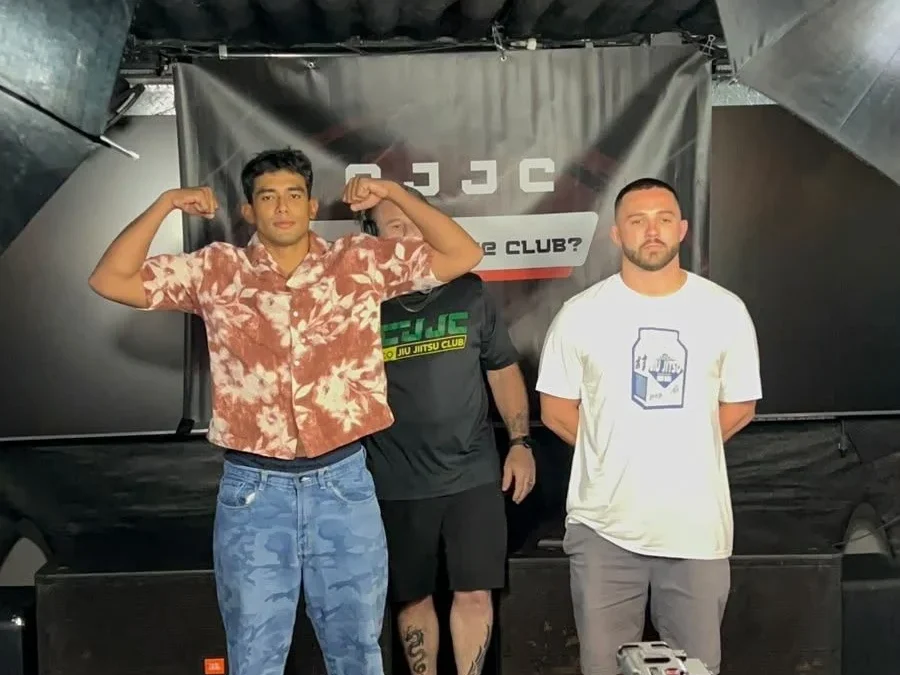
In the high-altitude climate of Denver, Colorado, a martial arts practitioner from the heart of Huila, Colombia, has etched his name into the annals of combat sports history. Juan David Calderón Ibarra, representing the world-renowned 10th Planet Denver academy—a global benchmark in No-Gi grappling—stepped into the octagonal cage of the Colorado Jiu Jitsu Club (CJJC) and secured a definitive victory against American fighter Travis Rice.
Rice, representing the traditional Easton Jiu-Jitsu school, one of the most prominent and largest martial arts institutions in Colorado, had never before been submitted in professional competition. Yet, at the CJJC 31: Dominium event, Calderón Ibarra altered that statistic dramatically.
Competing in the promotion’s signature format—a single, fast-paced five-minute round defined entirely by the absence of a judge’s scorecard—the 24-year-old Colombian needed a mere 60 seconds to lock in a textbook mataleón (Rear-Naked Choke) and force his formidable opponent to tap out.
This victory is more than just another win on a fighter’s record; it marks a historic milestone. Calderón Ibarra is officially the first athlete born in Neiva, Huila, to compete and emerge victorious inside the Colorado Jiu-Jitsu Club cage in Denver. His triumph bridges the gap between grassroots Latin American martial arts talent and the ultra-competitive American combat sports circuit, serving as a testament to resilience, technical mastery, and unwavering dedication.
Chronology: From the Classrooms of Neiva to the American Dream
The journey of Juan David Calderón Ibarra to the elite mats of Colorado spans years of sacrifice, geographic displacement, and relentless perseverance.
Roots in Neiva
Calderón’s martial arts journey began during his high school years at the INEM Julián Mota Salas educational institution in Neiva, where he was enrolled in 11th grade. Captivated by the tactical complexity of mixed martial arts through late-night broadcasts of the Ultimate Fighting Championship (UFC), he found himself naturally drawn to grappling—the discipline-heavy, non-striking subset of combat sports encompassing wrestling, judo, and jiu-jitsu.
His first formal contact with combat sports occurred at the Baekho martial arts academy in Neiva, under the instruction of coach Edwin Cortés. Initially entering through the doors of boxing for a strict three-month stint, Calderón’s trajectory shifted permanently when he crossed paths with a South African practitioner who introduced him to the intricacies of Brazilian Jiu-Jitsu (BJJ).
"Jiu-jitsu is like a mix of judo and wrestling," Calderón explains. "The objective is to control your rival and finish them through a submission, which could be a choke, a joint lock, or something similar. What hooked me immediately was that jiu-jitsu’s base is technique, not raw force. It allows someone who might be 20 or 30 kilos lighter to defeat a much heavier opponent."
He spent roughly three years competing across Colombia, supplementing his training with a dedicated one-year stint in the Wrestling League of Neiva under professor Miguel Ipúz, an experience he credits for instilling the physical conditioning and mental fortitude necessary to survive international competition. However, financial instability, lack of institutional sponsorship, and the immense personal cost of funding his own training camps ultimately forced him to look beyond national borders.
The Crucible of Migration
Calderón’s path to the United States was far from linear. In 2023, he made his first attempt to emigrate through a cultural exchange program, spending four grueling months living in a natural reserve camp where training facilities for jiu-jitsu were entirely nonexistent. Undeterred, he returned to Colombia, redoubled his efforts, saved every possible peso, and sought alternative pathways.
By 2025, he discovered the Au Pair program—an international childcare arrangement that places young adults with host families in the United States in exchange for housing, a stipend, and flexible scheduling. After logging 1,000 required hours of childcare experience, he was accepted by a host family in Denver, Colorado.
The arrangement proved to be the catalyst his athletic career needed. His host family generously structured his childcare duties to grant him two uninterrupted hours of free time every morning and another two in the evening—a window he meticulously carves out exclusively for training.
Supporting Data: Statistics, Format, and Athletic Profile
Understanding the magnitude of Calderón Ibarra’s recent victory requires an examination of the unique format under which he competes, as well as his impressive career statistics.

The Mechanics of CJJC Combat
Unlike standard MMA bouts governed by three five-minute rounds and scored by judges using the Ten-Point Must System, promotions like the Colorado Jiu-Jitsu Club often utilize specialized submission-only rulesets.
- Format: A single, continuous five-minute round.
- Scoring: There are no points awarded for takedowns, sweeps, or positional dominance.
- The Finish: The sole objective is submission. A fight can only end via tap-out due to a choke or joint lock.
- Overtime ("Sudden Death"): If both athletes survive the initial five-minute regulation period without a submission, the match enters overtime. This phase forces competitors to start from a heavily compromised defensive position ("back control" or "spider web"), where the winner is decided by who can either successfully escape or secure a faster submission.
By finishing Travis Rice via a Rear-Naked Choke in just one minute, Calderón bypassed the volatility of overtime entirely, making a definitive statement against a veteran of the local circuit.
Career Overview and Accolades
Despite the financial hurdles he faced while training in Colombia—where high costs of travel, tournament registration, and mandatory weight-cutting cycles (often dropping up to 10 kilograms per event) restricted him to competing barely once a year—Calderón has built an elite amateur and professional resume:
- Overall Record: Approximately 25 matches, boasting 22 victories and only 3 defeats.
- Titles & Honors: Champion of NAGA (North American Grappling Association), one of the most prestigious submission grappling circuits in North America.
- Promotional Experience: Extensive mat time in high-level organizations such as Grappling Industries.
- Current Training Ground: 10th Planet Denver, a premier academy renowned worldwide for pioneering advanced No-Gi (no kimono) systems, rubber guard variations, and modern catch-wrestling techniques.
Official Responses and Personal Reflections
Speaking exclusively to La Nación from his current base of operations in Denver—while simultaneously keeping a watchful eye on his host family’s children—Calderón reflected on the stark contrast between his athletic realities in Colombia versus the United States.
"I used to compete whenever I could, whenever there was money, and whenever my parents could help me out," Calderón shared candidly. "If it depended solely on my own savings, I could barely afford to compete once a year. Traveling, paying for lodging, and managing weight cuts made it extremely expensive."
The psychological weight of those early struggles forged an ironclad work ethic. Today, he balances a demanding daily routine that includes caring for children, pursuing a bachelor’s degree in foreign languages, and enduring grueling two-a-day training sessions under the elite tutelage of the 10th Planet system.
Before focusing exclusively on his international campaign, Calderón made sure to acknowledge the foundational pillars of his career:
"I want to thank the Calderón and Ibarra families, the Baekho Academy, the Wrestling League, and professor Miguel Ipúz for their unconditional support throughout the years. Everything I learned on the mats in Neiva prepared me for the intensity of the cage here in the United States."
Implications: The Horizon of Global Promoters
The victory at CJJC 31 is not merely a personal triumph for Juan David Calderón Ibarra; it serves as a beacon of inspiration for regional athletes across Huila and Colombia who struggle against systemic institutional abandonment in sports outside of football (soccer).
Breaking Barriers for Latin American Grapplers
By establishing a dominant presence in Denver’s competitive ecosystem, Calderón proves that world-class technical proficiency can emerge from unconventional training pipelines. His transition from local Colombian academies to a premier American gym underscores the viability of the Au Pair and cultural exchange routes for ambitious athletes seeking high-performance environments without immediate corporate sponsorship.
Future Goals and Upcoming Schedule
Calderón’s immediate horizon is densely packed with high-stakes competitive challenges designed to push him closer to his ultimate career objectives:
- October 17: Scheduled participation in a premier NAGA tournament in Colorado (contingent upon academic alignment with his university obligations).
- November 17: A high-profile appearance at a UFC-affiliated grappling and combat showcase event in Denver.
- December: Entry into an elite professional tournament structured in a bracket format—where the top four fighters square off in elimination rounds (1 vs. 2, 3 vs. 4) culminating in a championship final.
Looking further ahead, Calderón has set his sights on the absolute pinnacle of global combat sports and grappling federations.
"The ultimate goal for me is to reach the biggest promotions in the world," Calderón stated firmly. "The UFC has its own specialized jiu-jitsu division; there is also the prestigious ONE Championship submission grappling roster; and, of course, the ADCC (Abu Dhabi Combat Club) World Championship, which is universally recognized as the largest and most competitive grappling tournament on earth."
As Juan David Calderón Ibarra continues to balance textbooks, childcare duties, and the relentless grind of the 10th Planet Denver mats, the young man from Neiva has proven that neither geographic distance nor economic adversity can lock out a fighter destined for the global stage.



Leave a Reply