

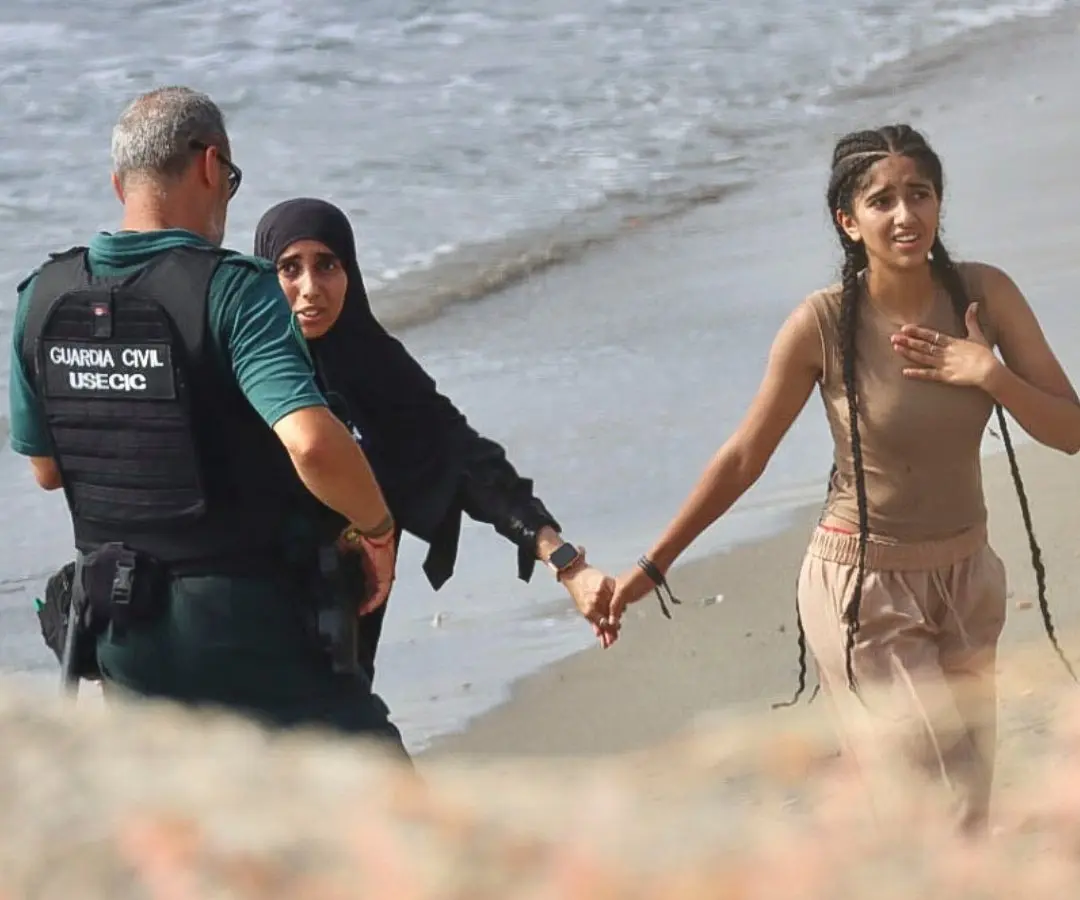
CEUTA — In what has been described as an unprecedented humanitarian and geopolitical crisis, more than 50,000 migrants crossed from Morocco into the Spanish enclave of Ceuta over a frantic four-day period starting Thursday. The massive influx across one of the European Union’s only two land borders with Africa has overwhelmed local infrastructure, resulted in at least 72 confirmed deaths, and ignited a major diplomatic row within the European Union, leading Italy to suspend its Schengen visa-free travel arrangements with Spain.
By Sunday, the scale of the tragedy became starkly apparent as rescue teams recovered five more bodies along the rocky Ceuta coastline, raising the official death toll to 72. Local authorities warn that this number is expected to rise as search-and-rescue operations continue in the treacherous waters of the Mediterranean.
Chronology of the Crisis
Thursday: The Sudden Influx
The crisis began in the early hours of Thursday, propelled by a wave of viral social media rumors suggesting that border controls had been temporarily lifted. Seizing what they believed was a fleeting window of opportunity, thousands of young men, women, and families with young children gathered on the Moroccan side of the border near the towns of Fnideq and Castillejos.
By midday, the gathering had swelled into an unstoppable sea of humanity. Thousands bypassed Moroccan border checkpoints, attempting to scale the double-layered, six-meter-high wire fences at the Tarajal border crossing. Simultaneously, thousands of others launched themselves into the sea, attempting to swim around the breakwaters that separate Moroccan waters from the Spanish enclave. The sheer volume of people quickly overwhelmed both Moroccan border guards and the Spanish Guardia Civil stationed on the beaches.
Friday: Emergency Mobilization and Tragedy
By Friday morning, the situation had deteriorated into a full-scale humanitarian emergency. Spanish authorities deployed the military to support local police forces, setting up temporary medical tents along the Tarajal beach to treat hypothermia, lacerations from the razor-wire fences, and physical exhaustion.
Despite the deployment, the crossings continued throughout the day. It was during these hours that the first fatalities were recorded. Several migrants drowned in the strong currents, while others were crushed or suffered fatal falls while attempting to scale the breakwater and the border fence in the dark.
Saturday: Border Hardening and Mass Returns
On Saturday, Spain took decisive action to stem the flow. The Spanish government authorized the deployment of additional police reinforcements and Spanish Army units. By Saturday afternoon, engineers had installed a 500-meter floating barrier off the coast of Ceuta to block maritime transit routes.
Concurrently, a massive bilateral repatriation effort began. Following urgent diplomatic negotiations between Madrid and Rabat, Moroccan authorities agreed to accept the immediate return of those who had crossed. Within 48 hours, more than 48,000 people were returned to Morocco, with thousands more processed and repatriated over the remainder of the weekend.
Sunday: Grim Discoveries and Relative Calm
By Sunday, the intense wave of crossings had largely subsided, replaced by a grim recovery operation. The discovery of five additional bodies washed ashore on Ceuta’s beaches brought the official death toll from the four-day surge to 72.
Miguel Ángel Pérez, the Spanish government’s representative in Ceuta, addressed journalists on Sunday afternoon, confirming that while the immediate physical chaos on the beaches had been brought under control, the enclave remained in a state of shock and high alert.
Supporting Data and Humanitarian Impact
The sheer scale of the incident has shattered all historical migration records for the enclave. To put the crisis into perspective, the 50,000 crossings represent more than half of Ceuta’s permanent resident population of roughly 85,000.
Key Figures of the Ceuta Border Crisis
| Category | Recorded Figure | Source / Notes |
|---|---|---|
| Total Border Crossings (Est.) | 50,000+ | Spanish Border Control / Guardia Civil |
| Confirmed Deaths (Directly linked to surge) | 72 | Ceuta Government Representative |
| Total Bodies in Ceuta Morgue | 88 | Includes deaths from previous minor crossings in the last 14 days |
| Medical Interventions | 1,000+ | Red Cross and local health services |
| Immediate Repatriations (to Morocco) | 48,000+ | Completed within 48 hours of crossing |
| New Defensive Infrastructure | 500 meters | Floating maritime barrier installed Saturday |
The Human Toll
The physical toll on those attempting the crossing was severe. According to medical personnel, over 1,000 individuals received urgent medical attention. Common injuries included deep lacerations from the border fence’s razor wire, severe fractures from falls, and acute hypothermia from hours spent in the water.
The human tragedy has deeply affected the local community. Karima Abenaz, a French citizen residing in Ceuta with family in Morocco, expressed her grief and anger to reporters while fighting back tears:
"Me duele profundamente que haya jóvenes muriendo en el mar. No es justo que, en el año 2026, mujeres con niños de tan solo dos meses de edad tengan que cruzar el mar solo para morir. En Marruecos hay comida, hay todo lo que necesitamos. Si no tenemos un trabajo digno, deberíamos ir a la huelga y exigir nuestros derechos al Gobierno. No deberíamos morir en el mar, no está bien."
(“It deeply pains me that young people are dying in the sea. It is not fair that, in the year 2026, women with children as young as two months old have to cross the sea only to die. In Morocco, there is food, there is everything we need. If we do not have a dignified job, we should go on strike and demand our rights from the government. We should not die in the sea; it is not right.”)
Juan Jesús Vivas, the President of Ceuta, revealed the strain on local infrastructure, telling the Spanish daily El País that the city’s municipal morgue was completely overwhelmed. The facility had received 88 bodies in total, which included the 72 victims of the weekend surge alongside 16 others recovered from smaller, desperate night-swim attempts over the preceding two weeks. Vivas noted that Moroccan authorities were also recovering bodies from their territorial waters, though no official figures had been shared by Rabat.
Official Responses and Diplomatic Fallout
The unprecedented breach of an external EU border has sent shockwaves through Brussels and European capitals, exposing deep-seated divisions over migration policy.
Spanish Government Response
In Madrid, the government of Prime Minister Pedro Sánchez defended its handling of the crisis, praising the rapid coordination between the Spanish military, the Guardia Civil, and Moroccan security forces. However, Spanish officials found themselves on the defensive regarding their domestic migration policies.
Spain has recently championed a highly progressive migration stance compared to its EU neighbors, launching a major legislative program aimed at regularizing the status of more than half a million undocumented migrants currently living in the country. Critics across Europe were quick to label this program a "pull factor" (efecto llamada) that encouraged the mass rush on Ceuta.
The Spanish government strongly rejected these assertions. In an official statement, Madrid clarified that under existing emergency protocols, any individual entering Ceuta or Melilla irregularly is subject to immediate return and is legally barred from traveling to mainland Spain or accessing the wider Schengen zone.
European Union Reaction and Schengen Suspension
The crisis has triggered a swift and severe reaction from EU member states. A coalition of 22 EU nations drafted and signed a joint letter addressed to the European Commission, demanding immediate, coordinated action to reinforce the bloc’s external borders and prevent similar mass breaches.
The most dramatic fallout came from Rome. Expressing deep concern over the security of the Schengen Area’s southern flank, the Italian government announced a temporary, one-month suspension of the Schengen passport-free travel agreement with Spain. Under the emergency measure, all travelers arriving in Italy from Spanish airports and ports will be subject to mandatory passport controls and security screenings.
Implications for EU Migration Policy
The events in Ceuta underscore the ongoing fragility of the European Union’s southern borders and the complex, often volatile dependency of the bloc on transit countries like Morocco to act as border guards.
The Fragility of Schengen
Italy’s unilateral suspension of Schengen travel with Spain highlights how quickly internal European solidarity can fracture under the pressure of migration surges. Analysts warn that if such localized border breaches continue to trigger national border closures within Europe, the fundamental principle of free movement—one of the crowning achievements of European integration—could be permanently compromised.
The Role of Digital Disinformation
The Ceuta crisis also highlights a modern challenge in border management: the weaponization and rapid spread of digital disinformation. The sudden mobilization of 50,000 people was largely driven by coordinated rumors on social media platforms, which falsely claimed that European authorities were welcoming all arrivals due to a policy shift. For border agencies, combating online disinformation has now become as critical as physical border security.
A Clash of Migration Philosophies
Ultimately, the crisis lays bare the ideological rift dividing Europe. On one side is Spain’s pragmatic, integrationist approach, which views the regularization of undocumented workers as a economic and humanitarian necessity. On the other side is the "Fortress Europe" philosophy championed by a growing bloc of member states demanding tighter border controls, external processing centers, and rapid deportations.
As Ceuta begins the long process of recovering from the weekend’s devastating events, the tragedy stands as a stark reminder of the human cost of this unresolved European debate.


Leave a Reply