

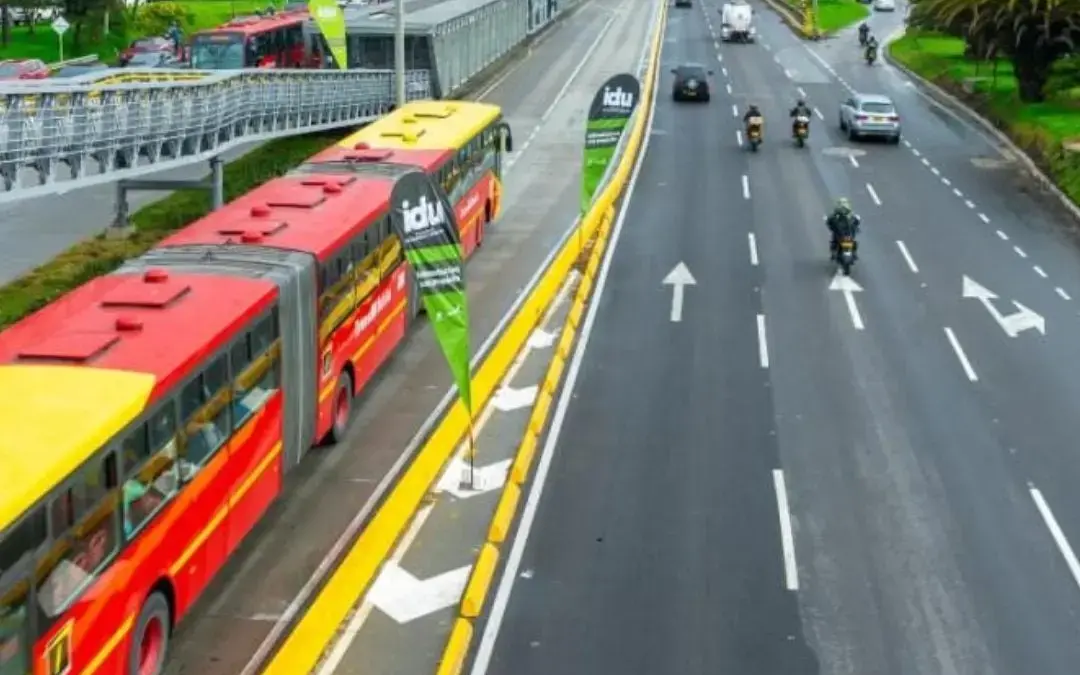
BOGOTÁ, Colombia — In a decisive move to address mounting traffic congestion at the capital’s northern gateway, the District Secretariat of Mobility has officially announced a sweeping operational pilot project. Set to launch in the coming years, this initiative introduces a temporary contraflow system on one of the city’s most historic and vital arterial corridors: Carrera Séptima.
The upcoming mobility intervention is designed to fundamentally reshape how weekend vehicular traffic exits the city, offering a much-needed alternative to the heavily saturated Autopista Norte. By temporarily converting a key stretch of Carrera Séptima into a one-way, south-to-north corridor during peak weekend hours, city planners aim to optimize traffic flow, reduce travel times for thousands of motorists, and evaluate long-term infrastructure solutions for northern Bogotá.
This comprehensive report details the core mechanics of the pilot, its chronological rollout, supporting traffic data, official statements from municipal leadership, and the broad implications this measure holds for local residents, commuters, and public transportation networks.
1. Main Facts and Operational Mechanics
The core of the initiative involves a specialized traffic management strategy implemented along the upper northeastern corridor of Bogotá.
According to the District Secretariat of Mobility, starting Saturday, September 26, 2026, a contraflow pilot will be operational on Carrera Séptima between Calle 193 and Calle 245. During this designated time frame, the entire multi-lane section will operate exclusively in a south-to-north direction.
The operational schedule for the contraflow is strictly defined:
- Days: Four consecutive Saturdays.
- Hours: 9:00 a.m. to 1:00 p.m.
Revised Routes for Inbound Travelers
Because the corridor will be entirely dedicated to outbound traffic during the specified hours, motorists entering Bogotá from the northern municipalities and surrounding regions will need to adjust their customary routes.
Drivers arriving from the north who intend to connect with Carrera Séptima must modify their trajectory:
- Continue traveling southward along the Autopista Norte.
- Take the exit and turn eastward at Calle 183.
- Proceed from Calle 183 to reconnect with local eastern networks and Carrera Séptima south of the restricted zone.
Public Transportation Adjustments
The operational changes will also directly impact the SITP (Integrated Public Transport System) and rural feeder routes. Specifically, the rural route 18-14 (Torca – Tibabita) will undergo a mandatory temporary detour during the pilot hours.
The revised path for route 18-14 will operate as follows:
- Buses will divert via Calle 187.
- Proceed toward the Autopista Norte.
- Head west/south to Calle 183.
- Connect back to Carrera Séptima.
- Continue north along Calle 245 up to the designated turnaround point prior to the Peaje Andes (Andes Toll Plaza).
2. Chronology of the Initiative
The development of the Carrera Séptima contraflow pilot is the result of months of logistical planning, traffic modeling, and public feedback collection by the District.
Phase 1: Identification of Northern Bottlenecks (Early to Mid-2025)
For years, the northern exit of Bogotá—primarily funneled through the Autopista Norte and Carrera Séptima—has suffered from severe capacity constraints, particularly on weekend mornings. Outbound travelers heading toward Sopó, Chía, Cajicá, and weekend country houses frequently encounter gridlock. District mobility analysts began reviewing alternative traffic channeling strategies to relieve pressure on the Autopista Norte, identifying the underutilized capacity of outbound lanes on Carrera Séptima during specific morning windows.
Phase 2: Public Consultation and Route Modeling (Late 2025)
Municipal authorities held listening sessions with residents of Usaquén, Torca, and Tibabita, as well as commuters who regularly utilize the northern corridors. Citizens repeatedly voiced frustration over the lack of viable exit options on Saturday mornings. In response, transportation engineers ran micro-simulation models to test how a temporary weekend contraflow on Carrera Séptima would perform without causing catastrophic gridlock for inbound travelers or local neighborhoods.
Phase 3: Official District Announcement (Current Period)
The Secretariat of Mobility formally unveiled the project details, establishing the launch date of September 26, 2026. This advance notice gives residents, local businesses, schools, and transport operators ample time to adjust their schedules and logistics.
Phase 4: Execution of the Four-Week Pilot (September – October 2026)
The contraflow will be tested across four consecutive Saturdays:
- Saturday, September 26, 2026 (Launch and baseline data collection)
- Saturday, October 3, 2026 (Operational adjustments and enforcement reinforcement)
- Saturday, October 10, 2026 (Mid-term evaluation and congestion mapping)
- Saturday, October 17, 2026 (Final pilot session and comprehensive data aggregation)
Phase 5: Post-Pilot Evaluation and Permanent Decision (Late 2026)
Following the conclusion of the fourth Saturday, transportation experts will analyze travel times, public feedback, environmental impacts, and traffic volume metrics. A final determination will then be made regarding whether to implement the contraflow permanently, modify its schedule, or discard the measure in favor of alternative infrastructure investments.
3. Supporting Data and Traffic Metrics
To understand why the District has turned its focus to the northern exits, one must examine the staggering volume of vehicles that attempt to leave the capital during the weekend.
The Autopista Norte Burden
Traffic statistics compiled by the District Secretariat of Mobility reveal that approximately 5,300 vehicles depart Bogotá via the Autopista Norte during the morning hours of a typical Saturday. This immense volume routinely overwhelms the highway’s capacity, creating miles-long tailbacks that stretch back into the urban core of the city.
The concentration of outbound traffic onto a single primary artery creates systemic vulnerabilities: any minor vehicular breakdown, traffic accident, or maintenance work on the Autopista Norte results in immediate, catastrophic gridlock that traps thousands of motorists for hours.
Carrera Séptima’s Potential
Carrera Séptima represents a parallel historical artery that connects the northern edge of the city toward regional highways. While weekday commuting patterns on Séptima are heavily regulated through reversible lanes (picos y placa, and morning/evening contraflows), weekend utilization patterns remain asymmetrical.
By implementing a dedicated south-to-north contraflow between Calles 193 and 245, the District estimates it can siphon a significant percentage of weekend recreational traffic away from the Autopista Norte. Initial theoretical models suggest that diverting even 1,000 to 1,500 vehicles away from the Autopista during peak departure hours (9:00 a.m. to 11:00 a.m.) could reduce overall corridor delay times by up to 25%.
4. Official Responses and Leadership Insights
The introduction of this high-impact mobility trial has drawn commentary from key municipal authorities, highlighting the District’s commitment to data-driven, citizen-responsive urban planning.
Statement from the Secretary of Mobility
María Fernanda Ortiz, the District Secretary of Mobility, emphasized that the pilot is a direct response to citizen demands for better weekend traffic alternatives. She stressed that the administration is not rushing into permanent changes without first gathering empirical evidence.
"We listened to the citizenry who, every Saturday, search for alternatives to leave Bogotá through the north, and today we are reviewing a concrete option on Carrera Séptima," Ortiz stated during the press briefing announcing the measure. "We are going to measure its effectiveness, evaluate how traffic behaves, and see if it is viable to keep it in place on a permanent basis."
Ortiz underscored that transparency and flexibility will guide the pilot. If the data shows that the contraflow successfully redistributes the vehicular load without creating insurmountable bottlenecks for inbound traffic or emergency services, the District will look into institutionalizing the schedule as a standard weekend protocol. Conversely, if unforeseen logistical hurdles arise, the administration retains the flexibility to pivot or adjust the parameters.
Collaboration with Traffic Enforcement
The District Secretariat of Mobility has confirmed that traffic agents (Agentes de Tránsito) and personnel from the Transit Police (Seccional de Tránsito y Transporte) will be stationed at critical intersections along the corridor—specifically around Calles 183, 193, 222, and 245. Their presence will be essential for managing the transition phases at 9:00 a.m. and 1:00 p.m., guiding drivers unfamiliar with the contraflow layout, and ensuring the smooth redirection of inbound vehicles toward Calle 183.
5. Broader Implications for Urban Mobility and the Community
The decision to pilot a weekend contraflow on Carrera Séptima carries significant implications for various stakeholders across northern Bogotá, ranging from local residents to regional travelers and urban planners.
Impact on Local Residents and Neighborhoods
Residents living adjacent to Carrera Séptima in the Usaquén locality and northern suburban sectors face a complex set of trade-offs. On one hand, neighborhoods situated near Calle 183 may experience increased localized traffic volumes as inbound motorists from the north are forced off the Autopista and onto eastern connectors. On the other hand, the long-term resolution of chronic weekend gridlock could improve overall property accessibility and reduce the frustration of being trapped in neighborhood spillover traffic.
Local community action boards (Juntas de Acción Comunal) have expressed cautious optimism, though many have called for rigorous monitoring of noise pollution, pedestrian safety, and emergency vehicle access during the four Saturday pilot sessions.
Implications for Regional Tourism and Economy
Northern Bogotá serves as the primary departure corridor for weekend tourism heading toward the department of Cundinamarca and Boyacá. Destinations such as Sopó, Guatavita, Zipaquirá, and Nemocón rely heavily on weekend visitors from the capital.
By streamlining the exit process and reducing departure bottlenecks, the pilot could inadvertently boost regional economic activity. Shorter travel times encourage more frequent weekend excursions, benefiting restaurants, hotels, eco-parks, and local merchants throughout the Sabana Centro region.
A Testbed for Future Infrastructure Strategies
Urban mobility experts view this pilot as a litmus test for dynamic traffic management in Bogotá. As the city continues to grow outward, traditional fixed-capacity infrastructure is no longer sufficient to handle the exponential surge in private vehicle ownership and regional commuting.
The use of temporary contraflows, reversible lanes, and flexible corridor management represents a cost-effective, agile approach to urban traffic engineering. If successful, the methodology tested on Carrera Séptima could serve as a blueprint for managing peak traffic loads in other congested sectors of the capital, such as the southern and western regional entry points.
Environmental and Sustainability Considerations
While the primary goal of the pilot is congestion relief, transportation planners will also monitor environmental metrics. Stop-and-go traffic is a major contributor to localized carbon emissions and particulate matter ($textPM_2.5$) accumulation in northern Bogotá. By smoothing out traffic flow and reducing idling times, the contraflow could yield marginal improvements in air quality during Saturday morning hours, aligning with the District’s broader sustainability and climate action goals.
Conclusion
As the launch date of September 26, 2026, approaches, the eyes of urban planners, commuters, and municipal leaders will be firmly fixed on northern Bogotá. The four-week Saturday contraflow pilot on Carrera Séptima represents a bold attempt to re-engineer weekend mobility, balancing the demands of outward-bound travelers with the logistical needs of inbound traffic and local neighborhoods.
With comprehensive data collection, active traffic enforcement, and direct oversight from the District Secretariat of Mobility under the leadership of María Fernanda Ortiz, this pilot will provide definitive answers on whether Carrera Séptima can successfully share the burden of Bogotá’s northern vehicular exodus. Until the final evaluation is complete, motorists are advised to stay informed, plan their weekend journeys in advance, and pay close attention to directional signage and official District updates.



Leave a Reply